
Continuing mumps outbreak in Keralam leads to renewed demand for MMR vaccine
The Hindu — Health · 18 Oct 2026 · 5 min read
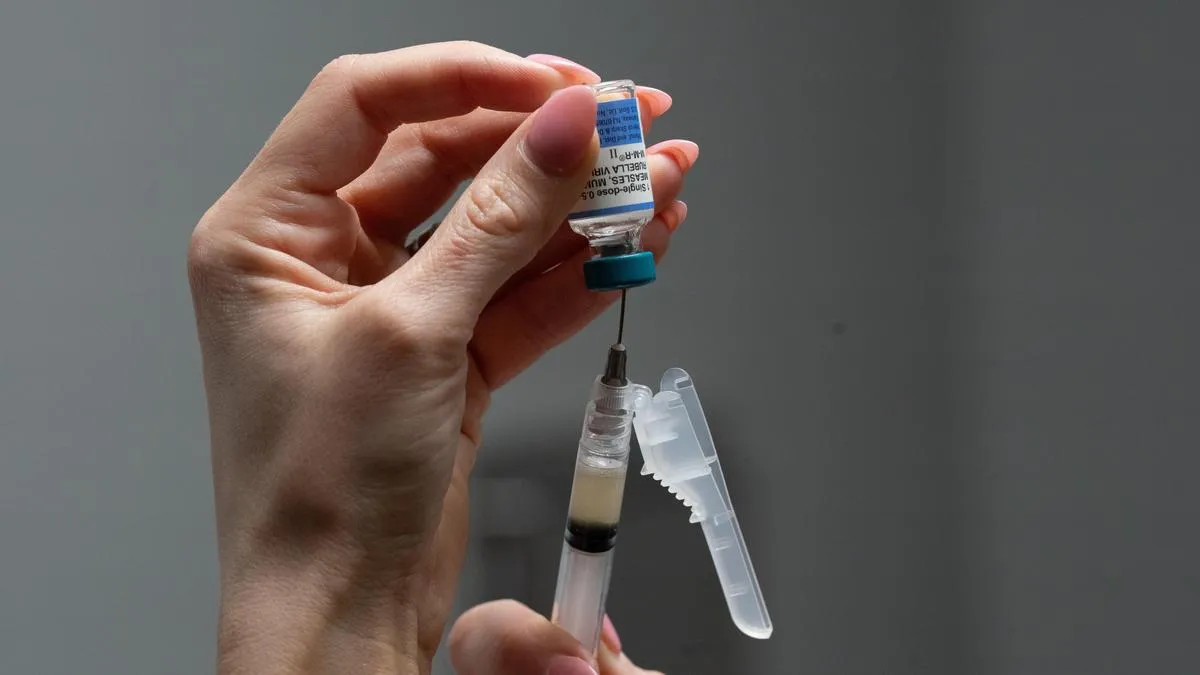
Continuing mumps outbreak in Keralam leads to renewed demand for MMR vaccine left Image for representation AP AP https://th-i.thgim.com/public/incoming/fyc8zj/article71596949.ece/alternates/FREE_1200/Measles_Deaths_51471.jpg Mary Conlon FILE - A nurse, prepares a combination measles, mumps and rubella vaccine for a patient at a pediatrics clinic in Easley, S.
C., March 17, 2026. (AP Photo/Mary Conlon, File) The demand has gained strength following studies from Keralam documenting immunity gaps among children, complications that can cause long-term disability, and genetic differences between the circulating mumps virus and the strain used in the vaccine, indicating how the continued exclusion of MMR vaccine from Universal Immunisation Programme represents an important gap in disease prevention Thiruvananthapuram The continuing mumps outbreak in Keralam, which began in late 2023 and has persisted into 2026, has renewed demands for including the mumps-measles-rubella (MMR) vaccine in the Universal Immunisation Programme (UIP).
Outbreaks have forced the closure of schools and hostels for weeks in Alappuzha, Thrissur and Kottayam.
The demand has gained strength following studies from Keralam documenting immunity gaps among children, complications that can cause long-term disability, and genetic differences between the circulating mumps virus and the strain used in the vaccine, indicating how the continued exclusion of the MMR vaccine from the UIP represented an important gap in disease prevention.
From an annual average of over 2,000 cases, mumps infections began surging in November 2023.
Keralam reported 74,907 cases in 2024 and 26,462 in 2025.
A further 6,606 cases have been reported so far this year.
As Chennai reports cases of measles, doctors stress need for timely vaccination As Chennai reports cases of measles, doctors stress need for timely vaccination While there is no surge in the number of cases or disease cluster, paediatricians say most affected children were not fully vaccinated against measles As Chennai reports cases of measles, doctors stress need for timely vaccination storyline 1 Low priority Despite being vaccine-preventable, mumps has remained a relatively low priority in India’s immunisation policy, largely because of its low mortality.
Although a time-tested combined MMR vaccine is available, the UIP provides two doses of the measles-rubella (MR) vaccine, which does not protect against mumps.
The Indian Academy of Paediatrics (IAP) has long recommended MMR in place of MR, a vaccine combination available to children through the private sector since the 1980s.
It has argued that mumps’ public health significance is underestimated because clinical cases, complications and long-term outcomes are inadequately documented.
With outbreaks also occurring regularly in other States, several have urged the Centre to include MMR in the UIP.
In a response to the Tamil Nadu government obtained through an RTI application, the Centre said decisions on introducing vaccines under the UIP consider disease prevalence and incidence, mortality, vaccine efficacy and cost-effectiveness, among other factors.
According to the response, the National Technical Advisory Group on Immunisation (NTAGI) considers mumps-associated disability not a significant public health concern.
Adding the mumps component, it said, would more than double the vaccine’s cost compared with MR, without proportionate additional health benefits.
Bangladesh launches emergency vaccination campaign as measles outbreak spreads Bangladesh launches emergency vaccination campaign as measles outbreak spreads Health Ministry figures show there have been 17 confirmed deaths from measles so far, with 113 suspected deaths and more than 7,500 suspected infections nationwide Bangladesh launches emergency vaccination campaign as measles outbreak spreads storyline 1 ‘Poorly documented’ Paediatricians contest this assessment, arguing that the disease burden and long-term complications of mumps remain poorly documented. “The increased cost argument is being made in a setting where the mumps burden and associated long-term complications are poorly documented.
Systematic surveillance, documentation of complications and disabilities, transparent vaccine-price comparisons and an economic evaluation factoring in health-care costs, school absenteeism and complications should settle this,” they say. “Mumps may not cause mortality, but its morbidity is significant, particularly during epidemics among unimmunised children.
Complications include acute pancreatitis, encephalitis and aseptic meningitis.
The virus can affect the reproductive glands in both sexes, with long-term consequences that may not be immediately apparent.
It is also a leading cause of acquired sensorineural hearing loss in children, sometimes resulting in permanent, irreversible deafness due to nerve damage,” says K.
K.
Purushothaman, former Professor of Paediatrics, Government Medical College, Thrissur.
He also questions whether the Centre has applied consistent standards of evidence and affordability when deciding which vaccines merit public funding, given the subsequent inclusion of relatively expensive vaccines such as the pneumococcal conjugate vaccine (PCV) in the UIP and later the HPV vaccine (as a special initiative).
MMR, he argues, is a time-tested and safe option that has not been assessed against current evidence using comparable cost-effectiveness standards.
Why we need to take measles seriously again Why we need to take measles seriously again Measles is far more than just a rash and a fever: the virus systematically targets and destroys the cells that form the backbone of the immune system’s memory.
With vaccination rates falling globally and herd immunity weakening, the time has come for caution and preparation Why we need to take measles seriously again storyline 1 Molecular characterisation A study by the Keralam unit of the National Institute of Virology, published in Infection, Genetics and Evolution in September 2026, adds another dimension to the debate.
Molecular characterisation of mumps viruses circulating in Keralam during 2024–25 identified genotype C, genetically different from genotype N (L-Zagreb), the strain used in the mumps vaccine.
The researchers emphasised the need for continued molecular surveillance to track viral evolution and evaluate the current vaccination strategy.
However, genetic differences alone do not establish that the vaccine is ineffective.
The study noted that available seroepidemiological evidence and outbreak patterns indicate a considerable mumps burden.
The continued exclusion of a mumps vaccine from the UIP, it suggested, leaves an important gap in disease prevention.
Related articles
 India · The Hindu — Health · 20 hours ago
Webinar on modern-day tips for posture to be held on October 25
The webinar will explore how daily habits, workplace ergonomics and physical inactivity affect the spine, and discuss practical ways to prevent and manage common…
Read full article India · The Hindu — Health · 22 hours ago
Shamonda virus, the livestock pathogen detected in human for the first time | Explained
The virus, which mainly affects livestock, has been detected in humans for the first time, prompting investigations into its potential public health implications
Read full article India · The Hindu — Health · 24 hours ago
Inadequate sleep increases the risk of fatty liver disease
With every one-hour decrease in sleep time from the recommended seven-eight hours, the risk of fat deposition in the liver increased by 24%
Read full article