
A promising development in prostate cancer care: can immunotherapy help?
The Hindu — Health · 20 Oct 2026 · 7 min read
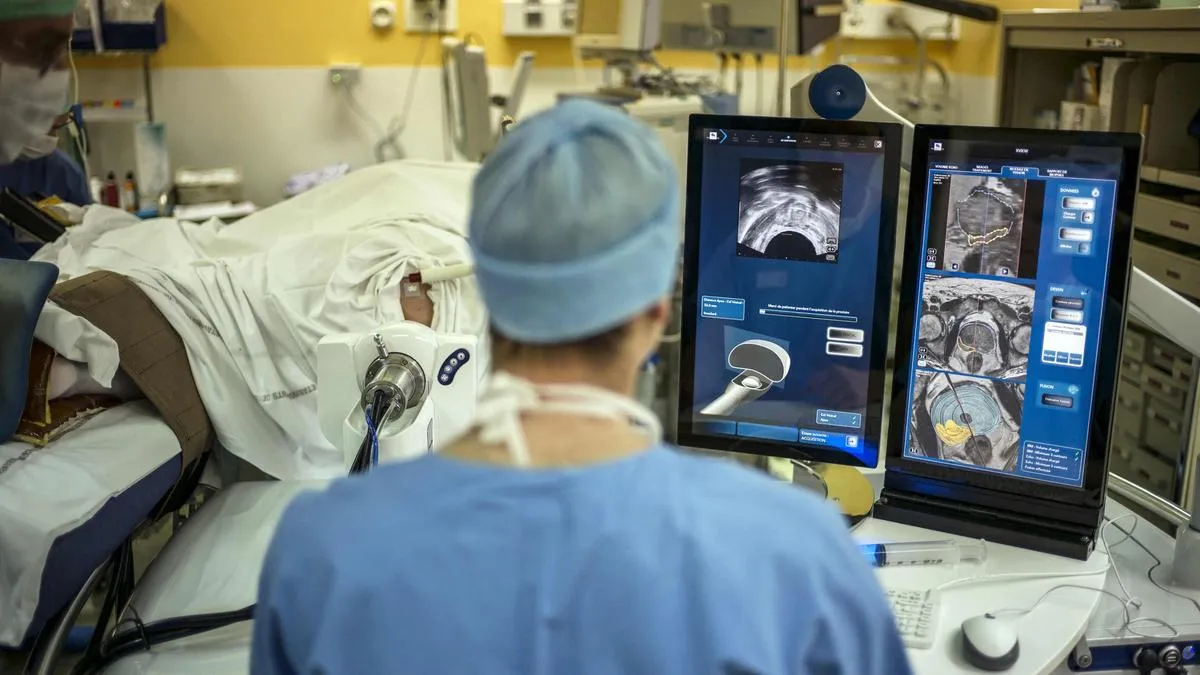
A promising development in prostate cancer care: can immunotherapy help? left Immunotherapy could offer a new approach to treating localised, high-risk prostate cancer when combined with established treatments such as radiotherapy and hormone therapy.
However, further research and follow-up are needed to establish its long-term benefits and determine whether it could become part of standard treatment |Image used for representational purpose only AFP AFP https://th-i.thgim.com/public/incoming/oyallb/article71600841.ece/alternates/FREE_1200/AFP_32T77YH.jpg JEFF PACHOUD (FILES) In this file photo taken on April 10, 2014 a surgeon sitting in front of screens of a Focal Onedevice performs a robot-assisted prostate tumorectomy using ultrasound imaging at the Edouard Herriot hospital in Lyon, center France. - Robots are becoming more and more important in hospitals, where they help track down tumors and change certain practices.
In the French hospital Gustave Roussy, Professor Thierry de Baere, chief of the interventional radiology service, has been using the robot "Epione" for more than a year: a technological platform composed of a planning and control screen, as well as a camera that allows the robot to locate itself, and a robotic arm, which will guide the treatment needle. (Photo by Jeff PACHOUD / AFP) While new research indicates that immunotherapy in men with localised, high-risk prostate cancer could offer benefits, there is still a long way to go before it becomes part of established treatment In my career, one of the things I have found that has to evolved tremendously, is the approach to the care of prostate cancer.
The disease used to be simply diagnosed and treated.
However, now there is much more attention to its aggressiveness, chances of recurrence, and most importantly, ways of controlling the disease without negatively impacting the quality of a person’s life. negatively.
This progress It is especially important in the case of intermediate and high-risk localised prostate cancer, when surgery and radiation therapy have proven to be effective treatments.
Hormone therapy is used in certain patients depending on their risk factors.
Nevertheless, recurrence is still an issue in some cases, after treatment aimed at curing the disease. in some cases.
This is why the rising interest in immunotherapy for prostate cancer attracts my attention.
A recent Phase 3, double-blind clinical trial, published in The Lancet, has added to this conversation by examining whether an immune-based approach can enhance the effects of established treatment, radiotherapy, in men with localised, high-risk prostate cancer. https://www.thelancet.com/journals/lanonc/article/PIIS1470-2045(26)00071-9/fulltext A safer alternative to treat aggressive prostate cancer found A safer alternative to treat aggressive prostate cancer found Drugs routinely used for treating prostate cancer may actually be worsening the condition story A safer alternative to treat aggressive prostate cancer found Counterproductive : The methods currently used produce encouraging results initailly but the cancer often returns in a more aggressive form, say (from right) Bushra Ateeq, Nishat Manzar and Ritika Tiwari.
Harnessing the immune system Making the immune system part of treatment Treatment through immunotherapy has changed the scenario in a variety of cancers, and yet, it has proven to be difficult when it comes to more difficult in treating prostate cancer.
Traditional immune-checkpoint inhibitors, for example, cannot be used to treat localised prostate cancer.
The therapy being used in this latest above Phase 3 clinical trial, however, differs from traditional therapies.
Aglatimagene besadenovec is an innovative viral immunotherapy that works by delivering the therapy directly to the site of the tumour.
It works by killing tumour cells and stimulating the body’s immune response against the cancerous cells.
From a clinician’s point of view, this is an intriguing direction since it goes beyond treatment of the tumor via just one pathway.
Radiation can be used to control for controlling the local growth of the tumour, hormones can address the dependence of the disease on androgens, while the immune system can add yet another layer to the treatment.
A crucial point to remember here, though, is that this is what the immune system can The crucial thing, however, is potentially do -- it is not yet a guaranteed outcome.
Oncology is a field where an interesting mechanism is just the starting point; one has to wait for more research and trials to help establish the outcome, which is what really counts. but it is the outcome that really counts in the end.
What is stereotactic radiation therapy for prostate cancer?
How does it compare to other treatments?
What is stereotactic radiation therapy for prostate cancer?
How does it compare to other treatments?
Stereotactic radiotherapy uses high doses of radiation to target and kill cancer cells; it uses newer machines that can deliver very focused radiation beams What is stereotactic radiation therapy for prostate cancer?
How does it compare to other treatments? storyline 1 Promising findings Encouraging findings, with some perspective Benefit in terms of disease-free survival was achieved by means of the combination strategy.
Another exploratory analysis showed that 80% percent of patients treated with the experimental therapy were negative for tumour cells in their prostate biopsies after two years, while only 63% percent of the control group achieved this outcome.
While these results appear promising, it is important to note that they should not be overstated.
Specifically, the prostate biopsy was an exploratory analysis for an evaluable subgroup of patients and did not represent the primary endpoint of the trial.
Likewise, other outcomes mentioned in the results of the study will need further follow-up and evaluation.
This is crucial for the patient.
An encouraging outcome does not guarantee that a new treatment will replace an already existing one.
How far have we come in providing personalised radiation treatment for cancer patients?
How far have we come in providing personalised radiation treatment for cancer patients?
With research into AI-driver therapy, genomics and nanoparticle technology gaining ground, the day is not far when the concept of personalised radiotherapy will be translated from the laboratory bench to bedside practise How far have we come in providing personalised radiation treatment for cancer patients? storyline 1 Bringing immunotherapy in early Could immunotherapy move earlier in cancer care?
Immunotherapy for cancer is mainly used immunotherapy was mainly addressed in the case of advanced and metastatic cancer.
What I liked The thing I like about this study is that one can see how immune therapy works at the early stages of cancer when it is localised and treatment aims at curing.
The issue with treating cancer is that despite the absence of any visible tumours in scans, there may still be a trace of the disease left.
Could activation of the immune system early help eliminate those cells?
This would seem like It would be good to know much more about it, but it seems like it would be a good direction for future research.
Understanding why chemotherapy is a lifeline in cancer care Understanding why chemotherapy is a lifeline in cancer care While chemotherapy may be feared for its side effects, its role in saving lives cannot be overstated; it plays a critical role in managing the growing epidemic of cancer Understanding why chemotherapy is a lifeline in cancer care storyline 1 What patients should know What should patients take from this?
For now, I think of these results as positive signs rather than a revolution in the established management of prostate cancer.
Individualised decision-making should remain a key component of treatment with attention paid to such factors as PSA values, Gleason score, imaging studies, risk group, age, general condition of the patient and his personal preferences.
Surgery, radiotherapy and hormonal therapy are essential, and an individual treatment modality varies from case to case.
It’s important to understand But the main thing here is that there is continuous progress being made in a continuous development of prostate cancer treatment.
Doctors and scientists are beginning to think We start thinking about how we can combine different treatment methods rather than using only one. of them.
If we will learn in future how to predict who can benefit from immunotherapy, how stable this effect is and if it leads to improved prognosis in the end, then such treatment might become a crucial step in localised prostate cancer treatment.
That is where, for me, the true promise exists, not in replacing something that works but in figuring out how to make it work even better for the patient. (Dr.
Ashwin Giridhar is senior consultant & lead - urology & uro-oncology, HCG Cancer Hospitals, Hebbal, Bengaluru. drashwingiridhar@gmail.com)
Related articles
 India · The Hindu — Health · 19 hours ago
Webinar on modern-day tips for posture to be held on October 25
The webinar will explore how daily habits, workplace ergonomics and physical inactivity affect the spine, and discuss practical ways to prevent and manage common…
Read full article India · The Hindu — Health · 22 hours ago
Shamonda virus, the livestock pathogen detected in human for the first time | Explained
The virus, which mainly affects livestock, has been detected in humans for the first time, prompting investigations into its potential public health implications
Read full article India · The Hindu — Health · 23 hours ago
Inadequate sleep increases the risk of fatty liver disease
With every one-hour decrease in sleep time from the recommended seven-eight hours, the risk of fat deposition in the liver increased by 24%
Read full article