
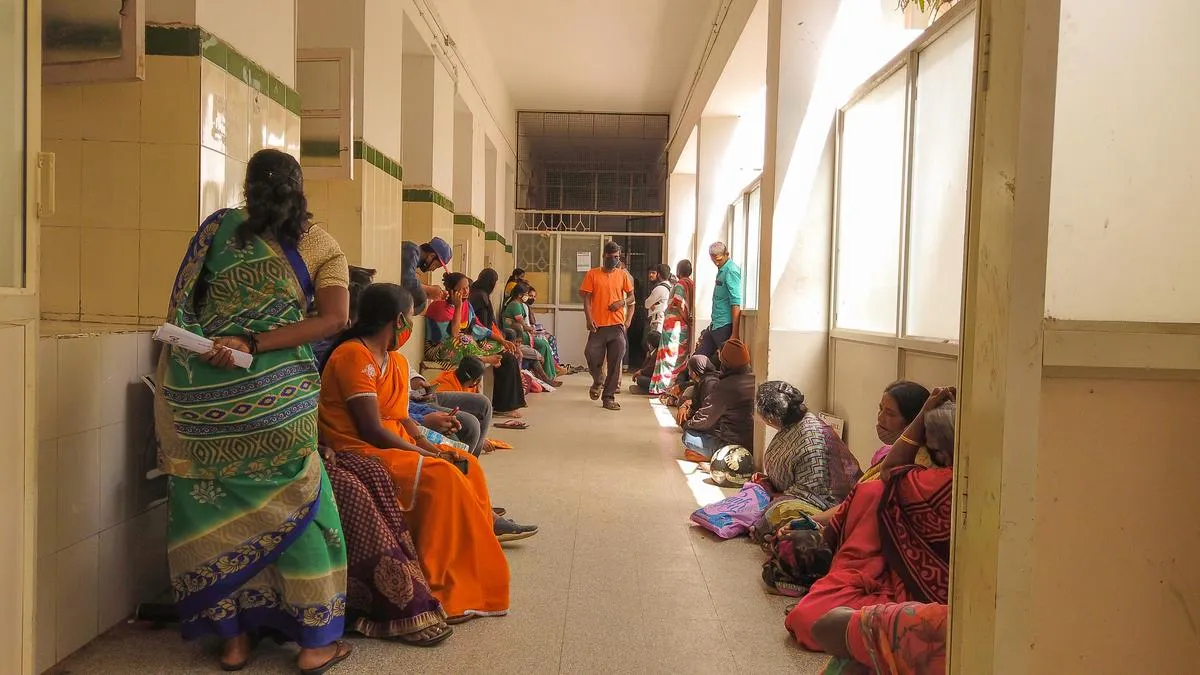
When care falls short Health Matters left Health rights must translate into accessible, dignified care for all, while protecting those who challenge the conditions that deny people their basic rights |Image used for representational purpose only Getty Images Getty Images https://th-i.thgim.com/public/incoming/d8fkta/article71603872.ece/alternates/FREE_1200/iStock-1296313099.jpg Priya darshan An Moving scene at the Old General hospital premises on a busy morning where patients are seen waiting for their Medical Examination in rural Mysuru,India.
On the cost and safety of medicines, research, ageing, the questions around healthcare rights, medical evidence and more (In the weekly Health Matters newsletter, Athira Elssa Johnson writes about getting to good health, and staying there. You can subscribe here to get the newsletter in your inbox.) https://www.thehindu.com/newsletter-subscription/?nl_id=9848&utm_source=website_article_health_matters&utm_campaign=newsletter_signup&utm_medium=website For anyone navigating the healthcare system, diagnosis is only the harsh beginning.
There are medicines to afford, compulsive researching, decisions to make, follow-up appointments to keep and, sometimes, conflicting advice to sort through.
For people living with chronic illnesses and disabilities, these become part of everyday life.
The question is not only whether medical science can offer a treatment, but whether the care is in reach and if one can understand their options and make informed decisions about their health.
A few of this week’s reports look at these questions Treatment and questions The government has capped trade margins on 137 anti-cancer drugs, as Bindu Shajan Perappadan reported.
The move brings the discourse on the cost of cancer treatment back into focus.
For patients and their families, the price of medicines can influence how manageable treatment is over months or years.
A price cap is an important policy intervention, but its real value will depend on whether patients see meaningful savings.
Centre to cap trade margins on non-scheduled cancer drugs to 30% of MRP storyline 1 And in Keralam, parents of children with spinal muscular atrophy have sought political support over concerns about a generic drug.
For families dealing with a rare condition, access to treatment can involve difficult decisions about affordability and the medicines available to them.
These decisions need clear communication and reliable evidence on safety and effectiveness, alongside efforts to make treatment accessible.
Parents of SMA-affected kids in Keralam seek political support for their concerns over generic drug storyline 1 There is also the question of the use of medication and Dr.
Chandrakant Lahariya examines India’s problem of overtreatment and overmedication.
Unnecessary tests and medicines can add costs and expose patients to avoidable risks.
For people already managing several conditions or taking multiple medicines, knowing what is necessary and what may not be is an important part of safe care.
India’s problem of overtreatment and overmedication opinion 1 What new research tells us I write about lung adenocarcinoma in the all you need to know about series, following news that Pope Leo XIV underwent surgery for the cancer.
The Vatican later said his recovery was on track.
The explainer looks at the disease behind the headlines and offers readers a clearer understanding of this type of lung cancer.
All you need to know about: lung adenocarcinoma storyline 1 Pope's recovery on track after surgery, Vatican says storyline 1 Other research this week looks at how differently people can experience disease.
A study suggests that early-onset Alzheimer’s disease can look very different from the late-onset form.
Another suggests that menopause may involve a more pronounced physiological shift around the final menstrual period than the idea of a gradual transition implies.
Early-onset Alzheimer's disease looks very different to late-onset version: study storyline 1 Menopause not gradual, body might experience a 'physiological cliff' around last period: Study storyline 1 Long COVID remains another area where researchers are working to understand why some people continue to experience effects long after an infection.
A new study suggests that the condition may affect bacteria in the mouth and lungs.
It is still too early to conclude what these changes mean for persistent symptoms, but the research adds to efforts to understand the longer-term effects of COVID-19.
Long COVID may impact bacteria in mouth, lungs: study storyline 1 Science, integrity and disease detection An analysis of more than 4,000 cancer research articles has identified suspected paper-mill activity, raising concerns about the reliability of published research.
Scientific findings often become the starting point for further studies, so potentially fraudulent papers can have consequences well beyond the journals in which they appear.
Trust in science depends not just on new discoveries, but also on how carefully the evidence is produced and checked.
Analysis reveals fraudulent 'paper mill' activity across over 4,000 cancer research articles storyline 1 V.
Geetanath reports on a genetic toolkit developed by scientists at the Centre for Cellular and Molecular Biology to study the inner workings of tuberculosis.
The tool could help researchers investigate the bacterium more closely.
It is an example of the foundational work that often happens long before a discovery leads to a new test or treatment.
CCMB scientists develop genetic toolkit to shine light on TB’s inner workings storyline 1 Another report looks at chemical signatures -- patterns of molecules and compounds in the body that could help identify diseases by detecting changes associated with illness.
These signatures may offer clues to disease processes and support earlier diagnosis, but researchers must establish how accurately they can identify specific conditions and distinguish them from other causes of similar changes.
The challenge is to validate these findings in different patient groups and develop tests that are reliable, clinically useful and accessible in routine healthcare.
Chemical signatures could help detect diseases early, but accuracy and access remain challenges storyline 1 Climate and community health The health effects of climate change are not always immediately visible, but their potential scale is considerable.
An analysis suggests that limiting global warming to 1.8°C could prevent the loss of 1.89 billion years of healthy life.
The estimate puts the consequences of a warming planet in terms of human health, reminding us that the conditions in which people live are closely tied to their ability to stay well.
Limiting warming to 1.8 degree C could prevent loss of 1.89 billion years of healthy life: Analysis storyline 1 Closer home, Kozhikode has reported 161 confirmed measles cases and one death.
C.
Maya reports that a continuing mumps outbreak in Keralam has also renewed demands for the measles, mumps and rubella vaccine.
Continuing mumps outbreak in Keralam leads to renewed demand for MMR vaccine storyline 1 Care also needs to continue beyond the immediate event that brings someone into the health system.
Dr.
Sowmya Josyula writes about why maternal health care after delivery is crucial.
Once a baby is born, attention can shift almost entirely to the newborn, even though the mother may still need medical follow-up and support.
Postpartum care is an essential part of maternal healthcare, not an optional extra.
Spotlighting maternal health: why care after delivery is crucial storyline 1 Sudha Chandrashekar’s article on making Keralam age-ready takes up a related question: how can the rights of the elderly be translated into accessible care?
Recognising those rights is only a starting point.
Older people need services and support that work in practice and respect their needs and autonomy.
In another important piece, Dr.
Parth Sharma examines how doctors working with marginalised communities risk facing reprisals when they challenge the conditions that make people sick, from displacement and hunger to the denial of basic healthcare.
Towards an age-ready Keralam: translating rights into care storyline 1 Being a good doctor is risky in India storyline 1 And more Elysia Poggi Davis, Benjamin L.
Hankin and Catherine Demers write in The Conversation about research suggesting that treating depression during pregnancy may benefit a baby’s brain development.
Treating depression during pregnancy may benefit baby’s brain development – new research storyline 1 Preeti Zachariah examines why whey protein prices are rising in India.
Whey protein prices soar in India: Why your daily scoop is getting expensive storyline 1 Smruthi Prabhu explains what intestinal gas can tell us about gastrointestinal health.
What intestinal gas can tell us about our gastrointestinal health storyline 1 Biju Dharmapalan looks at whether a sugar-rich diet while taking antibiotics could affect the gut microbiome, he also writes about why citizens should be research partners in science.
Is a sugar-rich diet while on antibiotics a threat to the gut microbiome?
A new study attempts to find out storyline 1 Why science’s contract with society needs citizens as research partners storyline 1 Zubeda Hamid’s In Focus podcast examines the plague case in Siberia, what is known about the disease and what remains uncertain.
Plague case in Siberia: what we know and what we should know | In Focus Podcast audio In Say Her Name series, Ramya Kannan revisits the story of India’s first woman Surgeon General and the barriers she faced in pursuing a place in science.
India’s first woman Surgeon General fought for a place in science storyline 1 Divya Gandhi reports on a study suggesting that wealthier Indians may be more prone to heart disease than poorer groups.
India’s consistently rich more prone to heart disease than the poor: study storyline 1 Anirban Mukhopadhyay explores a molecule that could help make treatments for inflammatory bowel disease more effective.
Two-Face molecule could help make IBD treatments more effective storyline 1 Dr.
C.
Aravinda examines how AI-MedTech is regulated in India.
How is AI-MedTech in India regulated? storyline 1 Dr.
Dinesh Arab reflects on health and ageing in The back end of 55.
The back end of 55 storyline 1 Dr.
Sushma Gopalan explore how too many treatment options can complicate decisions for patients and doctors.
The burden of choice: when a plethora of options hinder both patients and doctors storyline 1 Ahd here is a quiz to test readers’ knowledge of arthritis.
Health Quiz: On arthritis storyline 1 Also watch this special episode of Health Wrap, Episode 55 marking world sight day Watch: Caring for your eyes | Health Wrap | Episode 55 video 1 (There is much more, do head to our health page and subscribe to the health newsletter here) https://www.thehindu.com/sci-tech/health/?utm_source=health_matters&utm_medium=email&utm_campaign=Newsletter&pnespid=56VgVi1ebLETw.
LHrSqvHY2HuRa1V54nN7O2m.
I3qQxmSgprwjPCkHFChU96p0evrLrKV1a7Kg http://thehindu.com/newsletter-subscription/?utm_source=health_matters&utm_medium=email&utm_campaign=Newsletter&pnespid=uatkCjZOLLkG0PrFvjewHoiVuACiSoEuLLi1m.p1oRJmYkfyrk_K6t72FaC2yJIOYFNR2Jd4Aw
Related articles
 India · The Hindu — Health · 14 hours ago
France reports first human Shamonda virus case, says no health risk
Despite circulating in Africa and Asia for several decades, the Shamonda virus has never previously been detected in humans, the Health and Agriculture Ministries…
Read full article India · The Hindu — Health · 17 hours ago
How illness, stigma, and social realities find a place in Tamil literature
Read full article India · The Hindu — Health · 22 hours ago
Vandalur Zoo closed for two days after avian influenza confirmed in water birds
The zoo will remain closed on October 22 and 23; Forest Department officials say seven water birds in the zoo had died between October…
Read full article