
Air pollution over 66 times WHO limit in parts of Delhi as people defy ban on firecrackers on Deepavali
The Hindu — Health · 9 Nov 2026 · 3 min read
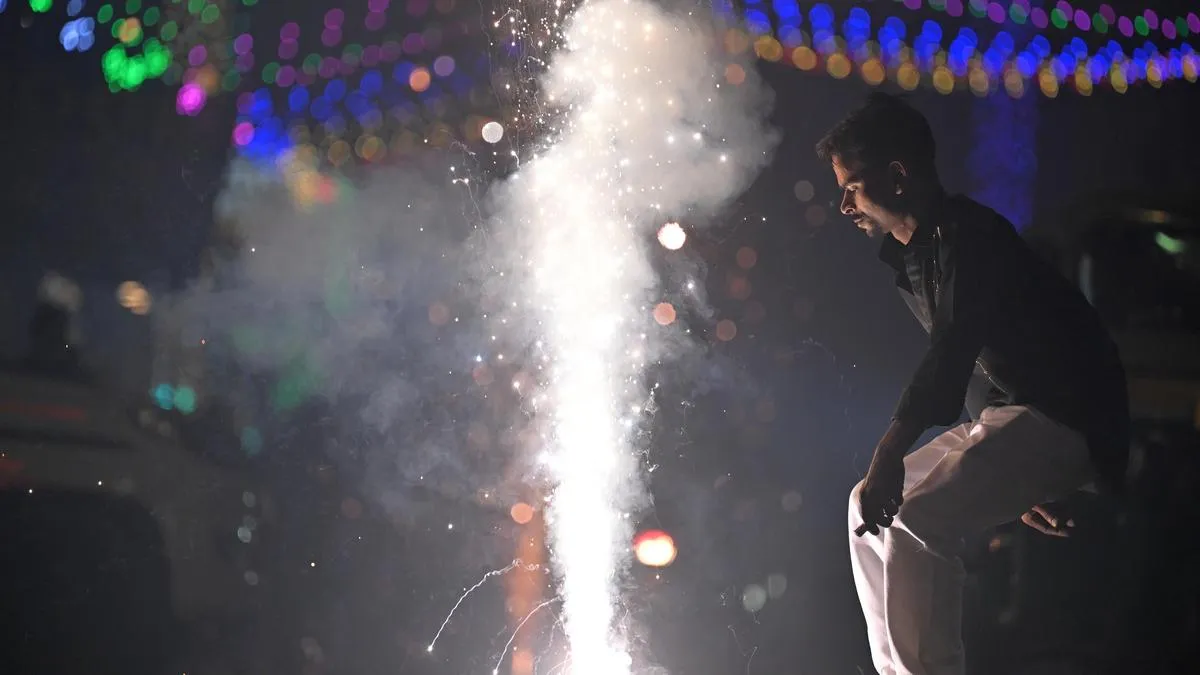
NEW DELHI As Delhiites burst firecrackers well past the 10 p.m. deadline set by the Supreme Court for Deepavali night, PM2.5 levels in parts of the city soared to 66 times the World Health Organization’s (WHO) recommended 24-hour guideline, before gradually declining in the early hours of Monday (November 9, 2026), according to official data.
However, at the peak of pollution following the bursting of firecrackers on Sunday (November 8) night, data from several monitoring stations operated by the Delhi Government’s Delhi Pollution Control Committee (DPCC) were unavailable for hours.
This raises the possibility that the actual spike in pollution could have been higher.
Data was unavailable for several hours at multiple stations, including Anand Vihar, R.
K.
Puram, and Bawana, according to the DPCC website.
Data from some other stations had also not been updated since Sunday (November 8) night.
Deepavali 2026: All you need to know about Supreme Court-permitted time slots, green crackers and other directives https://www.thehindu.com/news/national/diwali-2026-supreme-court-green-cracker-norms-permitted-time-slots-and-other-directions/article71669897.ece According to DPCC data, the PM2.5 concentration in Punjabi Bagh stood at 993 micrograms per cubic metre at 4 a.m. on Monday (November 9) — about 66.2 times the WHO’s recommended 24-hour guideline of 15 micrograms per cubic metre.
In Vivek Vihar, the PM2.5 concentration was 873 micrograms per cubic metre at 2 a.m. on Monday (November 9), about 58.2 times the WHO guideline.
In R.
K.
Puram, it stood at 924 micrograms per cubic metre at 10 p.m. on Sunday (November 8), about 61.6 times the guideline.
PM2.5 refers to fine inhalable particulate matter measuring 2.5 micrometres or less in diameter.
These particles can penetrate deep into the lungs and enter the bloodstream, potentially causing respiratory and other health problems.
Although the Supreme Court had permitted only green firecrackers during specified time windows on November 7 and 8, traditional firecrackers, which are more polluting, were also available in Delhi markets.
Also Read | Supreme Court calls Deepavali fireworks a ‘religious practice’, allows green crackers for two days in Delhi-NCR https://www.thehindu.com/news/cities/Delhi/supreme-court-lifts-firecracker-ban-for-deepavali-in-delhi-ncr/article71656147.ece ‘Severe’ air pollution in several parts Delhi’s overall air quality remained in the ‘very poor’ category on Monday (November 9) morning, while several parts of the city continued to record ‘severe’ pollution levels, according to Central Pollution Control Board (CPCB) data. ‘Severe’ air pollution affects healthy people and can seriously impact those with existing diseases, the CPCB says.
Delhi’s 24-hour average Air Quality Index (AQI) stood at 370, in the ‘very poor’ category, at 9 a.m. on Monday.
However, several areas, including Chandni Chowk, ITO, Delhi University’s North Campus, Rohini and Mundka, recorded ‘severe’ air quality.
Every winter, air pollution levels rise across Delhi-NCR and parts of the wider Indo-Gangetic Plain, largely due to meteorological conditions such as low wind speeds and falling temperatures.
Emissions from stubble burning in October and November, along with firecracker use during the festive season, add to pollution from vehicles and dust, further deteriorating air quality.
Related articles
 India · The Hindu — Health · 13 hours ago
Health officials step up surveillance as Shigella cases rise in Kerala’s Malappuram
Five of the eight Shigella cases reported in Malappuram district are linked to a wedding feast at Korakkuthu in Elamkulam panchayat near Perinthalmanna
Read full article India · The Hindu — Health · 13 hours ago
FSSAI seizes 3,280 tonne food items, cancels 52 licences in nationwide inspection drive
The regulator said it inspected 56,431 food establishments during its nationwide enforcement drive between September 1 and November 5, and seized non-compliant food products,…
Read full article India · The Hindu — Health · 13 hours ago
One child dead, 269 treated for burn injuries in T.N. during Deepavali
To manage the festive emergency load, 1,283 ambulances were deployed on active duty across the State.
Read full article