
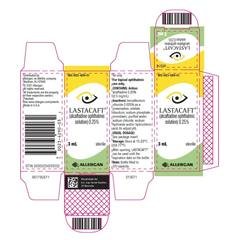
Lastacaft
11 DESCRIPTION LASTACAFT® (alcaftadine ophthalmic solution) is an H1 receptor antagonist, in a sterile ophthalmic solution for topical ophthalmic use. Alcaftadine is a white to yellow powder with an empirical formula of C 19 H 21 N 3 O and a molecular weight of 307.39. Contains: Active: alcaftadine 0.25% (2.5 mg/mL) Inactives: benzalkonium chloride 0.005% as a preservative; edetate disodium; sodium phosphate, monobasic; purified water; sodium chloride; sodium hydroxide and/or hydrochloric acid (to adjust pH) Chemical Name: 6,11-dihydro-11-(1-methyl-4-piperidinylidene)-5 H -imidazo[2,1-b] [3] benzazepine-3-carboxaldehyde Structural Formula: The drug product has a pH of approximately 7 and an osmolality of approximately 290 mOsm/kg. The chemical structure for Chemical Name: 6,11-dihydro-11-(1-methyl-4-piperidinylidene)-5H-imidazo[2,1-b] [3] benzazepine-3-carboxaldehyde
Information page. Not necessarily available for purchase.
What is Lastacaft?
11 DESCRIPTION LASTACAFT® (alcaftadine ophthalmic solution) is an H1 receptor antagonist, in a sterile ophthalmic solution for topical ophthalmic use. Alcaftadine is a white to yellow powder with an empirical formula of C 19 H 21 N 3 O and a molecular weight of 307.39. Contains: Active: alcaftadine 0.25% (2.5 mg/mL) Inactives: benzalkonium chloride 0.005% as a preservative; edetate disodium; sodium phosphate, monobasic; purified water; sodium chloride; sodium hydroxide and/or hydrochloric acid (to adjust pH) Chemical Name: 6,11-dihydro-11-(1-methyl-4-piperidinylidene)-5 H -imidazo[2,1-b] [3] benzazepine-3-carboxaldehyde Structural Formula: The drug product has a pH of approximately 7 and an osmolality of approximately 290 mOsm/kg. The chemical structure for Chemical Name: 6,11-dihydro-11-(1-methyl-4-piperidinylidene)-5H-imidazo[2,1-b] [3] benzazepine-3-carboxaldehyde
Uses of Lastacaft
Established uses
- 1 INDICATIONS AND USAGE LASTACAFT ® is an H 1 histamine receptor antagonist indicated for the prevention of itching associated with allergic conjunctivitis.
- LASTACAFT ® is an H 1 histamine receptor antagonist indicated for the prevention of itching associated with allergic conjunctivitis.
- ( 1 )
How Lastacaft works
In more detail: 12.1 Mechanism of Action Alcaftadine is an H 1 histamine receptor antagonist and inhibitor of the release of histamine from mast cells. Decreased chemotaxis and inhibition of eosinophil activation has also been demonstrated.
How to take Lastacaft
2 DOSAGE AND ADMINISTRATION Instill one drop in each eye once daily. If more than 1 topical ophthalmic medicinal product is being used, each one should be administered at least 5 minutes apart. Instill one drop in each eye once daily. ( 2 )
Dosage
Follow the dose prescribed by your doctor or pharmacist. The ranges below are general information, not a personal prescription.
- Adults
- 2 DOSAGE AND ADMINISTRATION Instill one drop in each eye once daily. If more than 1 topical ophthalmic medicinal product is being used, each one should be administered at least 5 minutes apart. Instill one drop in each eye once daily. ( 2 )
Side effects of Lastacaft
Common
- 6 ADVERSE REACTIONS The most common ocular adverse reactions, occurring in less than 4% of eyes treated with LASTACAFT ® , were eye irritation, burning and/or stinging on instillation, eye redness, and eye pruritus.
- ( 6.1 ) To report SUSPECTED ADVERSE REACTIONS, contact Allergan at 1-800-678-1605 or FDA at 1-800-FDA-1088 or www.fda.gov/medwatch.
- 6.1 Clinical Trials Experience Because clinical trials are conducted under widely varying conditions, adverse reaction rates observed in the clinical trials of a drug cannot be directly compared to rates in the clinical trials of another drug and may not reflect the rates observed in clinical practice.
- The most frequent ocular adverse reactions, occurring in less than 4% of eyes treated with LASTACAFT ® , were eye irritation, burning and/or stinging upon instillation, eye redness and eye pruritus.
- The most frequent non-ocular adverse reactions, occurring in less than 3% of subjects with eyes treated with LASTACAFT ® , were nasopharyngitis and headache.
- Some of these events were similar to the underlying disease being studied.
Warnings and who should not take it
Who should NOT take Lastacaft?
- 4 CONTRAINDICATIONS LASTACAFT ® is contraindicated in patients with hypersensitivity to any component in the product.
- Hypersensitivity ( 4 )
Safety at a glance
8.1 Pregnancy Risk Summary There are no adequate and well-controlled studies with LASTACAFT® in pregnant women to inform a drug associated risk. There are limited data with the use of alcaftadine eye drops in pregnant women. In embryofetal studies in rats and rabbits, oral administration of alcaftadine during the period of organogenesis did not produce maternal or embryofetal toxicity at clinically relevant doses. Advise pregnant women of a potential risk to the fetus and mother. LASTACAFT® should only be used during pregnancy if the potential benefit justifies the potential risk to the fetus and mother. The background risk of major birth defects and miscarriage for the indicated population is unknown. However, the background risk in the U.S. general population of major birth defects is 2 to 4%, and of miscarriage is 15 to 20%, of clinically recognized pregnancies. Data Animal Data In rats, oral administration of 5, 20 or 40 mg/kg/day alcaftadine during the period of organogenesis (gestational days 6 – 16) caused maternal lethality at doses of 40 mg/kg. The no observed adverse effect level (NOAEL) for maternal toxicity was 20 mg/kg/day (an exposure 230-times higher than that at the
Children and elderly
Children
8.4 Pediatric Use Safety and effectiveness in pediatric patients below the age of 2 years have not been established.
Elderly
8.5 Geriatric Use No overall differences in safety or effectiveness were observed between elderly and younger subjects.
Frequently asked questions
What is Lastacaft used for?
1 INDICATIONS AND USAGE LASTACAFT ® is an H 1 histamine receptor antagonist indicated for the prevention of itching associated with allergic conjunctivitis., LASTACAFT ® is an H 1 histamine receptor antagonist indicated for the prevention of itching associated with allergic conjunctivitis., ( 1 ).
How should I take Lastacaft?
2 DOSAGE AND ADMINISTRATION Instill one drop in each eye once daily. If more than 1 topical ophthalmic medicinal product is being used, each one should be administered at least 5 minutes apart. Instill one drop in each eye once daily. ( 2 )
What are the common side effects?
6 ADVERSE REACTIONS The most common ocular adverse reactions, occurring in less than 4% of eyes treated with LASTACAFT ® , were eye irritation, burning and/or stinging on instillation, eye redness, and eye pruritus., ( 6.1 ) To report SUSPECTED ADVERSE REACTIONS, contact Allergan at 1-800-678-1605 or FDA at 1-800-FDA-1088 or www.fda.gov/medwatch., 6.1 Clinical Trials Experience Because clinical trials are conducted under widely varying conditions, adverse reaction rates observed in the clinical trials of a drug cannot be directly compared to rates in the clinical trials of another drug and may not reflect the rates observed in clinical practice., The most frequent ocular adverse reactions, occurring in less than 4% of eyes treated with LASTACAFT ® , were eye irritation, burning and/or stinging upon instillation, eye redness and eye pruritus., The most frequent non-ocular adverse reactions, occurring in less than 3% of subjects with eyes treated with LASTACAFT ® , were nasopharyngitis and headache., Some of these events were similar to the underlying disease being studied..
Who should not take Lastacaft?
4 CONTRAINDICATIONS LASTACAFT ® is contraindicated in patients with hypersensitivity to any component in the product.; Hypersensitivity ( 4 ).
Can I take Lastacaft during pregnancy?
8.1 Pregnancy Risk Summary There are no adequate and well-controlled studies with LASTACAFT® in pregnant women to inform a drug associated risk. There are limited data with the use of alcaftadine eye drops in pregnant women. In embryofetal studies in rats and rabbits, oral administration of alcaftadine during the period of organogenesis did not produce maternal or embryofetal toxicity at clinically relevant doses. Advise pregnant women of a potential risk to the fetus and mother. LASTACAFT® should only be used during pregnancy if the potential benefit justifies the potential risk to the fetus and mother. The background risk of major birth defects and miscarriage for the indicated population is unknown. However, the background risk in the U.S. general population of major birth defects is 2 to 4%, and of miscarriage is 15 to 20%, of clinically recognized pregnancies. Data Animal Data In rats, oral administration of 5, 20 or 40 mg/kg/day alcaftadine during the period of organogenesis (gestational days 6 – 16) caused maternal lethality at doses of 40 mg/kg. The no observed adverse effect level (NOAEL) for maternal toxicity was 20 mg/kg/day (an exposure 230-times higher than that at the
Can children take Lastacaft?
8.4 Pediatric Use Safety and effectiveness in pediatric patients below the age of 2 years have not been established.
Medicine information on IMCURE is provided for educational purposes and is not a substitute for diagnosis, prescription or medical advice. Always follow your doctor’s or pharmacist’s instructions. Real product image from the U.S. National Library of Medicine's DailyMed listing for Lastacaft (Alcaftadine) Solution/ Drops. Packaging varies by brand and manufacturer.