
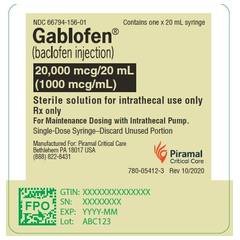
Gablofen
11 DESCRIPTION GABLOFEN (baclofen injection) is a muscle relaxant and antispastic. Baclofen's pharmacological class is a gamma-aminobutyric acid (GABA) ergic agonist. Baclofen's chemical name is 4-amino-3-(4-chlorophenyl) butanoic acid, and its structural formula is: Baclofen C 10 H 12 ClNO 2 Baclofen is a white to off-white powder, with a molecular weight of 213.66. It is slightly soluble in water, very slightly soluble in methanol and ethanol, practically insoluble in acetone and ether, soluble in 0.1N hydrochloric acid, 0.1N sodium hydroxide, and insoluble in chloroform. GABLOFEN is a sterile, pyrogen-free, isotonic solution free of antioxidants, preservatives or other potentially neurotoxic additives indicated only for intrathecal administration. The drug is stable in solution at 37°C and compatible with CSF. Each mL of GABLOFEN contains baclofen USP 50 mcg, 500 mcg, 1,000 mcg or 2,000 mcg and sodium chloride 9 mg in Water for Injection; pH range is 5.5 to 7.5. structure
Information page. Not necessarily available for purchase.
What is Gablofen?
11 DESCRIPTION GABLOFEN (baclofen injection) is a muscle relaxant and antispastic. Baclofen's pharmacological class is a gamma-aminobutyric acid (GABA) ergic agonist. Baclofen's chemical name is 4-amino-3-(4-chlorophenyl) butanoic acid, and its structural formula is: Baclofen C 10 H 12 ClNO 2 Baclofen is a white to off-white powder, with a molecular weight of 213.66. It is slightly soluble in water, very slightly soluble in methanol and ethanol, practically insoluble in acetone and ether, soluble in 0.1N hydrochloric acid, 0.1N sodium hydroxide, and insoluble in chloroform. GABLOFEN is a sterile, pyrogen-free, isotonic solution free of antioxidants, preservatives or other potentially neurotoxic additives indicated only for intrathecal administration. The drug is stable in solution at 37°C and compatible with CSF. Each mL of GABLOFEN contains baclofen USP 50 mcg, 500 mcg, 1,000 mcg or 2,000 mcg and sodium chloride 9 mg in Water for Injection; pH range is 5.5 to 7.5. structure
Uses of Gablofen
Established uses
- 1 INDICATIONS AND USAGE GABLOFEN is indicated for use in the management of severe spasticity in adult and pediatric patients age 4 years and above.
- Patients should first respond to a screening dose of intrathecal baclofen prior to consideration for long term infusion via an implantable pump.
- For spasticity of spinal cord origin, chronic infusion of GABLOFEN via an implantable pump should be reserved for patients unresponsive to oral baclofen therapy, or those who experience intolerable CNS side effects at effective doses.
- Patients with spasticity due to traumatic brain injury should wait at least one year after the injury before consideration of long term intrathecal baclofen therapy.
- GABLOFEN is intended for use by the intrathecal route in single bolus test doses (via spinal catheter or lumbar puncture) and, for chronic use, only with the Medtronic SynchroMed ® Programmable Pump or other pumps labeled for intrathecal administration of GABLOFEN [see Clinical Studies (14)] .
- Prior to implantation of a device for chronic intrathecal infusion of GABLOFEN, patients must show a response to GABLOFEN in a screening trial [see Dosage and Administration (2.2)] .
How Gablofen works
In more detail: 12.1 Mechanism of Action The precise mechanism of action of baclofen as a muscle relaxant and antispasticity agent is not fully understood. Baclofen inhibits both monosynaptic and polysynaptic reflexes at the spinal level, possibly by decreasing excitatory neurotransmitter release from primary afferent terminals, although actions at supraspinal sites may also occur and contribute to its clinical effect. Baclofen is a structural analog of the inhibitory neurotransmitter gamma-aminobutyric acid (GABA), and may exert its effects by stimulation of the GABAB receptor subtype. Baclofen when introduced directly into the intrathecal space permits effective CSF concentrations to be achieved with resultant plasma concentrations 100 times less than those occurring with oral administration. In people, as well as in animals, baclofen has been shown to have general CNS depressant properties as indicated by the production of sedation with tolerance, somnolence, ataxia, and respiratory and cardiovascular depression.
How to take Gablofen
2 DOSAGE AND ADMINISTRATION 2.1 Use Only in Medtronic SynchroMed ® Programmable Pump (or other pumps labeled for intrathecal administration of GABLOFEN) GABLOFEN is approved only for use with the Medtronic SynchroMed ® Programmable Pump or other pumps labeled for intrathecal administration of GABLOFEN. Refer to the manufacturer’s manual for specific instructions and precautions for programming the pump and/or refilling the reservoir. It is important to select the appropriate refill kit for the pump used to administer GABLOFEN. GABLOFEN is not to be compounded with other medications. 2.2 Screening Phase Prior to pump implantation and initiation of chronic infusion of GABLOFEN, patients must demonstrate a positive clinical response to a GABLOFEN bolus dose administered intrathecally in a screening trial. The screening trial employs GABLOFEN at a concentration of 50 mcg/mL. A 1 mL syringe (50 mcg/mL) is available for use in the screening trial. The screening procedure is as follows. An initial bolus containing 50 micrograms in a volume of 1 milliliter is administered into the intrathecal space by barbotage over a period of not less than one minute. The patient is observed over the ens
Dosage
Follow the dose prescribed by your doctor or pharmacist. The ranges below are general information, not a personal prescription.
- Adults
- 2 DOSAGE AND ADMINISTRATION 2.1 Use Only in Medtronic SynchroMed ® Programmable Pump (or other pumps labeled for intrathecal administration of GABLOFEN) GABLOFEN is approved only for use with the Medtronic SynchroMed ® Programmable Pump or other pumps labeled for intrathecal administration of GABLOFEN. Refer to the manufacturer’s manual for specific instructions and precautions for programming the pump and/or refilling the reservoir. It is important to select the appropriate refill kit for the pump used to administer GABLOFEN. GABLOFEN is not to be compounded with other medications. 2.2 Screening Phase Prior to pump implantation and initiation of chronic infusion of GABLOFEN, patients must demonstrate a positive clinical response to a GABLOFEN bolus dose administered intrathecally in a screening trial. The screening trial employs GABLOFEN at a concentration of 50 mcg/mL. A 1 mL syringe (50 mcg/mL) is available for use in the screening trial. The screening procedure is as follows. An initial bolus containing 50 micrograms in a volume of 1 milliliter is administered into the intrathecal space by barbotage over a period of not less than one minute. The patient is observed over the ens
Side effects of Gablofen
Common
- 6 ADVERSE REACTIONS 6.1 Spasticity of Spinal Cord Origin Most Common Adverse Reactions in Patients with Spasticity of Spinal Origin In pre- and post-marketing clinical trials, the most common adverse reactions associated with use of intrathecal baclofen which were not seen at an equivalent incidence among placebo-treated patients were: somnolence, dizziness, nausea, hypotension, headache, convulsions and hypotonia.
- Adverse Reactions Associated with Discontinuation of Treatment 8/474 patients with spasticity of spinal cord origin receiving long term infusion of intrathecal baclofen in pre- and post-marketing clinical studies in the U.S.
- discontinued treatment due to adverse reactions.
- These include: pump pocket infections (3), meningitis (2), wound dehiscence (1), gynecological fibroids (1) and pump overpressurization (1) with unknown, if any, sequela.
- Eleven patients who developed coma secondary to overdose had their treatment temporarily suspended, but all were subsequently re-started and were not, therefore, considered to be true discontinuations.
- Fatalities - [see Warnings and Precautions ( 5.6 )] .
Warnings and who should not take it
Who should NOT take Gablofen?
- 4 CONTRAINDICATIONS GABLOFEN is contraindicated in patients with a hypersensitivity to baclofen.
- Do not use GABLOFEN for intravenous, intramuscular, subcutaneous or epidural administration.
- · Hypersensitivity to baclofen (4) · Do not use GABLOFEN for intravenous, intramuscular, subcutaneous or epidural administration.
- (4)
Overdose
10 OVERDOSAGE Special attention must be given to recognizing the signs and symptoms of overdosage, especially during the initial screening and dose-titration phase of treatment, but also during re-introduction of GABLOFEN after a period of interruption in therapy. Symptoms of Intrathecal Baclofen Overdose Drowsiness, lightheadedness, dizziness, somnolence, respiratory depression, seizures, rostral progression of hypotonia and loss of consciousness progressing to coma of up to 72 hours duration. In most cases reported, coma was reversible without sequelae after drug was discontinued. Symptoms of intrathecal baclofen overdose were reported in a sensitive adult patient after receiving a 25 mcg intrathecal bolus. Treatment Suggestions for Overdose There is no specific antidote for treating overdoses of GABLOFEN; however, the following steps should ordinarily be undertaken: 1) Residual intrathecal baclofen solution should be removed from the pump as soon as possible. 2) Patients with respiratory depression should be intubated if necessary, until the drug is eliminated. Anecdotal reports suggest that intravenous physostigmine may reverse central side effects, notably drowsiness and respi
Safety at a glance
8.1 Pregnancy Risk Summary There are no adequate data on the developmental risk associated with the use of GABLOFEN in pregnant women. In animal studies, oral administration of baclofen to pregnant rats produced an increase in fetal malformations (see Data) . There are no animal data on developmental risk associated with baclofen administered via continuous intrathecal infusion. The background risk of major birth defects and miscarriage for the indicated population is unknown. In the U.S. general population, the estimated background risk of major birth defects and miscarriage in clinically recognized pregnancies is 2 to 4% and 15 to 20%, respectively. Data Animal Data Baclofen given orally to pregnant rats has been shown to increase the incidence of omphaloceles (ventral hernias) in fetuses at a dose associated with maternal toxicity. This abnormality was not seen in mice or rabbits.
Children and elderly
Children
8.4 Pediatric Use Children should be of sufficient body mass to accommodate the implantable pump for chronic infusion. Please consult pump manufacturer's manual for specific recommendations. Safety and effectiveness in pediatric patients below the age of 4 have not been established.
Interactions
Medicine and medicine
- 7 DRUG INTERACTIONS There is inadequate systematic experience with the use of intrathecal baclofen in combination with other medications to predict specific drug-drug interactions.
- Interactions attributed to the combined use of GABLOFEN and epidural morphine include hypotension and dyspnea.
- Combined use with morphine: hypotension and dyspnea ( 7 )
Frequently asked questions
What is Gablofen used for?
1 INDICATIONS AND USAGE GABLOFEN is indicated for use in the management of severe spasticity in adult and pediatric patients age 4 years and above., Patients should first respond to a screening dose of intrathecal baclofen prior to consideration for long term infusion via an implantable pump., For spasticity of spinal cord origin, chronic infusion of GABLOFEN via an implantable pump should be reserved for patients unresponsive to oral baclofen therapy, or those who experience intolerable CNS side effects at effective doses., Patients with spasticity due to traumatic brain injury should wait at least one year after the injury before consideration of long term intrathecal baclofen therapy., GABLOFEN is intended for use by the intrathecal route in single bolus test doses (via spinal catheter or lumbar puncture) and, for chronic use, only with the Medtronic SynchroMed ® Programmable Pump or other pumps labeled for intrathecal administration of GABLOFEN [see Clinical Studies (14)] ., Prior to implantation of a device for chronic intrathecal infusion of GABLOFEN, patients must show a response to GABLOFEN in a screening trial [see Dosage and Administration (2.2)] ..
How should I take Gablofen?
2 DOSAGE AND ADMINISTRATION 2.1 Use Only in Medtronic SynchroMed ® Programmable Pump (or other pumps labeled for intrathecal administration of GABLOFEN) GABLOFEN is approved only for use with the Medtronic SynchroMed ® Programmable Pump or other pumps labeled for intrathecal administration of GABLOFEN. Refer to the manufacturer’s manual for specific instructions and precautions for programming the pump and/or refilling the reservoir. It is important to select the appropriate refill kit for the pump used to administer GABLOFEN. GABLOFEN is not to be compounded with other medications. 2.2 Screening Phase Prior to pump implantation and initiation of chronic infusion of GABLOFEN, patients must demonstrate a positive clinical response to a GABLOFEN bolus dose administered intrathecally in a screening trial. The screening trial employs GABLOFEN at a concentration of 50 mcg/mL. A 1 mL syringe (50 mcg/mL) is available for use in the screening trial. The screening procedure is as follows. An initial bolus containing 50 micrograms in a volume of 1 milliliter is administered into the intrathecal space by barbotage over a period of not less than one minute. The patient is observed over the ens
What are the common side effects?
6 ADVERSE REACTIONS 6.1 Spasticity of Spinal Cord Origin Most Common Adverse Reactions in Patients with Spasticity of Spinal Origin In pre- and post-marketing clinical trials, the most common adverse reactions associated with use of intrathecal baclofen which were not seen at an equivalent incidence among placebo-treated patients were: somnolence, dizziness, nausea, hypotension, headache, convulsions and hypotonia., Adverse Reactions Associated with Discontinuation of Treatment 8/474 patients with spasticity of spinal cord origin receiving long term infusion of intrathecal baclofen in pre- and post-marketing clinical studies in the U.S., discontinued treatment due to adverse reactions., These include: pump pocket infections (3), meningitis (2), wound dehiscence (1), gynecological fibroids (1) and pump overpressurization (1) with unknown, if any, sequela., Eleven patients who developed coma secondary to overdose had their treatment temporarily suspended, but all were subsequently re-started and were not, therefore, considered to be true discontinuations., Fatalities - [see Warnings and Precautions ( 5.6 )] ..
Who should not take Gablofen?
4 CONTRAINDICATIONS GABLOFEN is contraindicated in patients with a hypersensitivity to baclofen.; Do not use GABLOFEN for intravenous, intramuscular, subcutaneous or epidural administration.; · Hypersensitivity to baclofen (4) · Do not use GABLOFEN for intravenous, intramuscular, subcutaneous or epidural administration.; (4).
Can I take Gablofen during pregnancy?
8.1 Pregnancy Risk Summary There are no adequate data on the developmental risk associated with the use of GABLOFEN in pregnant women. In animal studies, oral administration of baclofen to pregnant rats produced an increase in fetal malformations (see Data) . There are no animal data on developmental risk associated with baclofen administered via continuous intrathecal infusion. The background risk of major birth defects and miscarriage for the indicated population is unknown. In the U.S. general population, the estimated background risk of major birth defects and miscarriage in clinically recognized pregnancies is 2 to 4% and 15 to 20%, respectively. Data Animal Data Baclofen given orally to pregnant rats has been shown to increase the incidence of omphaloceles (ventral hernias) in fetuses at a dose associated with maternal toxicity. This abnormality was not seen in mice or rabbits.
Can children take Gablofen?
8.4 Pediatric Use Children should be of sufficient body mass to accommodate the implantable pump for chronic infusion. Please consult pump manufacturer's manual for specific recommendations. Safety and effectiveness in pediatric patients below the age of 4 have not been established.
Does Gablofen interact with other medicines?
7 DRUG INTERACTIONS There is inadequate systematic experience with the use of intrathecal baclofen in combination with other medications to predict specific drug-drug interactions.; Interactions attributed to the combined use of GABLOFEN and epidural morphine include hypotension and dyspnea.; Combined use with morphine: hypotension and dyspnea ( 7 ).
Medicine information on IMCURE is provided for educational purposes and is not a substitute for diagnosis, prescription or medical advice. Always follow your doctor’s or pharmacist’s instructions. Real product image from the U.S. National Library of Medicine's DailyMed listing for Gablofen (Baclofen Injection) Injection, Solution. Packaging varies by brand and manufacturer.