
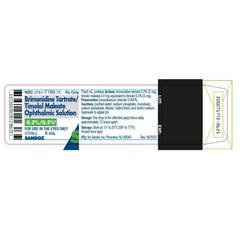
Brimonidine Tartrate And Timolol Maleate Ophthalmic Solution
11 DESCRIPTION Brimonidine tartrate/Timolol maleate ophthalmic solution 0.2%/0.5%, sterile, contains brimonidine tartrate, a relatively selective alpha -2 adrenergic receptor agonist, and timolol maleate, a non-selective beta-adrenergic receptor inhibitor (topical intraocular pressure lowering agent) for topical ophthalmic use. The structural formulae are: Brimonidine tartrate: 5-bromo-6-(2-imidazolidinylideneamino) quinoxaline L-tartrate; MW= 442.24 Timolol maleate: (-)-1-(tert-butylamino)-3-[(4-morpholino-1,2,5-thiadiazol-3-yl)-oxy]-2-propanol maleate (1:1) (salt); MW=432.50 as the maleate salt In solution, brimonidine tartrate/timolol maleate ophthalmic solution 0.2%/0.5% has a clear, greenish-yellow color. It has an osmolality of 260 to 330 mOsmol/kg and a pH during its shelf life of 6.5 to 7.3. Brimonidine tartrate appears as pale yellow colored powder to wheatish colored powder and is soluble in water, practically insoluble in anhydrous ethanol and in toluene. Timolol maleate appears as a white or almost white, crystalline powder or colorless crystals and is soluble in water, ethanol (96%) and in methanol, sparingly soluble in chloroform and in propylene glycol, insoluble in
Information page. Not necessarily available for purchase.
What is Brimonidine Tartrate And Timolol Maleate Ophthalmic Solution?
11 DESCRIPTION Brimonidine tartrate/Timolol maleate ophthalmic solution 0.2%/0.5%, sterile, contains brimonidine tartrate, a relatively selective alpha -2 adrenergic receptor agonist, and timolol maleate, a non-selective beta-adrenergic receptor inhibitor (topical intraocular pressure lowering agent) for topical ophthalmic use. The structural formulae are: Brimonidine tartrate: 5-bromo-6-(2-imidazolidinylideneamino) quinoxaline L-tartrate; MW= 442.24 Timolol maleate: (-)-1-(tert-butylamino)-3-[(4-morpholino-1,2,5-thiadiazol-3-yl)-oxy]-2-propanol maleate (1:1) (salt); MW=432.50 as the maleate salt In solution, brimonidine tartrate/timolol maleate ophthalmic solution 0.2%/0.5% has a clear, greenish-yellow color. It has an osmolality of 260 to 330 mOsmol/kg and a pH during its shelf life of 6.5 to 7.3. Brimonidine tartrate appears as pale yellow colored powder to wheatish colored powder and is soluble in water, practically insoluble in anhydrous ethanol and in toluene. Timolol maleate appears as a white or almost white, crystalline powder or colorless crystals and is soluble in water, ethanol (96%) and in methanol, sparingly soluble in chloroform and in propylene glycol, insoluble in
Uses of Brimonidine Tartrate And Timolol Maleate Ophthalmic Solution
Established uses
- 1 INDICATIONS AND USAGE Brimonidine Tartrate/Timolol Maleate Ophthalmic Solution, 0.2%/0.5% is indicated for the reduction of elevated intraocular pressure (IOP) in patients with glaucoma or ocular hypertension who require adjunctive or replacement therapy due to inadequately controlled IOP.
- The IOP-lowering of brimonidine tartrate/timolol maleate ophthalmic solution dosed twice a day was slightly less than that seen with the concomitant administration of 0.5% timolol maleate ophthalmic solution dosed twice a day and 0.2% brimonidine tartrate ophthalmic solution dosed three times per day.
- Brimonidine Tartrate/Timolol Maleate Ophthalmic Solution is a combination of brimonidine tartrate, an alpha-adrenergic receptor agonist, and timolol maleate, a beta-adrenergic receptor inhibitor indicated for the reduction of elevated intraocular pressure (IOP) in patients with glaucoma or ocular hypertension who require adjunctive or replacement therapy due to inadequately controlled IOP.
- The IOP-lowering of brimonidine tartrate/timolol maleate ophthalmic solution dosed twice a day was slightly less than that seen with the concomitant administration of timolol maleate ophthalmic solution, 0.5% do
How Brimonidine Tartrate And Timolol Maleate Ophthalmic Solution works
In more detail: 12.1 Mechanism of Action Brimonidine tartrate/timolol maleate ophthalmic solution is comprised of two components: brimonidine tartrate and timolol. Each of these two components decreases elevated intraocular pressure, whether or not associated with glaucoma. Elevated intraocular pressure is a major risk factor in the pathogenesis of optic nerve damage and glaucomatous visual field loss. The higher the level of intraocular pressure, the greater the likelihood of glaucomatous field loss and optic nerve damage. Brimonidine tartrate/timolol maleate ophthalmic solution is a relatively selective alpha-2 adrenergic receptor agonist with a non-selective beta-adrenergic receptor inhibitor. Both brimonidine and timolol have a rapid onset of action, with peak ocular hypotensive effect seen at two hours post-dosing for brimonidine and one to two hours for timolol. Fluorophotometric studies in animals and humans suggest that brimonidine tartrate has a dual mechanism of action by reducing aqueous humor production and increasing uveoscleral outflow. Timolol maleate is a beta 1 and beta 2 adrenergic receptor inhibitor that does not have significant intrinsic sympathomimetic, direct myocardial depr
How to take Brimonidine Tartrate And Timolol Maleate Ophthalmic Solution
2 DOSAGE AND ADMINISTRATION The recommended dosage is one drop in the affected eye(s) twice daily approximately 12 hours apart. If more than one topical ophthalmic product is to be used, the different products should be instilled at least 5 minutes apart. One drop in the affected eye(s), twice daily approximately 12 hours apart.
Dosage
Follow the dose prescribed by your doctor or pharmacist. The ranges below are general information, not a personal prescription.
- Adults
- 2 DOSAGE AND ADMINISTRATION The recommended dosage is one drop in the affected eye(s) twice daily approximately 12 hours apart. If more than one topical ophthalmic product is to be used, the different products should be instilled at least 5 minutes apart. One drop in the affected eye(s), twice daily approximately 12 hours apart.
Side effects of Brimonidine Tartrate And Timolol Maleate Ophthalmic Solution
Common
- 6 ADVERSE REACTIONS The following serious adverse reactions are described elsewhere in the labeling: Hypersensitivity Reactions [see Contraindications ( 4.4 )] Potential for Severe Respiratory or Cardiac Reactions [see Warnings and Precautions ( 5.1 )] Cardiac Failure [see Warnings and Precautions ( 5.2 )] Potentiation of Vascular Insufficiency [see Warnings and Precautions ( 5.4 )] Increased Reactivity to Allergens [see Warnings and Precautions ( 5.5 )] Potentiation of Muscle Weakness [see Warnings and Precautions ( 5.6 )] Masking of Hypoglycemic Symptoms in Patients with Diabetes Mellitus [see Warnings and Precautions ( 5.7 )] Masking of Thyrotoxicosis [see Warnings and Precautions ( 5.8 )] Ocular Hypersensitivity [see Warnings and Precautions ( 5.9 )] Contamination of Topical Ophthalmic Products after Use [see Warnings and Precautions ( 5.10 )] Impairment of Beta-adrenergically Mediated Reflexes During Surgery [see Warnings and Precautions ( 5.11 )] Most common adverse reactions occurring in approximately 5% to 15% of patients included allergic conjunctivitis, conjunctival folliculosis, conjunctival hyperemia, eye pruritus, ocular burning, and stinging.
- ( 6.1 ) To report SUSPECT
Warnings and who should not take it
Who should NOT take Brimonidine Tartrate And Timolol Maleate Ophthalmic Solution?
- 4 CONTRAINDICATIONS Bronchial asthma, a history of bronchial asthma, severe chronic obstructive pulmonary disease.
- ( 4.1 , 5.1 , 5.3 ) Sinus bradycardia, atrioventricular block, overt cardiac failure, cardiogenic shock.
- ( 4.2 , 5.2 ) Neonates and infants (pediatric patients younger than 2 years old).
- ( 4.3 ) Hypersensitivity to any component of this product.
- ( 4.4 ) 4.1 Reactive Airway Disease Including Asthma, COPD Brimonidine tartrate/timolol maleate ophthalmic solution is contraindicated in patients with reactive airway disease including bronchial asthma;
- a history of bronchial asthma;
Overdose
10 OVERDOSAGE There have been reports of inadvertent overdosage with timolol ophthalmic solution resulting in systemic effects similar to those seen with systemic beta-adrenergic blocking agents such as dizziness, headache, shortness of breath, bradycardia, bronchospasm, and cardiac arrest. With the exception of hypotension, very limited information exists on accidental ingestion of brimonidine in adults. Symptoms of brimonidine overdose have been reported in neonates, infants, and children receiving brimonidine ophthalmic solutions as part of medical treatment of congenital glaucoma or by accidental oral ingestion [see Use in Specific Populations ( 8.4 )] . Treatment of an oral overdose includes supportive and symptomatic therapy; a patent airway should be maintained.
Safety at a glance
8.1 Pregnancy Risk Summary There are no adequate and well-controlled studies with brimonidine tartrate/timolol maleate ophthalmic solution in pregnant women. Limited available data from postmarketing safety reports and published literature reviews with brimonidine tartrate/timolol maleate ophthalmic solution use in pregnant women are insufficient to establish a drug-associated risk of major birth defects, miscarriage or other adverse maternal or fetal outcomes (see Data) . In animal studies, brimonidine crossed the placenta and entered into the fetal circulation to a limited extent. Oral administration of brimonidine tartrate or timolol maleate to pregnant rats and rabbits during organogenesis at dose exposures 580 and 37 times the recommended human ophthalmic dose (RHOD) resulted in no adverse developmental effects (see Data) . Oral administration of timolol maleate to mice, rats, and rabbits during organogenesis at dose exposures up to 4,200 times the RHOD resulted in no evidence of fetal malformations (see Data) . The estimated background risk of major birth defects and miscarriage for the indicated population(s) is unknown. All pregnancies have a background risk of birth defect
Children and elderly
Children
8.4 Pediatric Use Brimonidine tartrate/timolol maleate ophthalmic solution is contraindicated in pediatric patients younger than 2 years old [see Contraindications ( 4.3 )] . During post-marketing surveillance, apnea, bradycardia, coma, hypotension, hypothermia, hypotonia, lethargy, pallor, respiratory depression, and somnolence have been reported in infants receiving brimonidine. The safety and effectiveness of brimonidine tartrate/timolol maleate ophthalmic solution for the reduction of elevated intraocular pressure (IOP) in patients with glaucoma or ocular hypertension who require adjunctive or replacement therapy due to inadequately controlled IOP have been established in pediatric patients aged 2 years and older. Use of brimonidine tartrate/timolol maleate ophthalmic solution for this indication is supported by evidence from adequate and well-controlled studies of brimonidine tartrate/timolol maleate ophthalmic solution in adults with additional data from a study of the concomitant use of brimonidine tartrate ophthalmic solution 0.2% and timolol maleate ophthalmic solution in pediatric glaucoma patients (ages 2 to 7 years). In this well-controlled clinical study, brimonidine t
Elderly
8.5 Geriatric Use No overall differences in safety or effectiveness have been observed between elderly and other adult patients.
Interactions
Medicine and medicine
- 7 DRUG INTERACTIONS Antihypertensives/cardiac glycosides may lower blood pressure.
- ( 7.1 ) Concomitant use with systemic beta-blockers may potentiate systemic beta-blockade.
- ( 7.2 ) Oral or intravenous calcium antagonists may cause atrioventricular conduction disturbances, left ventricular failure, and hypotension.
- ( 7.3 ) Catecholamine-depleting drugs may have additive effects and produce hypotension and/or marked bradycardia.
- ( 7.4 ) Use with CNS depressants may result in an additive or potentiating effect.
- ( 7.5 ) Digitalis and calcium antagonists may have additive effects in prolonging atrioventricular conduction time.
Frequently asked questions
What is Brimonidine Tartrate And Timolol Maleate Ophthalmic Solution used for?
1 INDICATIONS AND USAGE Brimonidine Tartrate/Timolol Maleate Ophthalmic Solution, 0.2%/0.5% is indicated for the reduction of elevated intraocular pressure (IOP) in patients with glaucoma or ocular hypertension who require adjunctive or replacement therapy due to inadequately controlled IOP., The IOP-lowering of brimonidine tartrate/timolol maleate ophthalmic solution dosed twice a day was slightly less than that seen with the concomitant administration of 0.5% timolol maleate ophthalmic solution dosed twice a day and 0.2% brimonidine tartrate ophthalmic solution dosed three times per day., Brimonidine Tartrate/Timolol Maleate Ophthalmic Solution is a combination of brimonidine tartrate, an alpha-adrenergic receptor agonist, and timolol maleate, a beta-adrenergic receptor inhibitor indicated for the reduction of elevated intraocular pressure (IOP) in patients with glaucoma or ocular hypertension who require adjunctive or replacement therapy due to inadequately controlled IOP., The IOP-lowering of brimonidine tartrate/timolol maleate ophthalmic solution dosed twice a day was slightly less than that seen with the concomitant administration of timolol maleate ophthalmic solution, 0.5% do.
How should I take Brimonidine Tartrate And Timolol Maleate Ophthalmic Solution?
2 DOSAGE AND ADMINISTRATION The recommended dosage is one drop in the affected eye(s) twice daily approximately 12 hours apart. If more than one topical ophthalmic product is to be used, the different products should be instilled at least 5 minutes apart. One drop in the affected eye(s), twice daily approximately 12 hours apart.
What are the common side effects?
6 ADVERSE REACTIONS The following serious adverse reactions are described elsewhere in the labeling: Hypersensitivity Reactions [see Contraindications ( 4.4 )] Potential for Severe Respiratory or Cardiac Reactions [see Warnings and Precautions ( 5.1 )] Cardiac Failure [see Warnings and Precautions ( 5.2 )] Potentiation of Vascular Insufficiency [see Warnings and Precautions ( 5.4 )] Increased Reactivity to Allergens [see Warnings and Precautions ( 5.5 )] Potentiation of Muscle Weakness [see Warnings and Precautions ( 5.6 )] Masking of Hypoglycemic Symptoms in Patients with Diabetes Mellitus [see Warnings and Precautions ( 5.7 )] Masking of Thyrotoxicosis [see Warnings and Precautions ( 5.8 )] Ocular Hypersensitivity [see Warnings and Precautions ( 5.9 )] Contamination of Topical Ophthalmic Products after Use [see Warnings and Precautions ( 5.10 )] Impairment of Beta-adrenergically Mediated Reflexes During Surgery [see Warnings and Precautions ( 5.11 )] Most common adverse reactions occurring in approximately 5% to 15% of patients included allergic conjunctivitis, conjunctival folliculosis, conjunctival hyperemia, eye pruritus, ocular burning, and stinging., ( 6.1 ) To report SUSPECT.
Who should not take Brimonidine Tartrate And Timolol Maleate Ophthalmic Solution?
4 CONTRAINDICATIONS Bronchial asthma, a history of bronchial asthma, severe chronic obstructive pulmonary disease.; ( 4.1 , 5.1 , 5.3 ) Sinus bradycardia, atrioventricular block, overt cardiac failure, cardiogenic shock.; ( 4.2 , 5.2 ) Neonates and infants (pediatric patients younger than 2 years old).; ( 4.3 ) Hypersensitivity to any component of this product.; ( 4.4 ) 4.1 Reactive Airway Disease Including Asthma, COPD Brimonidine tartrate/timolol maleate ophthalmic solution is contraindicated in patients with reactive airway disease including bronchial asthma;; a history of bronchial asthma;.
Can I take Brimonidine Tartrate And Timolol Maleate Ophthalmic Solution during pregnancy?
8.1 Pregnancy Risk Summary There are no adequate and well-controlled studies with brimonidine tartrate/timolol maleate ophthalmic solution in pregnant women. Limited available data from postmarketing safety reports and published literature reviews with brimonidine tartrate/timolol maleate ophthalmic solution use in pregnant women are insufficient to establish a drug-associated risk of major birth defects, miscarriage or other adverse maternal or fetal outcomes (see Data) . In animal studies, brimonidine crossed the placenta and entered into the fetal circulation to a limited extent. Oral administration of brimonidine tartrate or timolol maleate to pregnant rats and rabbits during organogenesis at dose exposures 580 and 37 times the recommended human ophthalmic dose (RHOD) resulted in no adverse developmental effects (see Data) . Oral administration of timolol maleate to mice, rats, and rabbits during organogenesis at dose exposures up to 4,200 times the RHOD resulted in no evidence of fetal malformations (see Data) . The estimated background risk of major birth defects and miscarriage for the indicated population(s) is unknown. All pregnancies have a background risk of birth defect
Can children take Brimonidine Tartrate And Timolol Maleate Ophthalmic Solution?
8.4 Pediatric Use Brimonidine tartrate/timolol maleate ophthalmic solution is contraindicated in pediatric patients younger than 2 years old [see Contraindications ( 4.3 )] . During post-marketing surveillance, apnea, bradycardia, coma, hypotension, hypothermia, hypotonia, lethargy, pallor, respiratory depression, and somnolence have been reported in infants receiving brimonidine. The safety and effectiveness of brimonidine tartrate/timolol maleate ophthalmic solution for the reduction of elevated intraocular pressure (IOP) in patients with glaucoma or ocular hypertension who require adjunctive or replacement therapy due to inadequately controlled IOP have been established in pediatric patients aged 2 years and older. Use of brimonidine tartrate/timolol maleate ophthalmic solution for this indication is supported by evidence from adequate and well-controlled studies of brimonidine tartrate/timolol maleate ophthalmic solution in adults with additional data from a study of the concomitant use of brimonidine tartrate ophthalmic solution 0.2% and timolol maleate ophthalmic solution in pediatric glaucoma patients (ages 2 to 7 years). In this well-controlled clinical study, brimonidine t
Does Brimonidine Tartrate And Timolol Maleate Ophthalmic Solution interact with other medicines?
7 DRUG INTERACTIONS Antihypertensives/cardiac glycosides may lower blood pressure.; ( 7.1 ) Concomitant use with systemic beta-blockers may potentiate systemic beta-blockade.; ( 7.2 ) Oral or intravenous calcium antagonists may cause atrioventricular conduction disturbances, left ventricular failure, and hypotension.; ( 7.3 ) Catecholamine-depleting drugs may have additive effects and produce hypotension and/or marked bradycardia.; ( 7.4 ) Use with CNS depressants may result in an additive or potentiating effect.; ( 7.5 ) Digitalis and calcium antagonists may have additive effects in prolonging atrioventricular conduction time..
Medicine information on IMCURE is provided for educational purposes and is not a substitute for diagnosis, prescription or medical advice. Always follow your doctor’s or pharmacist’s instructions. Real product image from the U.S. National Library of Medicine's DailyMed listing for Brimonidine Tartrate And Timolol Maleate Solution/ Drops. Packaging varies by brand and manufacturer.