
Cardioplegic
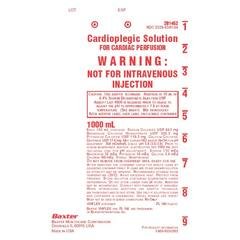
DESCRIPTION Baxter Cardioplegic Solution is a sterile, nonpyrogenic, essentially isotonic, formulation of electrolytes in Water for Injection, USP. It is a “core solution” intended for use only after addition of sodium bicarbonate to adjust pH prior to administration. After buffering with sodium bicarbonate it is suitable for cardiac instillation (usually with hypothermia) to induce arrest during open heart surgery. Other agents may be added to the solution prior to instillation (See INSTRUCTIONS FOR USE ). Each 100 mL of solution contains Calcium Chloride Dihydrate USP 17.6 mg, Magnesium Chloride, Hexahydrate USP 325.3 mg, Potassium Chloride USP 119.3 mg and Sodium Chloride USP 643 mg in Water for Injection, USP. May contain HCl and/or NaOH for pH adjustment. Electrolyte content per liter (not including ions for pH adjustment): Calcium (Ca ++ ) 2.4 mEq; Magnesium (Mg ++ ) 32 mEq; Potassium (K + ) 16 mEq; Sodium (Na + ) 110 mEq; Chloride (Cl - ) 160 mEq. Osmolar concentration, 304 mOsmol/liter (calc.); pH 3.8 (3.5 to 3.9) prior to sodium bicarbonate addition. It is required that 10 mL (840 mg) of 8.4% Sodium Bicarbonate Injection, USP (10 mEq each of sodium and bicarbonate) be adde
Information page. Not necessarily available for purchase.
What is Cardioplegic?
DESCRIPTION Baxter Cardioplegic Solution is a sterile, nonpyrogenic, essentially isotonic, formulation of electrolytes in Water for Injection, USP. It is a “core solution” intended for use only after addition of sodium bicarbonate to adjust pH prior to administration. After buffering with sodium bicarbonate it is suitable for cardiac instillation (usually with hypothermia) to induce arrest during open heart surgery. Other agents may be added to the solution prior to instillation (See INSTRUCTIONS FOR USE ). Each 100 mL of solution contains Calcium Chloride Dihydrate USP 17.6 mg, Magnesium Chloride, Hexahydrate USP 325.3 mg, Potassium Chloride USP 119.3 mg and Sodium Chloride USP 643 mg in Water for Injection, USP. May contain HCl and/or NaOH for pH adjustment. Electrolyte content per liter (not including ions for pH adjustment): Calcium (Ca ++ ) 2.4 mEq; Magnesium (Mg ++ ) 32 mEq; Potassium (K + ) 16 mEq; Sodium (Na + ) 110 mEq; Chloride (Cl - ) 160 mEq. Osmolar concentration, 304 mOsmol/liter (calc.); pH 3.8 (3.5 to 3.9) prior to sodium bicarbonate addition. It is required that 10 mL (840 mg) of 8.4% Sodium Bicarbonate Injection, USP (10 mEq each of sodium and bicarbonate) be adde
Uses of Cardioplegic
Established uses
- INDICATIONS AND USAGE Baxter Cardioplegic Solution when suitably buffered in combination with ischemia and hypothermia is used to induce cardiac arrest during open heart surgery.
How to take Cardioplegic
DOSAGE AND ADMINISTRATION The following information is suggested as a guide and is subject to variation according to the preference and experience of the surgeon. It is required that 10 mL (840 mg) of 8.4% Sodium Bicarbonate Injection, USP (10 mEq each of sodium and bicarbonate) be added aseptically and thoroughly mixed with each 1000 mL of cardioplegic solution to adjust pH. Use 10 mL of Hospira 1 List 4900, 8.4% Sodium Bicarbonate Injection, USP, to achieve the approximate pH of 7.8 when measured at room temperature. Use of any other Sodium Bicarbonate Injection may not achieve this pH due to the varying pH’s of Sodium Bicarbonate Injections. Due to its inherent instability with other components, sodium bicarbonate must be added just prior to administration. After this addition, the solution must be used within 24 hours. The solution should be cooled to 4°C prior to use. Following institution of cardiopulmonary bypass at perfusate temperatures of 28° to 30°C, and after cross-clamping of the ascending aorta, the buffered solution is administered by rapid infusion into the aortic root. The initial rate of infusion may be 300 mL/m 2 /minute (about 540 mL/min in a 5’ 8”, 70 kg adult
Dosage
Follow the dose prescribed by your doctor or pharmacist. The ranges below are general information, not a personal prescription.
- Adults
- DOSAGE AND ADMINISTRATION The following information is suggested as a guide and is subject to variation according to the preference and experience of the surgeon. It is required that 10 mL (840 mg) of 8.4% Sodium Bicarbonate Injection, USP (10 mEq each of sodium and bicarbonate) be added aseptically and thoroughly mixed with each 1000 mL of cardioplegic solution to adjust pH. Use 10 mL of Hospira 1 List 4900, 8.4% Sodium Bicarbonate Injection, USP, to achieve the approximate pH of 7.8 when measured at room temperature. Use of any other Sodium Bicarbonate Injection may not achieve this pH due to the varying pH’s of Sodium Bicarbonate Injections. Due to its inherent instability with other components, sodium bicarbonate must be added just prior to administration. After this addition, the solution must be used within 24 hours. The solution should be cooled to 4°C prior to use. Following institution of cardiopulmonary bypass at perfusate temperatures of 28° to 30°C, and after cross-clamping of the ascending aorta, the buffered solution is administered by rapid infusion into the aortic root. The initial rate of infusion may be 300 mL/m 2 /minute (about 540 mL/min in a 5’ 8”, 70 kg adult
Side effects of Cardioplegic
Common
- ADVERSE REACTIONS Intraoperative and perioperative potential hazards of open heart surgery include myocardial infarction, electrocardiographic abnormalities, and arrhythmias, including ventricular fibrillation.
- Spontaneous recovery after cardioplegic cardiac arrest may be delayed or absent when circulation is restored.
- Defibrillation by electric shock may be required to restore normal cardiac function.
Warnings and who should not take it
Who should NOT take Cardioplegic?
- CONTRAINDICATIONS Baxter Cardioplegic Solution must not be administered without the addition of 8.4% Sodium Bicarbonate Injection, USP, Hospira 1 List 4900.
- NOT FOR INTRAVENOUS INJECTION.
- This solution is only for instillation into cardiac vasculature after buffering with sodium bicarbonate.
Warnings and precautions
- WARNINGS This solution should be used only by those trained to perform open heart surgery.
- This solution is intended only for use during cardiopulmonary bypass when the coronary circulation is isolated from the systemic circulation (See INDICATIONS AND USAGE ).
- Do not instill the solution into the coronary vasculature unless sodium bicarbonate has been added.
- If large volumes of cardioplegic solution are infused and allowed to return to the heart lung machine without any venting from the right heart, then plasma magnesium and potassium levels may rise.
- Development of severe hypotension and metabolic acidosis while on bypass has been reported when large volumes (8 to 10 liters) of solution are instilled and allowed to enter the pump and then the systemic circulation.
- Right heart venting is therefore recommended.
Overdose
OVERDOSAGE Overzealous instillation of the solution may result in unnecessary dilatation of the myocardial vasculature and leakage into the perivascular myocardium, possibly causing tissue edema (See WARNINGS , PRECAUTIONS , and ADVERSE REACTIONS ).
Children and elderly
Children
Pediatric Use Safety and effectiveness in pediatric patients have not been established. Because of differences in structure, function, and metabolism, clinical myocardial protection strategies and Cardioplegia solutions that are effective in adult hearts may be less effective in the immature heart.
Elderly
Geriatric Use Clinical studies of cardioplegic solution did not include sufficient numbers of subjects aged 65 and over to determine whether they responded differently from younger subjects. Other reported clinical experience has not identified differences in responses between older and younger patients. In general, dose selection for an elderly patient should be cautious, usually starting at the low end of the dosage range reflecting the greater frequency of decreased hepatic, renal, or cardiac function, and of concomitant disease. This product is unique in that there is no hepatic or renal excretion and specific adjustments for dosing in the elderly are not known.
Interactions
Medicine and medicine
- Drug Interactions Additives may be incompatible.
- Consult with pharmacist, if available.
- When introducing additives, use aseptic technique, mix thoroughly and do not store (See INSTRUCTIONS FOR USE ).
- Pregnancy: Animal reproduction studies have not been conducted with Cardioplegic Solution.
- It is also not known whether this solution can cause fetal harm when administered to a pregnant woman or can affect reproduction capacity.
- Cardioplegic Solution should be given to a pregnant woman only if clearly needed.
Frequently asked questions
What is Cardioplegic used for?
INDICATIONS AND USAGE Baxter Cardioplegic Solution when suitably buffered in combination with ischemia and hypothermia is used to induce cardiac arrest during open heart surgery..
How should I take Cardioplegic?
DOSAGE AND ADMINISTRATION The following information is suggested as a guide and is subject to variation according to the preference and experience of the surgeon. It is required that 10 mL (840 mg) of 8.4% Sodium Bicarbonate Injection, USP (10 mEq each of sodium and bicarbonate) be added aseptically and thoroughly mixed with each 1000 mL of cardioplegic solution to adjust pH. Use 10 mL of Hospira 1 List 4900, 8.4% Sodium Bicarbonate Injection, USP, to achieve the approximate pH of 7.8 when measured at room temperature. Use of any other Sodium Bicarbonate Injection may not achieve this pH due to the varying pH’s of Sodium Bicarbonate Injections. Due to its inherent instability with other components, sodium bicarbonate must be added just prior to administration. After this addition, the solution must be used within 24 hours. The solution should be cooled to 4°C prior to use. Following institution of cardiopulmonary bypass at perfusate temperatures of 28° to 30°C, and after cross-clamping of the ascending aorta, the buffered solution is administered by rapid infusion into the aortic root. The initial rate of infusion may be 300 mL/m 2 /minute (about 540 mL/min in a 5’ 8”, 70 kg adult
What are the common side effects?
ADVERSE REACTIONS Intraoperative and perioperative potential hazards of open heart surgery include myocardial infarction, electrocardiographic abnormalities, and arrhythmias, including ventricular fibrillation., Spontaneous recovery after cardioplegic cardiac arrest may be delayed or absent when circulation is restored., Defibrillation by electric shock may be required to restore normal cardiac function..
Who should not take Cardioplegic?
CONTRAINDICATIONS Baxter Cardioplegic Solution must not be administered without the addition of 8.4% Sodium Bicarbonate Injection, USP, Hospira 1 List 4900.; NOT FOR INTRAVENOUS INJECTION.; This solution is only for instillation into cardiac vasculature after buffering with sodium bicarbonate..
Can children take Cardioplegic?
Pediatric Use Safety and effectiveness in pediatric patients have not been established. Because of differences in structure, function, and metabolism, clinical myocardial protection strategies and Cardioplegia solutions that are effective in adult hearts may be less effective in the immature heart.
Does Cardioplegic interact with other medicines?
Drug Interactions Additives may be incompatible.; Consult with pharmacist, if available.; When introducing additives, use aseptic technique, mix thoroughly and do not store (See INSTRUCTIONS FOR USE ).; Pregnancy: Animal reproduction studies have not been conducted with Cardioplegic Solution.; It is also not known whether this solution can cause fetal harm when administered to a pregnant woman or can affect reproduction capacity.; Cardioplegic Solution should be given to a pregnant woman only if clearly needed..
Medicine information on IMCURE is provided for educational purposes and is not a substitute for diagnosis, prescription or medical advice. Always follow your doctor’s or pharmacist’s instructions. Real product image from the U.S. National Library of Medicine's DailyMed listing for Cardioplegic (Calcium Chloride, Magnesium Chloride, Potassium Chloride And Sodium Chloride. Packaging varies by brand and manufacturer.