
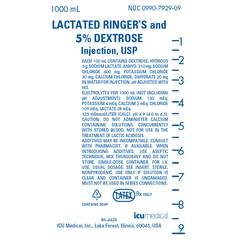
Potassium Chloride In Lactated Ringers And Dextrose
11 DESCRIPTION Potassium Chloride in Lactated Ringer’s and Dextrose (5%) Injection, USP is a sterile, nonpyrogenic solution for fluid and electrolyte replenishment and caloric supply in a single dose container for intravenous administration. It contains no antimicrobial agents. Composition, osmolarity, pH, ionic concentration and caloric content are shown in Table 1 . Dextrose is derived from corn. Table 1 Potassium Chloride in Lactated Ringer’s and Dextrose (5%) Injection, USP Size (mL) Composition (g/L) Normal physiologic osmolarity range is approximately 280 to 310 mOsmol/L. Osmolarity (mOsmol/L) (calc) pH Ionic Concentration (mEq/L) Caloric Content (kcal/L) Dextrose, USP Sodium Chloride, USP Sodium Lactate Potassium Chloride, USP Calcium Chloride, USP Sodium Potassium Calcium Chloride Lactate 20 mEq Potassium added 1000 50 6 3.1 1.79 0.2 565 5.0 (3.5 to 6.5) 130 24 3 129 28 170 The chemical name, structural formula, and molecular weight of the active ingredients are shown in Table 2 . Table 2 Chemical Name Structural Formula Molecular Weight Sodium Chloride, USP 58.44 Sodium Lactate 112.06 Potassium Chloride, USP 74.55 Calcium Chloride, USP 147.02 Dextrose, USP 198.17 The VIAFL
Information page. Not necessarily available for purchase.
What is Potassium Chloride In Lactated Ringers And Dextrose?
11 DESCRIPTION Potassium Chloride in Lactated Ringer’s and Dextrose (5%) Injection, USP is a sterile, nonpyrogenic solution for fluid and electrolyte replenishment and caloric supply in a single dose container for intravenous administration. It contains no antimicrobial agents. Composition, osmolarity, pH, ionic concentration and caloric content are shown in Table 1 . Dextrose is derived from corn. Table 1 Potassium Chloride in Lactated Ringer’s and Dextrose (5%) Injection, USP Size (mL) Composition (g/L) Normal physiologic osmolarity range is approximately 280 to 310 mOsmol/L. Osmolarity (mOsmol/L) (calc) pH Ionic Concentration (mEq/L) Caloric Content (kcal/L) Dextrose, USP Sodium Chloride, USP Sodium Lactate Potassium Chloride, USP Calcium Chloride, USP Sodium Potassium Calcium Chloride Lactate 20 mEq Potassium added 1000 50 6 3.1 1.79 0.2 565 5.0 (3.5 to 6.5) 130 24 3 129 28 170 The chemical name, structural formula, and molecular weight of the active ingredients are shown in Table 2 . Table 2 Chemical Name Structural Formula Molecular Weight Sodium Chloride, USP 58.44 Sodium Lactate 112.06 Potassium Chloride, USP 74.55 Calcium Chloride, USP 147.02 Dextrose, USP 198.17 The VIAFL
Uses of Potassium Chloride In Lactated Ringers And Dextrose
Established uses
- 1 INDICATIONS AND USAGE Potassium Chloride in Lactated Ringer’s and Dextrose (5%) Injection is indicated for use as a source of water, electrolytes, and calories or as an alkalinizing agent in adults and pediatric patients.
- Potassium Chloride in Lactated Ringer’s and Dextrose (5%) Injection is indicated for use as a source of water, electrolytes, and calories or as an alkalinizing agent in adults and pediatric patients.
- ( 1 )
How Potassium Chloride In Lactated Ringers And Dextrose works
In more detail: 12.1 Mechanism of Action Potassium Chloride in Lactated Ringer’s and Dextrose (5%) Injection is a source of water, electrolytes, and calories, and produces an alkalinizing effect. • Sodium, the major cation of the extracellular fluid, functions primarily in the control of water distribution, fluid balance, and osmotic pressure of body fluids. Sodium is also associated with chloride and bicarbonate in the regulation of the acid-base equilibrium of body fluid. • Potassium, the principal cation of intracellular fluid, participates in carbohydrate utilization and protein synthesis and is critical in the regulation of nerve conduction and muscle contraction, particularly in the heart. • Chloride, the major extracellular anion, closely follows the metabolism of sodium, and changes in the acid-base balance of the body are reflected by changes in the chloride concentration. • Calcium, an important cation, provides the framework of bones and teeth in the form of calcium phosphate and calcium carbonate. In the ionized form, calcium is essential for the functional mechanism of the clotting of blood, normal cardiac function, and regulation of neuromuscular irritability. • Sodium lactate provid
How to take Potassium Chloride In Lactated Ringers And Dextrose
2 DOSAGE AND ADMINISTRATION • The recommended dosage and duration are based on the patient’s age, weight, clinical condition, and concomitant therapy. ( 2.1 ) • To reduce the risk of air embolism, adhere to the preparation instructions. ( 2.2 , 5.2 ) • Potassium Chloride in Lactated Ringer’s and Dextrose (5%) Injection is for intravenous use. ( 2.3 ) • Use a peripheral vein to administer if the final dextrose concentration is 5% or less, and the osmolarity is less than 900 mOsm/L. ( 2.3 ). • Consider using a central vein to administer hypertonic solutions with osmolarity of 900 mOsm/L or more to avoid venous irritation, including phlebitis. ( 2.3 ) • Do not administer Potassium Chloride in Lactated Ringer’s and Dextrose (5%) Injection simultaneously with ceftriaxone in neonates (28 days of age or younger) due to serious risks. ( 2.4 ) • See full prescribing information for information dosage considerations, preparation, administration, and drug incompatibilities. ( 2 ) 2.1 Dosage Considerations The recommended dosage and duration of Potassium Chloride in Lactated Ringer’s and Dextrose (5%) Injection is based on the patient’s age, weight, clinical condition, and concomitant therapy.
Dosage
Follow the dose prescribed by your doctor or pharmacist. The ranges below are general information, not a personal prescription.
- Adults
- 2 DOSAGE AND ADMINISTRATION • The recommended dosage and duration are based on the patient’s age, weight, clinical condition, and concomitant therapy. ( 2.1 ) • To reduce the risk of air embolism, adhere to the preparation instructions. ( 2.2 , 5.2 ) • Potassium Chloride in Lactated Ringer’s and Dextrose (5%) Injection is for intravenous use. ( 2.3 ) • Use a peripheral vein to administer if the final dextrose concentration is 5% or less, and the osmolarity is less than 900 mOsm/L. ( 2.3 ). • Consider using a central vein to administer hypertonic solutions with osmolarity of 900 mOsm/L or more to avoid venous irritation, including phlebitis. ( 2.3 ) • Do not administer Potassium Chloride in Lactated Ringer’s and Dextrose (5%) Injection simultaneously with ceftriaxone in neonates (28 days of age or younger) due to serious risks. ( 2.4 ) • See full prescribing information for information dosage considerations, preparation, administration, and drug incompatibilities. ( 2 ) 2.1 Dosage Considerations The recommended dosage and duration of Potassium Chloride in Lactated Ringer’s and Dextrose (5%) Injection is based on the patient’s age, weight, clinical condition, and concomitant therapy.
Side effects of Potassium Chloride In Lactated Ringers And Dextrose
Common
- 6 ADVERSE REACTIONS The following serious adverse reactions are discussed in greater detail in other sections of the labeling: • Serious Risk with Concomitant Use with Ceftriaxone [see Warnings and Precautions (5.1) ] • Air Embolism [see Warnings and Precautions (5.2) ] • Hypersensitivity Reactions [see Warnings and Precautions (5.3) ] • Potassium Imbalances [see Warnings and Precautions (5.4) ] • Hyponatremia [see Warnings and Precautions (5.5) ] • Neonatal Hypoglycemia [see Warnings and Precautions (5.6) ] • Hyperglycemia and Hyperosmolar Hyperglycemic State [see Warnings and Precautions (5.7) ] • Hypercalcemia [see Warnings and Precautions (5.8) ] • Fluid Overload [see Warnings and Precautions (5.9) ] • Acid/Base Imbalances [see Warnings and Precautions (5.10) ] The following adverse reactions have been identified during postapproval use of Lactated Ringer’s products.
- Because these reactions are reported voluntarily from a population of uncertain size, it is not always possible to reliably estimate their frequency or establish a causal relationship to drug exposure: General Disorders and Administration Site Conditions: Phlebitis, extravasation, infusion site inflammation, infusi
Warnings and who should not take it
Who should NOT take Potassium Chloride In Lactated Ringers And Dextrose?
- 4 CONTRAINDICATIONS Potassium Chloride in Lactated Ringer’s and Dextrose (5%) Injection is contraindicated in: • Neonates (28 days of age or younger) who are receiving concomitant treatment with ceftriaxone, even if separate infusion lines are used, due to the risk of fatal ceftriaxone-calcium salt precipitation in the neonate’s bloodstream [see Warnings and Precautions (5.1) and Specific Populations (8.4) ] .
- Patients with known hypersensitivity to any of the components of Potassium Chloride in Lactated Ringer’s solution and Dextrose (5%) Injection [see Warnings and Precautions (5.3) ] .
- Patients with clinically significant hyperkalemia [see Warnings and Precautions (5.4) ] .
- Patients with clinically significant hyperglycemia [see Warnings and Precautions (5.7) ] .
- Concomitant treatment with ceftriaxone in neonates (28 days of age or younger).
- ( 4 ) • Patients with known hypersensitivity to any of the components of Potassium Chloride in Lactated Ringer’s solution and Dextrose (5%) Injection ( 4 ) • Patients with clinically significant hyperkalemia ( 4 ).
Overdose
10 OVERDOSAGE Excessive administration of Potassium Chloride in Lactated Ringer’s and Dextrose (5%) Injection can cause: • Hyperkalemia and hypernatremia, especially in patients with severe renal impairment. • Fluid overload (which can lead to pulmonary and/or peripheral edema). • Hyperglycemia, hyperosmolarity, and osmotic diuresis, dehydration, and electrolyte loss. • Metabolic alkalosis with or without hypokalemia. • Loss of bicarbonate with an acidifying effect. • Hypercalcemia. Overdose interventions include Potassium Chloride in Lactated Ringer’s and Dextrose (5%) Injection discontinuation, treatment of electrolyte imbalances, treatment of hyperglycemia, and close monitoring of fluid balance, electrolyte concentrations, and acid-base balance [see Warnings and Precautions (5.4 , 5.5 , 5.6 , 5.7 , 5.9 , 5.10 )]
Safety at a glance
8.1 Pregnancy Risk Summary Potassium Chloride in Lactated Ringer’s and Dextrose (5%) Injection as a source of water and electrolytes has been used for decades during labor and delivery. Appropriate administration of Potassium Chloride in Lactated Ringer’s and Dextrose (5%) Injection is not expected to cause major birth defects, miscarriage, or adverse maternal or fetal outcomes. Animal reproduction studies have not been conducted with this drug. The background risk of major birth defects and miscarriage for the indicated population is unknown. All pregnancies have a background risk of birth defect, loss, or other adverse outcomes. In the U.S. general population, the estimated background risk of major birth defects and miscarriage in clinically recognized pregnancies is 2 to 4% and 15 to 20%, respectively.
Children and elderly
Children
8.4 Pediatric Use Potassium Chloride in Lactated Ringer’s and Dextrose (5%) Injection is contraindicated in neonates (28 days of age or younger) who are receiving ceftriaxone due to reported deaths that occurred when neonates received ceftriaxone and intravenous calcium-containing solutions concomitantly [see Warnings and Precautions (5.1) ]. The safety and effectiveness of Lactated Ringer’s Injection for use as a source of water, electrolytes, and calories or as an alkalinizing agent have been established in pediatric patients of all ages, including neonates. The safety profile of Potassium Chloride in Dextrose Injection in pediatric patients is similar to adults. Closely monitor plasma electrolyte concentrations in young pediatric patients with immature kidney function who may have decreased ability to maintain fluid and electrolyte balance [see Warnings and Precautions (5.4 , 5.5 , 5.8 , 5.9 )]. Administration of a lactate-containing intravenous solution, including Potassium Chloride in Lactated Ringer’s and Dextrose (5%) Injection to pediatric patients should account for liver and kidney maturation (the kidney function affects the biotransformation and renal excretion of lactat
Elderly
8.5 Geriatric Use Geriatric patients treated with Potassium Chloride in Lactated Ringer’s and Dextrose (5%) Injection are at increased risk of developing electrolyte imbalances. Potassium Chloride in Lactated Ringer’s and Dextrose (5%) Injection is substantially excreted by the kidney, and the risk of adverse reactions to Potassium Chloride in Lactated Ringer’s and Dextrose (5%) Injection may be greater in patients with renal impairment than in patients with normal renal function. Because geriatric patients are more likely to have decreased renal function, consider monitoring renal function in geriatric patients and consider starting the infusion at the low end of the dosing range.
Interactions
Medicine and medicine
- 7 DRUG INTERACTIONS • Drugs that Affect Electrolyte and/or Fluid Balance : Avoid concomitant use.
- If concomitant use cannot be avoided, closely monitor electrolyte concentrations and fluid balance.
- ( 7.1 ) • Lithium : Avoid concomitant use.
- If concomitant use is unavoidable, monitor serum lithium concentrations more frequently.
- ( 7.2 ) • Digoxin : Consider reducing the volume or rate of Potassium Chloride in Lactated Ringer’s and Dextrose (5%) Injection due to the increased risk of digoxin toxicity with calcium-containing solutions.
- ( 7.3 ) • Drugs with pH-Dependent Renal Elimination : Renal clearance of acidic drugs may be increased.
Frequently asked questions
What is Potassium Chloride In Lactated Ringers And Dextrose used for?
1 INDICATIONS AND USAGE Potassium Chloride in Lactated Ringer’s and Dextrose (5%) Injection is indicated for use as a source of water, electrolytes, and calories or as an alkalinizing agent in adults and pediatric patients., Potassium Chloride in Lactated Ringer’s and Dextrose (5%) Injection is indicated for use as a source of water, electrolytes, and calories or as an alkalinizing agent in adults and pediatric patients., ( 1 ).
How should I take Potassium Chloride In Lactated Ringers And Dextrose?
2 DOSAGE AND ADMINISTRATION • The recommended dosage and duration are based on the patient’s age, weight, clinical condition, and concomitant therapy. ( 2.1 ) • To reduce the risk of air embolism, adhere to the preparation instructions. ( 2.2 , 5.2 ) • Potassium Chloride in Lactated Ringer’s and Dextrose (5%) Injection is for intravenous use. ( 2.3 ) • Use a peripheral vein to administer if the final dextrose concentration is 5% or less, and the osmolarity is less than 900 mOsm/L. ( 2.3 ). • Consider using a central vein to administer hypertonic solutions with osmolarity of 900 mOsm/L or more to avoid venous irritation, including phlebitis. ( 2.3 ) • Do not administer Potassium Chloride in Lactated Ringer’s and Dextrose (5%) Injection simultaneously with ceftriaxone in neonates (28 days of age or younger) due to serious risks. ( 2.4 ) • See full prescribing information for information dosage considerations, preparation, administration, and drug incompatibilities. ( 2 ) 2.1 Dosage Considerations The recommended dosage and duration of Potassium Chloride in Lactated Ringer’s and Dextrose (5%) Injection is based on the patient’s age, weight, clinical condition, and concomitant therapy.
What are the common side effects?
6 ADVERSE REACTIONS The following serious adverse reactions are discussed in greater detail in other sections of the labeling: • Serious Risk with Concomitant Use with Ceftriaxone [see Warnings and Precautions (5.1) ] • Air Embolism [see Warnings and Precautions (5.2) ] • Hypersensitivity Reactions [see Warnings and Precautions (5.3) ] • Potassium Imbalances [see Warnings and Precautions (5.4) ] • Hyponatremia [see Warnings and Precautions (5.5) ] • Neonatal Hypoglycemia [see Warnings and Precautions (5.6) ] • Hyperglycemia and Hyperosmolar Hyperglycemic State [see Warnings and Precautions (5.7) ] • Hypercalcemia [see Warnings and Precautions (5.8) ] • Fluid Overload [see Warnings and Precautions (5.9) ] • Acid/Base Imbalances [see Warnings and Precautions (5.10) ] The following adverse reactions have been identified during postapproval use of Lactated Ringer’s products., Because these reactions are reported voluntarily from a population of uncertain size, it is not always possible to reliably estimate their frequency or establish a causal relationship to drug exposure: General Disorders and Administration Site Conditions: Phlebitis, extravasation, infusion site inflammation, infusi.
Who should not take Potassium Chloride In Lactated Ringers And Dextrose?
4 CONTRAINDICATIONS Potassium Chloride in Lactated Ringer’s and Dextrose (5%) Injection is contraindicated in: • Neonates (28 days of age or younger) who are receiving concomitant treatment with ceftriaxone, even if separate infusion lines are used, due to the risk of fatal ceftriaxone-calcium salt precipitation in the neonate’s bloodstream [see Warnings and Precautions (5.1) and Specific Populations (8.4) ] .; Patients with known hypersensitivity to any of the components of Potassium Chloride in Lactated Ringer’s solution and Dextrose (5%) Injection [see Warnings and Precautions (5.3) ] .; Patients with clinically significant hyperkalemia [see Warnings and Precautions (5.4) ] .; Patients with clinically significant hyperglycemia [see Warnings and Precautions (5.7) ] .; Concomitant treatment with ceftriaxone in neonates (28 days of age or younger).; ( 4 ) • Patients with known hypersensitivity to any of the components of Potassium Chloride in Lactated Ringer’s solution and Dextrose (5%) Injection ( 4 ) • Patients with clinically significant hyperkalemia ( 4 )..
Can I take Potassium Chloride In Lactated Ringers And Dextrose during pregnancy?
8.1 Pregnancy Risk Summary Potassium Chloride in Lactated Ringer’s and Dextrose (5%) Injection as a source of water and electrolytes has been used for decades during labor and delivery. Appropriate administration of Potassium Chloride in Lactated Ringer’s and Dextrose (5%) Injection is not expected to cause major birth defects, miscarriage, or adverse maternal or fetal outcomes. Animal reproduction studies have not been conducted with this drug. The background risk of major birth defects and miscarriage for the indicated population is unknown. All pregnancies have a background risk of birth defect, loss, or other adverse outcomes. In the U.S. general population, the estimated background risk of major birth defects and miscarriage in clinically recognized pregnancies is 2 to 4% and 15 to 20%, respectively.
Can children take Potassium Chloride In Lactated Ringers And Dextrose?
8.4 Pediatric Use Potassium Chloride in Lactated Ringer’s and Dextrose (5%) Injection is contraindicated in neonates (28 days of age or younger) who are receiving ceftriaxone due to reported deaths that occurred when neonates received ceftriaxone and intravenous calcium-containing solutions concomitantly [see Warnings and Precautions (5.1) ]. The safety and effectiveness of Lactated Ringer’s Injection for use as a source of water, electrolytes, and calories or as an alkalinizing agent have been established in pediatric patients of all ages, including neonates. The safety profile of Potassium Chloride in Dextrose Injection in pediatric patients is similar to adults. Closely monitor plasma electrolyte concentrations in young pediatric patients with immature kidney function who may have decreased ability to maintain fluid and electrolyte balance [see Warnings and Precautions (5.4 , 5.5 , 5.8 , 5.9 )]. Administration of a lactate-containing intravenous solution, including Potassium Chloride in Lactated Ringer’s and Dextrose (5%) Injection to pediatric patients should account for liver and kidney maturation (the kidney function affects the biotransformation and renal excretion of lactat
Does Potassium Chloride In Lactated Ringers And Dextrose interact with other medicines?
7 DRUG INTERACTIONS • Drugs that Affect Electrolyte and/or Fluid Balance : Avoid concomitant use.; If concomitant use cannot be avoided, closely monitor electrolyte concentrations and fluid balance.; ( 7.1 ) • Lithium : Avoid concomitant use.; If concomitant use is unavoidable, monitor serum lithium concentrations more frequently.; ( 7.2 ) • Digoxin : Consider reducing the volume or rate of Potassium Chloride in Lactated Ringer’s and Dextrose (5%) Injection due to the increased risk of digoxin toxicity with calcium-containing solutions.; ( 7.3 ) • Drugs with pH-Dependent Renal Elimination : Renal clearance of acidic drugs may be increased..
Medicine information on IMCURE is provided for educational purposes and is not a substitute for diagnosis, prescription or medical advice. Always follow your doctor’s or pharmacist’s instructions. Real product image from the U.S. National Library of Medicine's DailyMed listing for Lactated Ringers And Dextrose (Sodium Chloride, Sodium Lactate, Potassium Chloride, Calciu. Packaging varies by brand and manufacturer.