
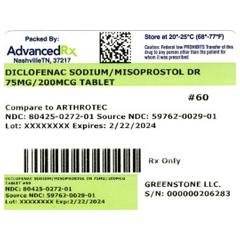
Diclofenac Sodium And Misoprostol Dr
11 DESCRIPTION Diclofenac sodium/misoprostol is a combination product containing diclofenac sodium, an NSAID with analgesic properties, and misoprostol, a gastrointestinal (GI) mucosal protective prostaglandin-1 (PGE1) analog. Diclofenac sodium/misoprostol tablets are white to off-white, round, biconvex, and approximately 11 mm in diameter. Each tablet consists of an enteric-coated core containing 50 mg (diclofenac sodium/misoprostol 50) or 75 mg (diclofenac sodium/misoprostol 75) of diclofenac sodium (equivalent to 46.39 mg or 69.58 mg of diclofenac, respectively) surrounded by an outer mantle containing 200 mcg misoprostol. Diclofenac sodium is a phenylacetic acid derivative that is a white to off-white, virtually odorless, crystalline powder. Diclofenac sodium is freely soluble in methanol, soluble in ethanol, and practically insoluble in chloroform and in dilute acid. Diclofenac sodium is sparingly soluble in water. Its chemical formula and name are: C 14 H 10 Cl 2 NO 2 Na [M.W. = 318.14] 2-[(2,6-dichlorophenyl) amino] benzeneacetic acid, monosodium salt. Misoprostol is a water-soluble, viscous liquid that contains approximately equal amounts of two diastereomers. Its chemical
Information page. Not necessarily available for purchase.
What is Diclofenac Sodium And Misoprostol Dr?
11 DESCRIPTION Diclofenac sodium/misoprostol is a combination product containing diclofenac sodium, an NSAID with analgesic properties, and misoprostol, a gastrointestinal (GI) mucosal protective prostaglandin-1 (PGE1) analog. Diclofenac sodium/misoprostol tablets are white to off-white, round, biconvex, and approximately 11 mm in diameter. Each tablet consists of an enteric-coated core containing 50 mg (diclofenac sodium/misoprostol 50) or 75 mg (diclofenac sodium/misoprostol 75) of diclofenac sodium (equivalent to 46.39 mg or 69.58 mg of diclofenac, respectively) surrounded by an outer mantle containing 200 mcg misoprostol. Diclofenac sodium is a phenylacetic acid derivative that is a white to off-white, virtually odorless, crystalline powder. Diclofenac sodium is freely soluble in methanol, soluble in ethanol, and practically insoluble in chloroform and in dilute acid. Diclofenac sodium is sparingly soluble in water. Its chemical formula and name are: C 14 H 10 Cl 2 NO 2 Na [M.W. = 318.14] 2-[(2,6-dichlorophenyl) amino] benzeneacetic acid, monosodium salt. Misoprostol is a water-soluble, viscous liquid that contains approximately equal amounts of two diastereomers. Its chemical
Uses of Diclofenac Sodium And Misoprostol Dr
Established uses
- 1 INDICATIONS AND USAGE Diclofenac sodium/misoprostol is indicated for treatment of the signs and symptoms of osteoarthritis or rheumatoid arthritis in adult patients at high risk of developing NSAID-induced gastric and duodenal ulcers and their complications.
- For a list of factors that may increase the risk of NSAID-induced gastric and duodenal ulcers and their complications [see Warnings and Precautions (5.3) ] .
- Diclofenac sodium/misoprostol is a combination of diclofenac sodium, a non‑steroidal anti‑inflammatory drug, and misoprostol, a prostaglandin-1 (PGE1) analog, indicated for the treatment of signs and symptoms of osteoarthritis or rheumatoid arthritis in adult patients at high risk of developing NSAID‑induced gastric and duodenal ulcers and their complications.
- ( 1 )
How Diclofenac Sodium And Misoprostol Dr works
In more detail: 12.1 Mechanism of Action Diclofenac sodium/misoprostol is a combination product containing diclofenac sodium, an NSAID with analgesic, anti-inflammatory and antipyretic properties, and misoprostol, a GI mucosal protective prostaglandin-1 (PGE1) analog. Diclofenac The mechanism of action of diclofenac, like that of other NSAIDs, is not completely understood but involves inhibition of cyclooxygenase (COX-1 and COX-2). Diclofenac is a potent inhibitor of prostaglandin (PG) synthesis in vitro. Diclofenac concentrations reached during therapy have produced in vivo effects. Prostaglandins sensitize afferent nerves and potentiate the action of bradykinin in inducing pain in animal models. Prostaglandins are mediators of inflammation. Because diclofenac is an inhibitor of prostaglandin synthesis, its mode of action may be due to a decrease of prostaglandins in peripheral tissues. Misoprostol Misoprostol is a synthetic PGE1 analog with gastric antisecretory and mucosal protective properties. NSAIDs inhibit prostaglandin synthesis. A deficiency of prostaglandins within the gastric and duodenal mucosa may lead to diminishing bicarbonate and mucus secretion and may contribute to the mucosal da
How to take Diclofenac Sodium And Misoprostol Dr
2 DOSAGE AND ADMINISTRATION Use the lowest effective dosage for the shortest duration consistent with individual patient treatment goals. ( 2.1 ) Osteoarthritis: The recommended dosage for maximal GI protection is one tablet (containing 50 mg of diclofenac and 200 mcg of misoprostol) three times daily. A dosage of diclofenac higher than 150 mg/day is not recommended. ( 2.2 ) Rheumatoid Arthritis: The recommended dosage for maximal GI protection is one tablet (containing 50 mg of diclofenac and 200 mcg of misoprostol) three or four times daily A dosage of diclofenac higher than 200 mg/day is not recommended. ( 2.3 ) For dosage modifications due to intolerance, see the full Prescribing Information. ( 2.2 , 2.3 ) 2.1 Important Dosage Information Carefully consider the potential benefits and risks of diclofenac sodium/misoprostol and other treatment options before deciding to use diclofenac sodium/misoprostol. Use the lowest effective dosage for the shortest duration consistent with individual patient treatment goals [see Warnings and Precautions (5) ]. After observing the response to initial therapy with diclofenac sodium/misoprostol, the dose and frequency should be adjusted to suit
Dosage
Follow the dose prescribed by your doctor or pharmacist. The ranges below are general information, not a personal prescription.
- Adults
- 2 DOSAGE AND ADMINISTRATION Use the lowest effective dosage for the shortest duration consistent with individual patient treatment goals. ( 2.1 ) Osteoarthritis: The recommended dosage for maximal GI protection is one tablet (containing 50 mg of diclofenac and 200 mcg of misoprostol) three times daily. A dosage of diclofenac higher than 150 mg/day is not recommended. ( 2.2 ) Rheumatoid Arthritis: The recommended dosage for maximal GI protection is one tablet (containing 50 mg of diclofenac and 200 mcg of misoprostol) three or four times daily A dosage of diclofenac higher than 200 mg/day is not recommended. ( 2.3 ) For dosage modifications due to intolerance, see the full Prescribing Information. ( 2.2 , 2.3 ) 2.1 Important Dosage Information Carefully consider the potential benefits and risks of diclofenac sodium/misoprostol and other treatment options before deciding to use diclofenac sodium/misoprostol. Use the lowest effective dosage for the shortest duration consistent with individual patient treatment goals [see Warnings and Precautions (5) ]. After observing the response to initial therapy with diclofenac sodium/misoprostol, the dose and frequency should be adjusted to suit
Side effects of Diclofenac Sodium And Misoprostol Dr
Common
- 6 ADVERSE REACTIONS The following adverse reactions are discussed in greater detail in other sections of the labeling: Cardiovascular Thrombotic Events [see Warnings and Precautions (5.2) ] GI Bleeding, Ulceration and Perforation [see Warnings and Precautions (5.3) ] Hepatotoxicity [see Warnings and Precautions (5.4) ] Hypertension [see Warnings and Precautions (5.5) ] Heart Failure and Edema [see Warnings and Precautions (5.6) ] Renal Toxicity and Hyperkalemia [see Warnings and Precautions (5.7) ] Anaphylactic Reactions [see Warnings and Precautions (5.8) ] Serious Skin Reactions [see Warnings and Precautions (5.10) ] Hematologic Toxicity [see Warnings and Precautions (5.12) ] Most common adverse reactions (>2%) are: abdominal pain, diarrhea, dyspepsia, nausea, flatulence, gastritis, vomiting, constipation, headache, dizziness, alanine aminotransferase increased, hematocrit decreased ( 6.1 ) To report SUSPECTED ADVERSE REACTIONS, contact Pfizer Inc.
- at 1-800-438-1985 or FDA at 1-800-FDA-1088 or www.fda.gov/medwatch.
- 6.1 Clinical Trials Experience Because clinical trials are conducted under widely varying conditions, adverse reaction rates observed in the clinical trials of a drug
Warnings and who should not take it
Who should NOT take Diclofenac Sodium And Misoprostol Dr?
- 4 CONTRAINDICATIONS Diclofenac sodium/misoprostol is contraindicated in the following patients: Pregnancy.
- Use of misoprostol, a component of diclofenac sodium/misoprostol, during pregnancy can result in maternal and fetal harm, including uterine rupture, abortion, premature birth, or birth defects [see Warnings and Precautions (5.1) and Use in Specific Populations (8.1) ] In the setting of coronary artery bypass graft (CABG) surgery [see Warnings and Precautions (5.2) ] Active gastrointestinal bleeding [see Warnings and Precautions (5.3) ] History of asthma, urticaria, or other allergic-type reactions after taking aspirin or other NSAIDs.
- Severe, sometimes fatal, anaphylactic reactions to NSAIDs have been reported in such patients [see Warnings and Precautions (5.8 , 5.9) ] Known hypersensitivity (e.g., anaphylactic reactions and serious skin reactions) to diclofenac sodium and misoprostol, other prostaglandins, or any components of the drug product [see Warnings and Precautions (5.8 , 5.10) ] Pregnancy ( 4 ) In the setting of CABG surgery ( 4 ) Active gastrointestinal bleeding ( 4 ) History of asthma, urticaria, or other allergic-type reactions after taking aspirin or other NSAID
Overdose
10 OVERDOSAGE Manage patients with symptomatic and supportive care following an acute NSAID overdosage. There are no specific antidotes. It is advisable to contact a poison control center (1-800-222-1222) to determine the latest recommendations because strategies for the management of overdose are continually evolving. The toxic dose of diclofenac sodium/misoprostol has not been determined. However, signs of overdosage from the components of the product have been described. Diclofenac Symptoms following acute NSAID overdosages have been typically limited to lethargy, drowsiness, nausea, vomiting, and epigastric pain, which have been generally reversible with supportive care. Gastrointestinal bleeding has occurred. Hypertension, acute renal failure, respiratory depression, and coma have occurred, but were rare [see Warnings and Precautions (5.2 , 5.3 , 5.5 , 5.7) ] . Clinical signs that may suggest diclofenac sodium overdose include GI complaints, confusion, drowsiness, or general hypotonia. If gastric decontamination may be potentially beneficial to the patient, e.g., short time since ingestion or a large overdosage (5 to 10 times the recommended dosage), consider emesis and/or act
Safety at a glance
8.1 Pregnancy Risk Summary Diclofenac sodium/misoprostol is contraindicated in pregnant women [see Contraindications (4) ] . If a woman becomes pregnant while taking diclofenac sodium/misoprostol, discontinue the drug and advise the woman of the potential risks to her and to a fetus. There are no adequate and well-controlled studies of diclofenac sodium/misoprostol in pregnant women; however, there is information available about the active drug components of diclofenac sodium/misoprostol, diclofenac sodium and misoprostol. Administration of misoprostol to pregnant women can cause uterine rupture, abortion, premature birth, or birth defects or [see Warnings and Precautions (5.1) ] . Congenital anomalies sometimes associated with fetal death have been reported subsequent to the unsuccessful use of misoprostol as an abortifacient, but the drug's teratogenic mechanism has not been demonstrated. Use of NSAIDS, including diclofenac a component of diclofenac sodium/misoprostol, can cause premature closure of the fetal ductus arteriosus and fetal renal dysfunction leading to oligohydramnios and, in some cases, neonatal renal impairment (see Error! Hyperlink reference not valid. ) . There a
Children and elderly
Children
8.4 Pediatric Use Safety and effectiveness of diclofenac sodium/misoprostol in pediatric patients have not been established.
Elderly
8.5 Geriatric Use Geriatric patients (those 65 years of age and older), compared to younger adult patients, are at greater risk for NSAID-associated serious cardiovascular, gastrointestinal, and/or renal adverse reactions [see Warnings and Precautions (5.2 , 5.3 , 5.7 )] . In addition, the risk of diclofenac-associated adverse reactions may be greater in geriatric patients with renal impairment or those taking concomitant ACE inhibitors or ARBs [see Drug Interactions (7) and Use in Specific Populations (8.6) ] . Avoid use of diclofenac sodium/misoprostol in geriatric patients with cardiovascular and/or renal risk factors. If use cannot be avoided, use the lowest recommended dosage for the shortest duration and monitor for cardiac and renal adverse reactions [see Dosage and Administration (2.1) ] . Monitor renal function in geriatric patients during treatment with diclofenac sodium/misoprostol, especially in patients with concomitant use of ACE inhibitors or ARBs . Of the 2,184 patients in clinical studies with diclofenac sodium/misoprostol, 557 (25.5%) were 65 years of age and over. No overall differences in effectiveness were observed between these patients and younger adult patie
Interactions
Medicine and medicine
- 7 DRUG INTERACTIONS See Table 1 for clinically significant drug interactions with diclofenac and misoprostol.
- Table 1: Clinically Significant Drug Interactions with Diclofenac and Misoprostol Drugs That Interfere with Hemostasis Clinical Impact: Diclofenac and anticoagulants such as warfarin have a synergistic effect on bleeding.
- The concomitant use of diclofenac and anticoagulants have an increased risk of serious bleeding compared to the use of either drug alone.
- Serotonin release by platelets plays an important role in hemostasis.
- Case-control and cohort epidemiological studies showed that concomitant use of drugs that interfere with serotonin reuptake and an NSAID may potentiate the risk of bleeding more than an NSAID alone.
- Intervention: Monitor patients with concomitant use of diclofenac sodium/misoprostol with anticoagulants (e.g., warfarin), antiplatelet drugs (e.g., aspirin), SSRIs, and SNRIs for signs of bleeding [see Warnings and Precautions (5.12) ] .
Frequently asked questions
What is Diclofenac Sodium And Misoprostol Dr used for?
1 INDICATIONS AND USAGE Diclofenac sodium/misoprostol is indicated for treatment of the signs and symptoms of osteoarthritis or rheumatoid arthritis in adult patients at high risk of developing NSAID-induced gastric and duodenal ulcers and their complications., For a list of factors that may increase the risk of NSAID-induced gastric and duodenal ulcers and their complications [see Warnings and Precautions (5.3) ] ., Diclofenac sodium/misoprostol is a combination of diclofenac sodium, a non‑steroidal anti‑inflammatory drug, and misoprostol, a prostaglandin-1 (PGE1) analog, indicated for the treatment of signs and symptoms of osteoarthritis or rheumatoid arthritis in adult patients at high risk of developing NSAID‑induced gastric and duodenal ulcers and their complications., ( 1 ).
How should I take Diclofenac Sodium And Misoprostol Dr?
2 DOSAGE AND ADMINISTRATION Use the lowest effective dosage for the shortest duration consistent with individual patient treatment goals. ( 2.1 ) Osteoarthritis: The recommended dosage for maximal GI protection is one tablet (containing 50 mg of diclofenac and 200 mcg of misoprostol) three times daily. A dosage of diclofenac higher than 150 mg/day is not recommended. ( 2.2 ) Rheumatoid Arthritis: The recommended dosage for maximal GI protection is one tablet (containing 50 mg of diclofenac and 200 mcg of misoprostol) three or four times daily A dosage of diclofenac higher than 200 mg/day is not recommended. ( 2.3 ) For dosage modifications due to intolerance, see the full Prescribing Information. ( 2.2 , 2.3 ) 2.1 Important Dosage Information Carefully consider the potential benefits and risks of diclofenac sodium/misoprostol and other treatment options before deciding to use diclofenac sodium/misoprostol. Use the lowest effective dosage for the shortest duration consistent with individual patient treatment goals [see Warnings and Precautions (5) ]. After observing the response to initial therapy with diclofenac sodium/misoprostol, the dose and frequency should be adjusted to suit
What are the common side effects?
6 ADVERSE REACTIONS The following adverse reactions are discussed in greater detail in other sections of the labeling: Cardiovascular Thrombotic Events [see Warnings and Precautions (5.2) ] GI Bleeding, Ulceration and Perforation [see Warnings and Precautions (5.3) ] Hepatotoxicity [see Warnings and Precautions (5.4) ] Hypertension [see Warnings and Precautions (5.5) ] Heart Failure and Edema [see Warnings and Precautions (5.6) ] Renal Toxicity and Hyperkalemia [see Warnings and Precautions (5.7) ] Anaphylactic Reactions [see Warnings and Precautions (5.8) ] Serious Skin Reactions [see Warnings and Precautions (5.10) ] Hematologic Toxicity [see Warnings and Precautions (5.12) ] Most common adverse reactions (>2%) are: abdominal pain, diarrhea, dyspepsia, nausea, flatulence, gastritis, vomiting, constipation, headache, dizziness, alanine aminotransferase increased, hematocrit decreased ( 6.1 ) To report SUSPECTED ADVERSE REACTIONS, contact Pfizer Inc., at 1-800-438-1985 or FDA at 1-800-FDA-1088 or www.fda.gov/medwatch., 6.1 Clinical Trials Experience Because clinical trials are conducted under widely varying conditions, adverse reaction rates observed in the clinical trials of a drug.
Who should not take Diclofenac Sodium And Misoprostol Dr?
4 CONTRAINDICATIONS Diclofenac sodium/misoprostol is contraindicated in the following patients: Pregnancy.; Use of misoprostol, a component of diclofenac sodium/misoprostol, during pregnancy can result in maternal and fetal harm, including uterine rupture, abortion, premature birth, or birth defects [see Warnings and Precautions (5.1) and Use in Specific Populations (8.1) ] In the setting of coronary artery bypass graft (CABG) surgery [see Warnings and Precautions (5.2) ] Active gastrointestinal bleeding [see Warnings and Precautions (5.3) ] History of asthma, urticaria, or other allergic-type reactions after taking aspirin or other NSAIDs.; Severe, sometimes fatal, anaphylactic reactions to NSAIDs have been reported in such patients [see Warnings and Precautions (5.8 , 5.9) ] Known hypersensitivity (e.g., anaphylactic reactions and serious skin reactions) to diclofenac sodium and misoprostol, other prostaglandins, or any components of the drug product [see Warnings and Precautions (5.8 , 5.10) ] Pregnancy ( 4 ) In the setting of CABG surgery ( 4 ) Active gastrointestinal bleeding ( 4 ) History of asthma, urticaria, or other allergic-type reactions after taking aspirin or other NSAID.
Can I take Diclofenac Sodium And Misoprostol Dr during pregnancy?
8.1 Pregnancy Risk Summary Diclofenac sodium/misoprostol is contraindicated in pregnant women [see Contraindications (4) ] . If a woman becomes pregnant while taking diclofenac sodium/misoprostol, discontinue the drug and advise the woman of the potential risks to her and to a fetus. There are no adequate and well-controlled studies of diclofenac sodium/misoprostol in pregnant women; however, there is information available about the active drug components of diclofenac sodium/misoprostol, diclofenac sodium and misoprostol. Administration of misoprostol to pregnant women can cause uterine rupture, abortion, premature birth, or birth defects or [see Warnings and Precautions (5.1) ] . Congenital anomalies sometimes associated with fetal death have been reported subsequent to the unsuccessful use of misoprostol as an abortifacient, but the drug's teratogenic mechanism has not been demonstrated. Use of NSAIDS, including diclofenac a component of diclofenac sodium/misoprostol, can cause premature closure of the fetal ductus arteriosus and fetal renal dysfunction leading to oligohydramnios and, in some cases, neonatal renal impairment (see Error! Hyperlink reference not valid. ) . There a
Can children take Diclofenac Sodium And Misoprostol Dr?
8.4 Pediatric Use Safety and effectiveness of diclofenac sodium/misoprostol in pediatric patients have not been established.
Does Diclofenac Sodium And Misoprostol Dr interact with other medicines?
7 DRUG INTERACTIONS See Table 1 for clinically significant drug interactions with diclofenac and misoprostol.; Table 1: Clinically Significant Drug Interactions with Diclofenac and Misoprostol Drugs That Interfere with Hemostasis Clinical Impact: Diclofenac and anticoagulants such as warfarin have a synergistic effect on bleeding.; The concomitant use of diclofenac and anticoagulants have an increased risk of serious bleeding compared to the use of either drug alone.; Serotonin release by platelets plays an important role in hemostasis.; Case-control and cohort epidemiological studies showed that concomitant use of drugs that interfere with serotonin reuptake and an NSAID may potentiate the risk of bleeding more than an NSAID alone.; Intervention: Monitor patients with concomitant use of diclofenac sodium/misoprostol with anticoagulants (e.g., warfarin), antiplatelet drugs (e.g., aspirin), SSRIs, and SNRIs for signs of bleeding [see Warnings and Precautions (5.12) ] ..
How should it be stored?
Store at 20°C to 25°C (68°F to 77°F). Excursions permitted to 15°C to 30°C (59°F to 86°F) [See USP Controlled Room Temperature].
Medicine information on IMCURE is provided for educational purposes and is not a substitute for diagnosis, prescription or medical advice. Always follow your doctor’s or pharmacist’s instructions. Real product image from the U.S. National Library of Medicine's DailyMed listing for Diclofenac Sodium And Misoprostol Dr (Diclofenac Sodium And Misoprostol) Tablet, Film Coat. Packaging varies by brand and manufacturer.