
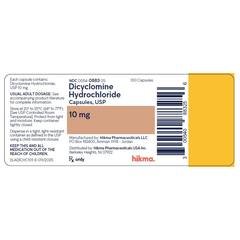
Dicyclomine Hydrochloride
11 DESCRIPTION Dicyclomine hydrochloride is an antispasmodic and anticholinergic (antimuscarinic) agent available as: Dicyclomine hydrochloride capsules, USP for oral use containing 10 mg dicyclomine hydrochloride, USP. Dicyclomine hydrochloride 10 mg capsules contain the following inactive ingredients: corn starch, lactose monohydrate, magnesium stearate, and microcrystalline cellulose. Capsule shells contain FD&C Blue No.1, FD&C Red No.40, gelatin, purified water, and sodium lauryl sulfate. The white monogramming ink contains: ammonium hydroxide, isopropyl alcohol, n-butyl alcohol, propylene glycol, shellac, simethicone, and titanium dioxide. Dicyclomine hydrochloride is [bicyclohexyl]-1-carboxylic acid, 2-(diethylamino) ethyl ester, hydrochloride, with a molecular formula of C 19 H 35 NO 2 •HCl and the following structural formula: Dicyclomine hydrochloride occurs as a fine, white, crystalline, practically odorless powder with a bitter taste. It is soluble in water, freely soluble in alcohol and chloroform, and very slightly soluble in ether. Dicyclomine hydrochloride structural image
Information page. Not necessarily available for purchase.
What is Dicyclomine Hydrochloride?
11 DESCRIPTION Dicyclomine hydrochloride is an antispasmodic and anticholinergic (antimuscarinic) agent available as: Dicyclomine hydrochloride capsules, USP for oral use containing 10 mg dicyclomine hydrochloride, USP. Dicyclomine hydrochloride 10 mg capsules contain the following inactive ingredients: corn starch, lactose monohydrate, magnesium stearate, and microcrystalline cellulose. Capsule shells contain FD&C Blue No.1, FD&C Red No.40, gelatin, purified water, and sodium lauryl sulfate. The white monogramming ink contains: ammonium hydroxide, isopropyl alcohol, n-butyl alcohol, propylene glycol, shellac, simethicone, and titanium dioxide. Dicyclomine hydrochloride is [bicyclohexyl]-1-carboxylic acid, 2-(diethylamino) ethyl ester, hydrochloride, with a molecular formula of C 19 H 35 NO 2 •HCl and the following structural formula: Dicyclomine hydrochloride occurs as a fine, white, crystalline, practically odorless powder with a bitter taste. It is soluble in water, freely soluble in alcohol and chloroform, and very slightly soluble in ether. Dicyclomine hydrochloride structural image
Uses of Dicyclomine Hydrochloride
Established uses
- 1 INDICATIONS AND USAGE Dicyclomine hydrochloride capsules, USP are indicated for the treatment of patients with functional bowel/irritable bowel syndrome.
- Dicyclomine hydrochloride capsules, USP are an antispasmodic and anticholinergic (antimuscarinic) agent indicated for the treatment of functional bowel/irritable bowel syndrome (1)
How Dicyclomine Hydrochloride works
In more detail: 12.1 Mechanism of Action Dicyclomine relieves smooth muscle spasm of the gastrointestinal tract. Animal studies indicate that this action is achieved via a dual mechanism: a specific anticholinergic effect (antimuscarinic) at the acetylcholine-receptor sites with approximately 1/8 the milligram potency of atropine ( in vitro , guinea pig ileum); and a direct effect upon smooth muscle (musculotropic) as evidenced by dicyclomine’s antagonism of bradykinin- and histamine-induced spasms of the isolated guinea pig ileum. Atropine did not affect responses to these two agonists. In vivo studies in cats and dogs showed dicyclomine to be equally potent against acetylcholine (ACh)- or barium chloride (BaCl 2 )-induced intestinal spasm while atropine was at least 200 times more potent against effects of ACh than BaCl 2 . Tests for mydriatic effects in mice showed that dicyclomine was approximately 1/500 as potent as atropine; antisialagogue tests in rabbits showed dicyclomine to be 1/300 as potent as atropine.
How to take Dicyclomine Hydrochloride
2 DOSAGE AND ADMINISTRATION Dosage must be adjusted to individual patient needs. Dosage for dicyclomine hydrochloride capsules must be adjusted to individual patient needs (2) . If a dose is missed, patients should continue the normal dosing schedule (2) . Oral in adults (2.1 ) : Starting dose: 20 mg four times a day. After a week treatment with the starting dose, the dose may be escalated to 40 mg four times a day, unless side effects limit dosage escalation Discontinue dicyclomine hydrochloride if efficacy not achieved or side effects require doses less than 80 mg per day after two weeks of treatment 2.1 Oral Dosage and Administration in Adults The recommended initial dose is 20 mg four times a day. After one week treatment with the initial dose, the dose may be increased to 40 mg four times a day unless side effects limit dosage escalation. If efficacy is not achieved within 2 weeks or side effects require doses below 80 mg per day, the drug should be discontinued. Documented safety data are not available for doses above 80 mg daily for periods longer than 2 weeks.
Dosage
Follow the dose prescribed by your doctor or pharmacist. The ranges below are general information, not a personal prescription.
- Adults
- 2 DOSAGE AND ADMINISTRATION Dosage must be adjusted to individual patient needs. Dosage for dicyclomine hydrochloride capsules must be adjusted to individual patient needs (2) . If a dose is missed, patients should continue the normal dosing schedule (2) . Oral in adults (2.1 ) : Starting dose: 20 mg four times a day. After a week treatment with the starting dose, the dose may be escalated to 40 mg four times a day, unless side effects limit dosage escalation Discontinue dicyclomine hydrochloride if efficacy not achieved or side effects require doses less than 80 mg per day after two weeks of treatment 2.1 Oral Dosage and Administration in Adults The recommended initial dose is 20 mg four times a day. After one week treatment with the initial dose, the dose may be increased to 40 mg four times a day unless side effects limit dosage escalation. If efficacy is not achieved within 2 weeks or side effects require doses below 80 mg per day, the drug should be discontinued. Documented safety data are not available for doses above 80 mg daily for periods longer than 2 weeks.
Side effects of Dicyclomine Hydrochloride
Common
- 6 ADVERSE REACTIONS The pattern of adverse effects seen with dicyclomine is mostly related to its pharmacological actions at muscarinic receptors [see Clinical Pharmacology (12) ] .
- They are a consequence of the inhibitory effect on muscarinic receptors within the autonomic nervous system.
- These effects are dose-related and are usually reversible when treatment is discontinued.
- The most serious adverse reactions reported with dicyclomine hydrochloride include cardiovascular and central nervous system symptoms [see Warnings and Precautions (5.2, 5.3) ].
- The most serious adverse reactions include cardiovascular and central nervous system symptoms.
- The most common adverse reactions (> 5% of patients) are dizziness, dry mouth, vision blurred, nausea, somnolence, asthenia and nervousness (6) To report SUSPECTED ADVERSE REACTIONS, contact Hikma Pharmaceuticals USA Inc.
Warnings and who should not take it
Who should NOT take Dicyclomine Hydrochloride?
- 4 CONTRAINDICATIONS Dicyclomine hydrochloride is contraindicated in infants less than 6 months of age [see Use in Specific P opu l a ti on s (8.4 ) ], nursing mothers [see Use in Specific Populations (8.3) ] and in patients with: unstable cardiovascular status in acute hemorrhage myasthenia gravis [see Warnings and Precautions (5.4) ] glaucoma [see Adverse Reactions (6.3) and Drug Interactions (7.1) ] obstructive uropathy [see Warnings and Precautions (5.8) ] obstructive disease of the gastrointestinal tract [see Warnings and Precautions (5.5) ] severe ulcerative colitis [see Warnings and Precautions (5.7) ] reflux esophagitis Infants less than 6 months of age (4) Nursing mothers (4) Unstable cardiovascular status in acute hemorrhage (4) Myasthenia gravis (4) Glaucoma (4) Obstructive uropathy (4) Obstructive disease of the gastrointestinal tract (4) Severe ulcerative colitis (4) Reflux esophagitis (4)
Overdose
10 OVERDOSAGE In case of an overdose, patients should contact a physician, poison control center (1-800-222-1222), or emergency room. The signs and symptoms of overdosage include: headache; nausea; vomiting; blurred vision; dilated pupils; hot, dry skin; dizziness; dryness of the mouth; difficulty in swallowing; and CNS stimulation including convulsion. A curare-like action may occur (i.e., neuromuscular blockade leading to muscular weakness and possible paralysis). One reported event included a 37-year-old who reported numbness on the left side, cold fingertips, blurred vision, abdominal and flank pain, decreased appetite, dry mouth, and nervousness following ingestion of 320 mg daily (four 20 mg tablets four times daily). These events resolved after discontinuing the dicyclomine. The acute oral LD 50 of the drug is 625 mg/kg in mice. The amount of drug in a single dose that is ordinarily associated with symptoms of overdosage or that is likely to be life- threatening, has not been defined. The maximum human oral dose recorded was 600 mg by mouth in a 10-month-old child and approximately 1500 mg in an adult, each of whom survived. In three of the infants who died following adminis
Safety at a glance
8.1 Pregnancy Pregnancy Category B Adequate and well-controlled studies have not been conducted with dicyclomine hydrochloride in pregnant women at the recommended doses of 80 to 160 mg/day. However, epidemiologic studies did not show an increased risk of structural malformations among babies born to women who took products containing dicyclomine hydrochloride at doses up to 40 mg/day during the first trimester of pregnancy. Reproduction studies have been performed in rats and rabbits at doses up to 33 times the maximum recommended human dose based on 160 mg/day (3 mg/kg) and have revealed no evidence of harm to the fetus due to dicyclomine. Because animal reproduction studies are not always predictive of human response, this drug should be used during pregnancy only if clearly needed.
8.3 Nursing Mothers Dicyclomine hydrochloride is contraindicated in women who are breastfeeding. Dicyclomine hydrochloride is excreted in human milk. Because of the potential for serious adverse reactions in breast-fed infants from dicyclomine hydrochloride, a decision should be made whether to discontinue nursing or to discontinue the drug, taking into account the importance of the drug to the mother [see Use in Specific Populations (8.4) ] .
Children and elderly
Children
8.4 Pediatric Use Safety and effectiveness in pediatric patients have not been established. Dicyclomine hydrochloride is contraindicated in infants less than 6 months of age [see Contraindications (4) ] . There are published cases reporting that the administration of dicyclomine hydrochloride to infants has been followed by serious respiratory symptoms (dyspnea, shortness of breath, breathlessness, respiratory collapse, apnea and asphyxia), seizures, syncope, pulse rate fluctuations, muscular hypotonia, and coma, and death, however; no causal relationship has been established.
Elderly
8.5 Geriatric Use Clinical studies of dicyclomine hydrochloride did not include sufficient numbers of subjects aged 65 and over to determine whether they respond differently from younger subjects. Other reported clinical experience has not identified differences in responses between the elderly and younger patients. In general, dose selection for an elderly patient should be cautious, usually starting at the low end of the dosing range in adults, reflecting the greater frequency of decreased hepatic, renal, or cardiac function, and of concomitant disease or other drug therapy . Because elderly patients are more likely to have decreased renal function, care should be taken in dose selection, and it may be useful to monitor renal function.
Interactions
Medicine and medicine
- 7 DRUG INTERACTIONS Antiglaucoma agents : anticholinergics antagonize antiglaucoma agents and may increase intraoccular pressure (7) Anticholinergic agents : may affect the gastrointestinal absorption of various drugs;
- may also increase certain actions or side effects of other anticholinergic drugs (7) Antacids : interfere with the absorption of anticholinergic agents (7) 7.1 Antiglaucoma Agents Anticholinergics antagonize the effects of antiglaucoma agents.
- Anticholinergic drugs in the presence of increased intraocular pressure may be hazardous when taken concurrently with agents such as corticosteroids.
- Use of dicyclomine hydrochloride in patients with glaucoma is not recommended [see Contraindications (4) ].
- 7.2 Other Drugs with Anticholinergic Activity The following agents may increase certain actions or side effects of anticholinergic drugs including dicyclomine hydrochloride: amantadine, antiarrhythmic agents of Class I (e.g., quinidine), antihistamines, antipsychotic agents (e.g., phenothiazines), benzodiazepines, MAO inhibitors, narcotic analgesics (e.g., meperidine), nitrates and nitrites, sympathomimetic agents, tricyclic antidepressants, and other drugs having anticholin
Frequently asked questions
What is Dicyclomine Hydrochloride used for?
1 INDICATIONS AND USAGE Dicyclomine hydrochloride capsules, USP are indicated for the treatment of patients with functional bowel/irritable bowel syndrome., Dicyclomine hydrochloride capsules, USP are an antispasmodic and anticholinergic (antimuscarinic) agent indicated for the treatment of functional bowel/irritable bowel syndrome (1).
How should I take Dicyclomine Hydrochloride?
2 DOSAGE AND ADMINISTRATION Dosage must be adjusted to individual patient needs. Dosage for dicyclomine hydrochloride capsules must be adjusted to individual patient needs (2) . If a dose is missed, patients should continue the normal dosing schedule (2) . Oral in adults (2.1 ) : Starting dose: 20 mg four times a day. After a week treatment with the starting dose, the dose may be escalated to 40 mg four times a day, unless side effects limit dosage escalation Discontinue dicyclomine hydrochloride if efficacy not achieved or side effects require doses less than 80 mg per day after two weeks of treatment 2.1 Oral Dosage and Administration in Adults The recommended initial dose is 20 mg four times a day. After one week treatment with the initial dose, the dose may be increased to 40 mg four times a day unless side effects limit dosage escalation. If efficacy is not achieved within 2 weeks or side effects require doses below 80 mg per day, the drug should be discontinued. Documented safety data are not available for doses above 80 mg daily for periods longer than 2 weeks.
What are the common side effects?
6 ADVERSE REACTIONS The pattern of adverse effects seen with dicyclomine is mostly related to its pharmacological actions at muscarinic receptors [see Clinical Pharmacology (12) ] ., They are a consequence of the inhibitory effect on muscarinic receptors within the autonomic nervous system., These effects are dose-related and are usually reversible when treatment is discontinued., The most serious adverse reactions reported with dicyclomine hydrochloride include cardiovascular and central nervous system symptoms [see Warnings and Precautions (5.2, 5.3) ]., The most serious adverse reactions include cardiovascular and central nervous system symptoms., The most common adverse reactions (> 5% of patients) are dizziness, dry mouth, vision blurred, nausea, somnolence, asthenia and nervousness (6) To report SUSPECTED ADVERSE REACTIONS, contact Hikma Pharmaceuticals USA Inc..
Who should not take Dicyclomine Hydrochloride?
4 CONTRAINDICATIONS Dicyclomine hydrochloride is contraindicated in infants less than 6 months of age [see Use in Specific P opu l a ti on s (8.4 ) ], nursing mothers [see Use in Specific Populations (8.3) ] and in patients with: unstable cardiovascular status in acute hemorrhage myasthenia gravis [see Warnings and Precautions (5.4) ] glaucoma [see Adverse Reactions (6.3) and Drug Interactions (7.1) ] obstructive uropathy [see Warnings and Precautions (5.8) ] obstructive disease of the gastrointestinal tract [see Warnings and Precautions (5.5) ] severe ulcerative colitis [see Warnings and Precautions (5.7) ] reflux esophagitis Infants less than 6 months of age (4) Nursing mothers (4) Unstable cardiovascular status in acute hemorrhage (4) Myasthenia gravis (4) Glaucoma (4) Obstructive uropathy (4) Obstructive disease of the gastrointestinal tract (4) Severe ulcerative colitis (4) Reflux esophagitis (4).
Can I take Dicyclomine Hydrochloride during pregnancy?
8.1 Pregnancy Pregnancy Category B Adequate and well-controlled studies have not been conducted with dicyclomine hydrochloride in pregnant women at the recommended doses of 80 to 160 mg/day. However, epidemiologic studies did not show an increased risk of structural malformations among babies born to women who took products containing dicyclomine hydrochloride at doses up to 40 mg/day during the first trimester of pregnancy. Reproduction studies have been performed in rats and rabbits at doses up to 33 times the maximum recommended human dose based on 160 mg/day (3 mg/kg) and have revealed no evidence of harm to the fetus due to dicyclomine. Because animal reproduction studies are not always predictive of human response, this drug should be used during pregnancy only if clearly needed.
Can I take Dicyclomine Hydrochloride while breastfeeding?
8.3 Nursing Mothers Dicyclomine hydrochloride is contraindicated in women who are breastfeeding. Dicyclomine hydrochloride is excreted in human milk. Because of the potential for serious adverse reactions in breast-fed infants from dicyclomine hydrochloride, a decision should be made whether to discontinue nursing or to discontinue the drug, taking into account the importance of the drug to the mother [see Use in Specific Populations (8.4) ] .
Can children take Dicyclomine Hydrochloride?
8.4 Pediatric Use Safety and effectiveness in pediatric patients have not been established. Dicyclomine hydrochloride is contraindicated in infants less than 6 months of age [see Contraindications (4) ] . There are published cases reporting that the administration of dicyclomine hydrochloride to infants has been followed by serious respiratory symptoms (dyspnea, shortness of breath, breathlessness, respiratory collapse, apnea and asphyxia), seizures, syncope, pulse rate fluctuations, muscular hypotonia, and coma, and death, however; no causal relationship has been established.
Does Dicyclomine Hydrochloride interact with other medicines?
7 DRUG INTERACTIONS Antiglaucoma agents : anticholinergics antagonize antiglaucoma agents and may increase intraoccular pressure (7) Anticholinergic agents : may affect the gastrointestinal absorption of various drugs;; may also increase certain actions or side effects of other anticholinergic drugs (7) Antacids : interfere with the absorption of anticholinergic agents (7) 7.1 Antiglaucoma Agents Anticholinergics antagonize the effects of antiglaucoma agents.; Anticholinergic drugs in the presence of increased intraocular pressure may be hazardous when taken concurrently with agents such as corticosteroids.; Use of dicyclomine hydrochloride in patients with glaucoma is not recommended [see Contraindications (4) ].; 7.2 Other Drugs with Anticholinergic Activity The following agents may increase certain actions or side effects of anticholinergic drugs including dicyclomine hydrochloride: amantadine, antiarrhythmic agents of Class I (e.g., quinidine), antihistamines, antipsychotic agents (e.g., phenothiazines), benzodiazepines, MAO inhibitors, narcotic analgesics (e.g., meperidine), nitrates and nitrites, sympathomimetic agents, tricyclic antidepressants, and other drugs having anticholin.
Medicine information on IMCURE is provided for educational purposes and is not a substitute for diagnosis, prescription or medical advice. Always follow your doctor’s or pharmacist’s instructions. Real product image from the U.S. National Library of Medicine's DailyMed listing for Dicyclomine Hydrochloride Capsule. Packaging varies by brand and manufacturer.