
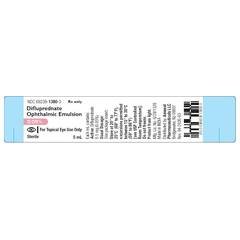
Difluprednate Ophthalmic
11 DESCRIPTION Difluprednate ophthalmic emulsion, 0.05% is a sterile, topical anti-inflammatory corticosteroid for ophthalmic use. The chemical name is 6α,9difluoro-11β,17,21-trihydroxypregna-1,4- diene-3,20-dione 21-acetate 17-butyrate (CAS number 23674-86-4). Difluprednate is represented by the following structural formula: Difluprednate has a molecular weight of 508.56 g/mol, and the empirical formula is C 27 H 34 F 2 O 7 . Each mL of difluprednate ophthalmic emulsion contains: Active: difluprednate 0.5 mg (0.05%); Inactives: boric acid, castor oil, edetate disodium, glycerin, polysorbate 80, sodium acetate, sodium hydroxide (to adjust the pH to 5.2 to 5.8), water for injection. Preservative: sorbic acid 0.1%. The emulsion is essentially isotonic with a tonicity of 304 to 411 mOsm/kg. ChemicalStructure
Information page. Not necessarily available for purchase.
What is Difluprednate Ophthalmic?
11 DESCRIPTION Difluprednate ophthalmic emulsion, 0.05% is a sterile, topical anti-inflammatory corticosteroid for ophthalmic use. The chemical name is 6α,9difluoro-11β,17,21-trihydroxypregna-1,4- diene-3,20-dione 21-acetate 17-butyrate (CAS number 23674-86-4). Difluprednate is represented by the following structural formula: Difluprednate has a molecular weight of 508.56 g/mol, and the empirical formula is C 27 H 34 F 2 O 7 . Each mL of difluprednate ophthalmic emulsion contains: Active: difluprednate 0.5 mg (0.05%); Inactives: boric acid, castor oil, edetate disodium, glycerin, polysorbate 80, sodium acetate, sodium hydroxide (to adjust the pH to 5.2 to 5.8), water for injection. Preservative: sorbic acid 0.1%. The emulsion is essentially isotonic with a tonicity of 304 to 411 mOsm/kg. ChemicalStructure
Uses of Difluprednate Ophthalmic
Established uses
- 1 INDICATIONS AND USAGE Difluprednate ophthalmic emulsion is a corticosteroid indicated for: • The treatment of inflammation and pain associated with ocular surgery.
- ( 1.1 ) • The treatment of endogenous anterior uveitis.
- ( 1.2 ) 1.1 Ocular Surgery Difluprednate ophthalmic emulsion is indicated for the treatment of inflammation and pain associated with ocular surgery.
- 1.2 Endogenous Anterior Uveitis Difluprednate ophthalmic emulsion is indicated for the treatment of endogenous anterior uveitis.
How Difluprednate Ophthalmic works
In more detail: 12.1 Mechanism of Action Corticosteroids inhibit the inflammatory response to a variety of inciting agents and may delay or slow healing. They inhibit edema, fibrin deposition, capillary dilation, leukocyte migration, capillary proliferation, fibroblast proliferation, deposition of collagen, and scar formation associated with inflammation. There is no generally accepted explanation for the mechanism of action of ocular corticosteroids. However, corticosteroids are thought to act by the induction of phospholipase A2 inhibitory proteins, collectively called lipocortins. It is postulated that these proteins control the biosynthesis of potent mediators of inflammation, such as prostaglandins and leukotreines by inhibiting the release of their common precursor arachidonic acid. Arachidonic acid is released from membrane phospholipids by phospholipase A2. Difluprednate is structurally similar to other corticosteroids.
How to take Difluprednate Ophthalmic
2 DOSAGE AND ADMINISTRATION • For the treatment of inflammation and pain associated with ocular surgery, instill one drop into the conjunctival sac of the affected eye 4 times daily beginning 24 hours after surgery and continuing throughout the first 2 weeks of the postoperative period, followed by 2 times daily for a week and then a taper based on the response. ( 2.1 ) • For the treatment of endogenous anterior uveitis, instill one drop into the conjunctival sac of the affected eye 4 times daily for 14 days followed by tapering as clinically indicated. ( 2.2 ) 2.1 Ocular Surgery Instill one drop into the conjunctival sac of the affected eye 4 times daily beginning 24 hours after surgery and continuing throughout the first 2 weeks of the postoperative period, followed by 2 times daily for a week and then a taper based on the response. 2.2 Endogenous Anterior Uveitis Instill one drop into the conjunctival sac of the affected eye 4 times daily for 14 days followed by tapering as clinically indicated. 2.3 Prescribing Guidelines The initial prescription and renewal of the medication order beyond one bottle should be made by a physician only after examination of the patient with the aid
Dosage
Follow the dose prescribed by your doctor or pharmacist. The ranges below are general information, not a personal prescription.
- Adults
- 2 DOSAGE AND ADMINISTRATION • For the treatment of inflammation and pain associated with ocular surgery, instill one drop into the conjunctival sac of the affected eye 4 times daily beginning 24 hours after surgery and continuing throughout the first 2 weeks of the postoperative period, followed by 2 times daily for a week and then a taper based on the response. ( 2.1 ) • For the treatment of endogenous anterior uveitis, instill one drop into the conjunctival sac of the affected eye 4 times daily for 14 days followed by tapering as clinically indicated. ( 2.2 ) 2.1 Ocular Surgery Instill one drop into the conjunctival sac of the affected eye 4 times daily beginning 24 hours after surgery and continuing throughout the first 2 weeks of the postoperative period, followed by 2 times daily for a week and then a taper based on the response. 2.2 Endogenous Anterior Uveitis Instill one drop into the conjunctival sac of the affected eye 4 times daily for 14 days followed by tapering as clinically indicated. 2.3 Prescribing Guidelines The initial prescription and renewal of the medication order beyond one bottle should be made by a physician only after examination of the patient with the aid
Side effects of Difluprednate Ophthalmic
Common
- 6 ADVERSE REACTIONS The following serious reactions are found elsewhere in the labeling: • Intraocular Pressure ( IOP) Increase [see Warnings and Precautions ( 5.1 )] • Cataracts [see Warnings and Precautions ( 5.2 )] • Delayed Healing [see Warnings and Precautions ( 5.3 )] • Corneal and Scleral Melting [see Warnings and Precautions ( 5.4 )] • Bacterial Infections [see Warnings and Precautions ( 5.5 )] • Viral Infections [see Warnings and Precautions ( 5.6 )] • Fungal Infections [see Warnings and Precautions ( 5.7 )] For treatment of inflammation and pain associated with ocular surgery, most common adverse reactions (incidence 5% to 15%) are corneal edema, ciliary and conjunctival hyperemia, eye pain, photophobia, posterior capsule opacification, anterior chamber cells, anterior chamber flare, conjunctival edema, and blepharitis.
- For treatment of endogenous anterior uveitis, most common adverse reactions (incidence 5% to 10%) are blurred vision, eye irritation, eye pain, headache, increased IOP, iritis, limbal and conjunctival hyperemia, punctate keratitis, and uveitis.
- To report SUSPECTED ADVERSE REACTIONS, contact Sandoz Inc., at 1-800-525-8747 or FDA at 1-800-FDA-1088 or www.fda
Warnings and who should not take it
Who should NOT take Difluprednate Ophthalmic?
- 4 CONTRAINDICATIONS Difluprednate ophthalmic emulsion, as with other ophthalmic corticosteroids, is contraindicated in most active viral diseases of the cornea and conjunctiva, including epithelial herpes simplex keratitis (dendritic keratitis), vaccinia, and varicella, and also in mycobacterial infection of the eye and fungal disease of ocular structures.
- Difluprednate ophthalmic emulsion is contraindicated in most active viral diseases of the cornea and conjunctiva, including epithelial herpes simplex keratitis (dendritic keratitis), vaccinia, and varicella, and also in mycobacterial infection of the eye and fungal diseases of ocular structures.
- ( 4 )
Children and elderly
Children
8.4 Pediatric Use Difluprednate ophthalmic emulsion was evaluated in a 3-month, multicenter, double-masked trial in 79 pediatric patients (39 difluprednate ophthalmic emulsion; 40 prednisolone acetate) 0 to 3 years of age for the treatment of inflammation following cataract surgery. A similar safety profile was observed in pediatric patients comparing difluprednate ophthalmic emulsion to prednisolone acetate ophthalmic suspension, 1%.
Elderly
8.5 Geriatric Use No overall differences in safety or effectiveness have been observed between elderly and younger patients.
Frequently asked questions
What is Difluprednate Ophthalmic used for?
1 INDICATIONS AND USAGE Difluprednate ophthalmic emulsion is a corticosteroid indicated for: • The treatment of inflammation and pain associated with ocular surgery., ( 1.1 ) • The treatment of endogenous anterior uveitis., ( 1.2 ) 1.1 Ocular Surgery Difluprednate ophthalmic emulsion is indicated for the treatment of inflammation and pain associated with ocular surgery., 1.2 Endogenous Anterior Uveitis Difluprednate ophthalmic emulsion is indicated for the treatment of endogenous anterior uveitis..
How should I take Difluprednate Ophthalmic?
2 DOSAGE AND ADMINISTRATION • For the treatment of inflammation and pain associated with ocular surgery, instill one drop into the conjunctival sac of the affected eye 4 times daily beginning 24 hours after surgery and continuing throughout the first 2 weeks of the postoperative period, followed by 2 times daily for a week and then a taper based on the response. ( 2.1 ) • For the treatment of endogenous anterior uveitis, instill one drop into the conjunctival sac of the affected eye 4 times daily for 14 days followed by tapering as clinically indicated. ( 2.2 ) 2.1 Ocular Surgery Instill one drop into the conjunctival sac of the affected eye 4 times daily beginning 24 hours after surgery and continuing throughout the first 2 weeks of the postoperative period, followed by 2 times daily for a week and then a taper based on the response. 2.2 Endogenous Anterior Uveitis Instill one drop into the conjunctival sac of the affected eye 4 times daily for 14 days followed by tapering as clinically indicated. 2.3 Prescribing Guidelines The initial prescription and renewal of the medication order beyond one bottle should be made by a physician only after examination of the patient with the aid
What are the common side effects?
6 ADVERSE REACTIONS The following serious reactions are found elsewhere in the labeling: • Intraocular Pressure ( IOP) Increase [see Warnings and Precautions ( 5.1 )] • Cataracts [see Warnings and Precautions ( 5.2 )] • Delayed Healing [see Warnings and Precautions ( 5.3 )] • Corneal and Scleral Melting [see Warnings and Precautions ( 5.4 )] • Bacterial Infections [see Warnings and Precautions ( 5.5 )] • Viral Infections [see Warnings and Precautions ( 5.6 )] • Fungal Infections [see Warnings and Precautions ( 5.7 )] For treatment of inflammation and pain associated with ocular surgery, most common adverse reactions (incidence 5% to 15%) are corneal edema, ciliary and conjunctival hyperemia, eye pain, photophobia, posterior capsule opacification, anterior chamber cells, anterior chamber flare, conjunctival edema, and blepharitis., For treatment of endogenous anterior uveitis, most common adverse reactions (incidence 5% to 10%) are blurred vision, eye irritation, eye pain, headache, increased IOP, iritis, limbal and conjunctival hyperemia, punctate keratitis, and uveitis., To report SUSPECTED ADVERSE REACTIONS, contact Sandoz Inc., at 1-800-525-8747 or FDA at 1-800-FDA-1088 or www.fda.
Who should not take Difluprednate Ophthalmic?
4 CONTRAINDICATIONS Difluprednate ophthalmic emulsion, as with other ophthalmic corticosteroids, is contraindicated in most active viral diseases of the cornea and conjunctiva, including epithelial herpes simplex keratitis (dendritic keratitis), vaccinia, and varicella, and also in mycobacterial infection of the eye and fungal disease of ocular structures.; Difluprednate ophthalmic emulsion is contraindicated in most active viral diseases of the cornea and conjunctiva, including epithelial herpes simplex keratitis (dendritic keratitis), vaccinia, and varicella, and also in mycobacterial infection of the eye and fungal diseases of ocular structures.; ( 4 ).
Can children take Difluprednate Ophthalmic?
8.4 Pediatric Use Difluprednate ophthalmic emulsion was evaluated in a 3-month, multicenter, double-masked trial in 79 pediatric patients (39 difluprednate ophthalmic emulsion; 40 prednisolone acetate) 0 to 3 years of age for the treatment of inflammation following cataract surgery. A similar safety profile was observed in pediatric patients comparing difluprednate ophthalmic emulsion to prednisolone acetate ophthalmic suspension, 1%.
Medicine information on IMCURE is provided for educational purposes and is not a substitute for diagnosis, prescription or medical advice. Always follow your doctor’s or pharmacist’s instructions. Real product image from the U.S. National Library of Medicine's DailyMed listing for Difluprednate (Difluprednate Ophthalmic) Emulsion. Packaging varies by brand and manufacturer.