
Ibuprofen And Famotidine
11 DESCRIPTION Ibuprofen and famotidine is supplied as a tablet for oral administration which combines the nonsteroidal anti- inflammatory drug, ibuprofen, and the histamine H 2 -receptor antagonist, famotidine. Ibuprofen is (±)-2-( p- isobutylphenyl)propionic acid. Its chemical formula is C 13 H 18 O 2 and molecular weight is 206.28. Ibuprofen is a white powder that is very slightly soluble in water (<1 mg/mL) and readily soluble in organic solvents such as ethanol and acetone. Its structural formula is: Famotidine is N'- (aminosulfonyl)-3-[[[2-[(diaminomethylene)amino]-4-thiazolyl]methyl]thio]propanimidamide. Its chemical formula is C 8 H 15 N 7 O 2 S 3 and molecular weight is 337.43. Famotidine is a white to pale yellow crystalline compound that is freely soluble in glacial acetic acid, slightly soluble in methanol, very slightly soluble in water, and practically insoluble in ethanol. Its structural formula is: Each ibuprofen and famotidine tablet contains ibuprofen (800 mg) and famotidine, USP (26.6 mg). The inactive ingredients in ibuprofen and famotidine tablet include: microcrystalline cellulose, pregelatinized starch, silicon dioxide, magnesium stearate, Hydroxy Propyl Meth
Information page. Not necessarily available for purchase.
What is Ibuprofen And Famotidine?
11 DESCRIPTION Ibuprofen and famotidine is supplied as a tablet for oral administration which combines the nonsteroidal anti- inflammatory drug, ibuprofen, and the histamine H 2 -receptor antagonist, famotidine. Ibuprofen is (±)-2-( p- isobutylphenyl)propionic acid. Its chemical formula is C 13 H 18 O 2 and molecular weight is 206.28. Ibuprofen is a white powder that is very slightly soluble in water (<1 mg/mL) and readily soluble in organic solvents such as ethanol and acetone. Its structural formula is: Famotidine is N'- (aminosulfonyl)-3-[[[2-[(diaminomethylene)amino]-4-thiazolyl]methyl]thio]propanimidamide. Its chemical formula is C 8 H 15 N 7 O 2 S 3 and molecular weight is 337.43. Famotidine is a white to pale yellow crystalline compound that is freely soluble in glacial acetic acid, slightly soluble in methanol, very slightly soluble in water, and practically insoluble in ethanol. Its structural formula is: Each ibuprofen and famotidine tablet contains ibuprofen (800 mg) and famotidine, USP (26.6 mg). The inactive ingredients in ibuprofen and famotidine tablet include: microcrystalline cellulose, pregelatinized starch, silicon dioxide, magnesium stearate, Hydroxy Propyl Meth
Uses of Ibuprofen And Famotidine
Established uses
- 1 INDICATIONS AND USAGE Ibuprofen and famotidine tablet, a combination of the NSAID ibuprofen and the histamine H 2 -receptor antagonist famotidine, is indicated for the relief of signs and symptoms of rheumatoid arthritis and osteoarthritis and to decrease the risk of developing upper gastrointestinal ulcers, which in the clinical trials was defined as a gastric and/or duodenal ulcer, in patients who are taking ibuprofen for those indications.
- The clinical trials primarily enrolled patients less than 65 years of age without a prior history of gastrointestinal ulcer.
- Controlled trials do not extend beyond 6 months [see Clinical Studies (14), Use in Specific Populations (8.5)] .
- Ibuprofen and famotidine tablet, a combination of a nonsteroidal anti-inflammatory drug (NSAID) ibuprofen and the histamine H 2 -receptor antagonist famotidine, is indicated for the relief of signs and symptoms of rheumatoid arthritis and osteoarthritis and to decrease the risk of developing upper gastrointestinal ulcers, which in the clinical trials was defined as a gastric and/or duodenal ulcer, in patients who are taking ibuprofen for those indications.
- The clinical trials primarily enrolled patients less
How to take Ibuprofen And Famotidine
2 DOSAGE AND ADMINISTRATION Carefully consider the potential benefits and risks of ibuprofen and famotidine tablets and other treatment options before deciding to use ibuprofen and famotidine tablets. Use ibuprofen at the lowest effective dosage for the shortest duration consistent with individual patient treatment goals [see Warnings and Precautions (5)] . The recommended daily dose of ibuprofen and famotidine 800 mg/26.6 mg is a single tablet administered orally three times per day. Ibuprofen and famotidine tablets should be swallowed whole, and should not be cut to supply a lower dose. Do not chew, divide, or crush tablets. Patients should be instructed that if a dose is missed, it should be taken as soon possible. However, if the next scheduled dose is due, the patient should not take the missed dose, and should be instructed to take the next dose on time. Patients should be instructed not to take 2 doses at one time to make up for a missed dose. Do not substitute ibuprofen and famotidine tablet with the single-ingredient products of ibuprofen and famotidine. One ibuprofen and famotidine tablet administered orally three times per day. (2) Use ibuprofen at the lowest effective d
Dosage
Follow the dose prescribed by your doctor or pharmacist. The ranges below are general information, not a personal prescription.
- Adults
- 2 DOSAGE AND ADMINISTRATION Carefully consider the potential benefits and risks of ibuprofen and famotidine tablets and other treatment options before deciding to use ibuprofen and famotidine tablets. Use ibuprofen at the lowest effective dosage for the shortest duration consistent with individual patient treatment goals [see Warnings and Precautions (5)] . The recommended daily dose of ibuprofen and famotidine 800 mg/26.6 mg is a single tablet administered orally three times per day. Ibuprofen and famotidine tablets should be swallowed whole, and should not be cut to supply a lower dose. Do not chew, divide, or crush tablets. Patients should be instructed that if a dose is missed, it should be taken as soon possible. However, if the next scheduled dose is due, the patient should not take the missed dose, and should be instructed to take the next dose on time. Patients should be instructed not to take 2 doses at one time to make up for a missed dose. Do not substitute ibuprofen and famotidine tablet with the single-ingredient products of ibuprofen and famotidine. One ibuprofen and famotidine tablet administered orally three times per day. (2) Use ibuprofen at the lowest effective d
Side effects of Ibuprofen And Famotidine
Common
- 6 ADVERSE REACTIONS The following serious adverse reactions are discussed in greater detail in other sections of the labeling: Cardiovascular Thrombotic Events [see Warnings and Precautions (5.1)] GI Bleeding, Ulceration, and Perforation [see Warnings and Precautions (5.2)] Hepatotoxicity [see Warnings and Precautions (5.4)] Hypertension [see Warnings and Precautions (5.5)] Heart Failure and Edema [see Warnings and Precautions (5.6)] Renal Toxicity and Hyperkalemia [see Warnings and Precautions (5.7)] Anaphylactic Reactions [see Warnings and Precautions (5.
- 8)] Seizures [see Warnings and Precautions (5.9)] Serious Skin Reactions [see Warnings and Precautions (5.11)] Drug Reaction with Eosinophilia and Systemic Symptoms (DRESS) [see Warnings and Precautions (5.12)] Fetal Toxicity [see Warnings and Precautions (5.13)] Hematologic Toxicity [see Warnings and Precautions (5.14)] Aseptic Meningitis [see Warnings and Precautions (5.18)] Ophthalmological Effects [see Warnings and Precautions (5.19)] Most common adverse reactions (≥1% and greater than ibuprofen alone) are nausea, diarrhea, constipation, upper abdominal pain, and headache.
- (6.1) To report SUSPECTED ADVERSE REACTIONS, contact
Warnings and who should not take it
Who should NOT take Ibuprofen And Famotidine?
- 4 CONTRAINDICATIONS Ibuprofen and famotidine tablet is contraindicated in the following patients: Known hypersensitivity (e.g., anaphylactic reactions and serious skin reactions) to ibuprofen or famotidine or any components of the drug product [see Warnings and Precautions (5.8, 5.11)] .
- History of asthma, urticaria, or other allergic-type reactions after taking aspirin or other NSAIDs.
- Severe, sometimes fatal, anaphylactic reactions to NSAIDs have been reported in such patients [see Warnings and Precautions (5.8, 5.10)] .
- In the setting of coronary artery bypass graft (CABG) surgery [see Warnings and Precautions (5.1)] .
- Ibuprofen and famotidine tablet should not be administered to patients with a history of hypersensitivity to other H 2 -receptor antagonists.
- Cross sensitivity with other H 2 -receptor antagonists has been observed.
Overdose
10 OVERDOSAGE Symptoms following acute NSAID overdosages have been typically limited to lethargy, drowsiness, nausea, vomiting, and epigastric pain, which have been generally reversible with supportive care. Gastrointestinal bleeding has occurred. Hypertension, acute renal failure, respiratory depression, and coma have occurred, but were rare [see Warnings and Precautions (5.1, 5.2, 5.5, 5.7, 5.9)] . No data are available with regard to overdose of ibuprofen and famotidine tablet. Findings related to the individual active substances are listed below. Ibuprofen Approximately 1 1/2 hours after the reported ingestion of from 7 to 10 ibuprofen tablets (400 mg), a 19-month-old child weighing 12 kg was seen in the hospital emergency room, apneic and cyanotic, responding only to painful stimuli. This type of stimulus, however, was sufficient to induce respiration. Oxygen and parenteral fluids were given; a greenish-yellow fluid was aspirated from the stomach with no evidence to indicate the presence of ibuprofen. Two hours after ingestion the child's condition seemed stable; she still responded only to painful stimuli and continued to have periods of apnea lasting from 5 to 10 seconds. Sh
Interactions
Medicine and medicine
- 7 DRUG INTERACTIONS See Table 3 for clinically significant drug interactions with ibuprofen.
- See full prescribing information for a list of clinically important drug interactions.
- (7) table 3.1 table 3.2 table 3.3
Frequently asked questions
What is Ibuprofen And Famotidine used for?
1 INDICATIONS AND USAGE Ibuprofen and famotidine tablet, a combination of the NSAID ibuprofen and the histamine H 2 -receptor antagonist famotidine, is indicated for the relief of signs and symptoms of rheumatoid arthritis and osteoarthritis and to decrease the risk of developing upper gastrointestinal ulcers, which in the clinical trials was defined as a gastric and/or duodenal ulcer, in patients who are taking ibuprofen for those indications., The clinical trials primarily enrolled patients less than 65 years of age without a prior history of gastrointestinal ulcer., Controlled trials do not extend beyond 6 months [see Clinical Studies (14), Use in Specific Populations (8.5)] ., Ibuprofen and famotidine tablet, a combination of a nonsteroidal anti-inflammatory drug (NSAID) ibuprofen and the histamine H 2 -receptor antagonist famotidine, is indicated for the relief of signs and symptoms of rheumatoid arthritis and osteoarthritis and to decrease the risk of developing upper gastrointestinal ulcers, which in the clinical trials was defined as a gastric and/or duodenal ulcer, in patients who are taking ibuprofen for those indications., The clinical trials primarily enrolled patients less.
How should I take Ibuprofen And Famotidine?
2 DOSAGE AND ADMINISTRATION Carefully consider the potential benefits and risks of ibuprofen and famotidine tablets and other treatment options before deciding to use ibuprofen and famotidine tablets. Use ibuprofen at the lowest effective dosage for the shortest duration consistent with individual patient treatment goals [see Warnings and Precautions (5)] . The recommended daily dose of ibuprofen and famotidine 800 mg/26.6 mg is a single tablet administered orally three times per day. Ibuprofen and famotidine tablets should be swallowed whole, and should not be cut to supply a lower dose. Do not chew, divide, or crush tablets. Patients should be instructed that if a dose is missed, it should be taken as soon possible. However, if the next scheduled dose is due, the patient should not take the missed dose, and should be instructed to take the next dose on time. Patients should be instructed not to take 2 doses at one time to make up for a missed dose. Do not substitute ibuprofen and famotidine tablet with the single-ingredient products of ibuprofen and famotidine. One ibuprofen and famotidine tablet administered orally three times per day. (2) Use ibuprofen at the lowest effective d
What are the common side effects?
6 ADVERSE REACTIONS The following serious adverse reactions are discussed in greater detail in other sections of the labeling: Cardiovascular Thrombotic Events [see Warnings and Precautions (5.1)] GI Bleeding, Ulceration, and Perforation [see Warnings and Precautions (5.2)] Hepatotoxicity [see Warnings and Precautions (5.4)] Hypertension [see Warnings and Precautions (5.5)] Heart Failure and Edema [see Warnings and Precautions (5.6)] Renal Toxicity and Hyperkalemia [see Warnings and Precautions (5.7)] Anaphylactic Reactions [see Warnings and Precautions (5., 8)] Seizures [see Warnings and Precautions (5.9)] Serious Skin Reactions [see Warnings and Precautions (5.11)] Drug Reaction with Eosinophilia and Systemic Symptoms (DRESS) [see Warnings and Precautions (5.12)] Fetal Toxicity [see Warnings and Precautions (5.13)] Hematologic Toxicity [see Warnings and Precautions (5.14)] Aseptic Meningitis [see Warnings and Precautions (5.18)] Ophthalmological Effects [see Warnings and Precautions (5.19)] Most common adverse reactions (≥1% and greater than ibuprofen alone) are nausea, diarrhea, constipation, upper abdominal pain, and headache., (6.1) To report SUSPECTED ADVERSE REACTIONS, contact.
Who should not take Ibuprofen And Famotidine?
4 CONTRAINDICATIONS Ibuprofen and famotidine tablet is contraindicated in the following patients: Known hypersensitivity (e.g., anaphylactic reactions and serious skin reactions) to ibuprofen or famotidine or any components of the drug product [see Warnings and Precautions (5.8, 5.11)] .; History of asthma, urticaria, or other allergic-type reactions after taking aspirin or other NSAIDs.; Severe, sometimes fatal, anaphylactic reactions to NSAIDs have been reported in such patients [see Warnings and Precautions (5.8, 5.10)] .; In the setting of coronary artery bypass graft (CABG) surgery [see Warnings and Precautions (5.1)] .; Ibuprofen and famotidine tablet should not be administered to patients with a history of hypersensitivity to other H 2 -receptor antagonists.; Cross sensitivity with other H 2 -receptor antagonists has been observed..
Does Ibuprofen And Famotidine interact with other medicines?
7 DRUG INTERACTIONS See Table 3 for clinically significant drug interactions with ibuprofen.; See full prescribing information for a list of clinically important drug interactions.; (7) table 3.1 table 3.2 table 3.3.
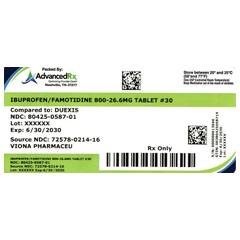
Medicine information on IMCURE is provided for educational purposes and is not a substitute for diagnosis, prescription or medical advice. Always follow your doctor’s or pharmacist’s instructions. Real product image from the U.S. National Library of Medicine's DailyMed listing for Ibuprofen And Famotidine Tablet. Packaging varies by brand and manufacturer.