
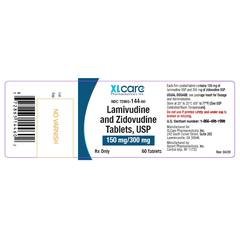
Lamivudine And Zidovudine
11 DESCRIPTION Lamivudine and Zidovudine tablets, USP are combination tablets containing lamivudine and zidovudine. Lamivudine (EPIVIR) and zidovudine (RETROVIR, azidothymidine, AZT, or ZDV) are synthetic nucleoside analogues with activity against HIV-1. Lamivudine and Zidovudine tablets, USP are for oral administration. Each film-coated tablet contains 150 mg of lamivudine, USP, 300 mg of zidovudine, USP, and the inactive ingredients microcrystalline cellulose, sodium starch glycolate, colloidal silicon dioxide, magnesium stearate and opadry white (hypromellose, polyethylene glycol, polysorbate 80 and titanium dioxide). Lamivudine The chemical name of lamivudine is (2R,cis)-4-amino-1-(2-hydroxymethyl-1,3-oxathiolan-5-yl)-(1H)-pyrimidine-2-one. Lamivudine is the (-) enantiomer of a dideoxy analogue of cytidine. Lamivudine has also been referred to as (-)2',3'-dideoxy, 3'-thiacytidine. It has a molecular formula of C8H11N303S and a molecular weight of 229.26. It has the following structural formula: Lamivudine USP is a white to off-white crystalline solid with a solubility of approximately 70 mg/mL in water at 20°C. Zidovudine The chemical name of zidovudine is 3'-azido-3'-deoxythym
Information page. Not necessarily available for purchase.
What is Lamivudine And Zidovudine?
11 DESCRIPTION Lamivudine and Zidovudine tablets, USP are combination tablets containing lamivudine and zidovudine. Lamivudine (EPIVIR) and zidovudine (RETROVIR, azidothymidine, AZT, or ZDV) are synthetic nucleoside analogues with activity against HIV-1. Lamivudine and Zidovudine tablets, USP are for oral administration. Each film-coated tablet contains 150 mg of lamivudine, USP, 300 mg of zidovudine, USP, and the inactive ingredients microcrystalline cellulose, sodium starch glycolate, colloidal silicon dioxide, magnesium stearate and opadry white (hypromellose, polyethylene glycol, polysorbate 80 and titanium dioxide). Lamivudine The chemical name of lamivudine is (2R,cis)-4-amino-1-(2-hydroxymethyl-1,3-oxathiolan-5-yl)-(1H)-pyrimidine-2-one. Lamivudine is the (-) enantiomer of a dideoxy analogue of cytidine. Lamivudine has also been referred to as (-)2',3'-dideoxy, 3'-thiacytidine. It has a molecular formula of C8H11N303S and a molecular weight of 229.26. It has the following structural formula: Lamivudine USP is a white to off-white crystalline solid with a solubility of approximately 70 mg/mL in water at 20°C. Zidovudine The chemical name of zidovudine is 3'-azido-3'-deoxythym
Uses of Lamivudine And Zidovudine
Established uses
- 1 INDICATIONS & USAGE Lamivudine and zidovudine tablets a combination of 2 nucleoside analogues, are indicated in combination with other antiretrovirals for the treatment of human immunodeficiency virus type 1 (HIV-1) infection.
- Lamivudine and zidovudine tablets, a combination of 2 nucleoside analogue reverse transcriptase inibitors, are indicated in combination with other antiretroviral agents for the treatment of HIV-1 infection.
- (1)
How Lamivudine And Zidovudine works
In more detail: 12.1 Mechanism of Action Lamivudine and zidovudine tablet is an antiretroviral agent [see Microbiology (12.4)].
How to take Lamivudine And Zidovudine
2 DOSAGE & ADMINISTRATION • Adults and Adolescents weighing greater than or equal to 30 kg: 1 tablet orally twice daily. (2.1) • Pediatrics weighing greater than or equal to 30 kg: 1 tablet orally twice daily. (2.2) • Because lamivudine and zidovudine tablet is a fixed-dose tablet and cannot be dose adjusted, lamivudine and zidovudine tablet is not recommended in patients requiring dosage adjustment or with hepatic impairment or experiencing dose-limiting adverse reactions. (2.3, 4) 2.1 Recommended Dosage for Adults and Adolescents The recommended dosage of lamivudine and zidovudine tablet in HIV-1-infected adults and adolescents weighing greater than or equal to 30 kg is 1 tablet (containing 150 mg of lamivudine and 300 mg of zidovudine) taken orally twice daily. 2.2 Recommended Dosage for Pediatric Patients The recommended dosage of scored lamivudine and zidovudine tablets for pediatric patients who weigh greater than or equal to 30 kg and for whom a solid oral dosage form is appropriate is 1 tablet administered orally twice daily. Before prescribing lamivudine and zidovudine tablets, children should be assessed for the ability to swallow tablets. If a child is unable to reliably
Dosage
Follow the dose prescribed by your doctor or pharmacist. The ranges below are general information, not a personal prescription.
- Adults
- 2 DOSAGE & ADMINISTRATION • Adults and Adolescents weighing greater than or equal to 30 kg: 1 tablet orally twice daily. (2.1) • Pediatrics weighing greater than or equal to 30 kg: 1 tablet orally twice daily. (2.2) • Because lamivudine and zidovudine tablet is a fixed-dose tablet and cannot be dose adjusted, lamivudine and zidovudine tablet is not recommended in patients requiring dosage adjustment or with hepatic impairment or experiencing dose-limiting adverse reactions. (2.3, 4) 2.1 Recommended Dosage for Adults and Adolescents The recommended dosage of lamivudine and zidovudine tablet in HIV-1-infected adults and adolescents weighing greater than or equal to 30 kg is 1 tablet (containing 150 mg of lamivudine and 300 mg of zidovudine) taken orally twice daily. 2.2 Recommended Dosage for Pediatric Patients The recommended dosage of scored lamivudine and zidovudine tablets for pediatric patients who weigh greater than or equal to 30 kg and for whom a solid oral dosage form is appropriate is 1 tablet administered orally twice daily. Before prescribing lamivudine and zidovudine tablets, children should be assessed for the ability to swallow tablets. If a child is unable to reliably
Side effects of Lamivudine And Zidovudine
Common
- 6 ADVERSE REACTIONS The following adverse reactions are discussed in other sections of the labeling: • Hematologic toxicity, including neutropenia and anemia [see Boxed Warning, Warnings and Precautions (5.1)].
- Symptomatic myopathy [see Boxed Warning, Warnings and Precautions (5.2)].
- Lactic acidosis and severe hepatomegaly with steatosis [see Boxed Warning, Warnings and Precautions (5.3)].
- Exacerbations of hepatitis B [see Boxed Warning, Warnings and Precautions (5.4)].
- Hepatic decompensation in patients co-infected with HIV-1 and hepatitis C [see Warnings and Precautions (5.5)].
- Exacerbation of anemia in HIV-1/HCV co-infected patients receiving ribavirin and zidovudine [see Warnings and Precautions (5.5)].
Warnings and who should not take it
Who should NOT take Lamivudine And Zidovudine?
- 4 CONTRAINDICATIONS Lamivudine and zidovudine tablets are contraindicated in patients with a previous hypersensitivity reaction to lamivudine or zidovudine.
- Lamivudine and zidovudine tablets are contraindicated in patients with a previous hypersensitivity reaction to lamivudine or zidovudine.
- (4)
Overdose
10 OVERDOSAGE There is no known specific treatment for overdose with lamivudine and zidovudine tablet. If overdose occurs, the patient should be monitored and standard supportive treatment applied as required. Lamivudine Because a negligible amount of lamivudine was removed via (4-hour) hemodialysis, continuous ambulatory peritoneal dialysis, and automated peritoneal dialysis, it is not known if continuous hemodialysis would provide clinical benefit in a lamivudine overdose event. Zidovudine Acute overdoses of zidovudine have been reported in pediatric patients and adults. These involved exposures up to 50 grams. No specific symptoms or signs have been identified following acute overdosage with zidovudine apart from those listed as adverse events such as fatigue, headache, vomiting, and occasional reports of hematological disturbances. Patients recovered without permanent sequelae. Hemodialysis and peritoneal dialysis appear to have a negligible effect on the removal of zidovudine, while elimination of its primary metabolite, 3'-azido-3'-deoxy-5'-O-β-D-glucopyranuronosylthymidine (GZDV), is enhanced.
Safety at a glance
8.1 Pregnancy Pregnancy Exposure Registry There is a pregnancy exposure registry that monitors pregnancy outcomes in women exposed to lamivudine and zidovudine during pregnancy. Healthcare providers are encouraged to register patients by calling the Antiretroviral Pregnancy Registry (APR) at 1-800-258-4263. Risk Summary Available data from the APR show no difference in the overall risk of birth defects for lamivudine or zidovudine compared with the background rate for birth defects of 2.7% in the Metropolitan Atlanta Congenital Defects Program (MACDP) reference population (see Data). The APR uses the MACDP as the U.S. reference population for birth defects in the general population. The MACDP evaluates women and infants from a limited geographic area and does not include outcomes for births that occurred at less than 20 weeks’ gestation. The rate of miscarriage is not reported in the APR. The estimated background rate of miscarriage in clinically recognized pregnancies in the U.S. general population is 15% to 20%. The background risk for major birth defects and miscarriage for the indicated population is unknown. In animal reproduction studies, oral administration of lamivudine to
Children and elderly
Children
8.4 Pediatric Use Lamivudine and zidovudine tablet is not recommended for use in pediatric patients who weigh less than 30 kg because it is a fixed-dose combination tablet that cannot be adjusted for this patient population [see Dosage and Administration (2.2)].
Elderly
8.5 Geriatric Use Clinical trials of lamivudine and zidovudine tablet did not include sufficient numbers of subjects aged 65 and over to determine whether they respond differently from younger subjects. In general, caution should be exercised in the administration of lamivudine and zidovudine tablet in elderly patients reflecting the greater frequency of decreased hepatic, renal, or cardiac function, and of concomitant disease or other drug therapy [see Clinical Pharmacology (12.3)].
Interactions
Medicine and medicine
- 7 DRUG INTERACTIONS • Agents antagonistic with zidovudine: Concomitant use should be avoided.
- (7.1) • Hematologic/bone marrow suppressive/cytotoxic agents: May increase the hematologic toxicity of zidovudine.
- (7.1) • Sorbitol: Coadministration of lamivudine and sorbitol may decrease lamivudine concentrations;
- when possible, avoid chronic coadministration.
- (7.2) • Agents antagonistic with zidovudine: Concomitant use should be avoided.
- (7.1) • Hematologic/bone marrow suppressive/cytotoxic agents: May increase the hematologic toxicity of zidovudine.
Frequently asked questions
What is Lamivudine And Zidovudine used for?
1 INDICATIONS & USAGE Lamivudine and zidovudine tablets a combination of 2 nucleoside analogues, are indicated in combination with other antiretrovirals for the treatment of human immunodeficiency virus type 1 (HIV-1) infection., Lamivudine and zidovudine tablets, a combination of 2 nucleoside analogue reverse transcriptase inibitors, are indicated in combination with other antiretroviral agents for the treatment of HIV-1 infection., (1).
How should I take Lamivudine And Zidovudine?
2 DOSAGE & ADMINISTRATION • Adults and Adolescents weighing greater than or equal to 30 kg: 1 tablet orally twice daily. (2.1) • Pediatrics weighing greater than or equal to 30 kg: 1 tablet orally twice daily. (2.2) • Because lamivudine and zidovudine tablet is a fixed-dose tablet and cannot be dose adjusted, lamivudine and zidovudine tablet is not recommended in patients requiring dosage adjustment or with hepatic impairment or experiencing dose-limiting adverse reactions. (2.3, 4) 2.1 Recommended Dosage for Adults and Adolescents The recommended dosage of lamivudine and zidovudine tablet in HIV-1-infected adults and adolescents weighing greater than or equal to 30 kg is 1 tablet (containing 150 mg of lamivudine and 300 mg of zidovudine) taken orally twice daily. 2.2 Recommended Dosage for Pediatric Patients The recommended dosage of scored lamivudine and zidovudine tablets for pediatric patients who weigh greater than or equal to 30 kg and for whom a solid oral dosage form is appropriate is 1 tablet administered orally twice daily. Before prescribing lamivudine and zidovudine tablets, children should be assessed for the ability to swallow tablets. If a child is unable to reliably
What are the common side effects?
6 ADVERSE REACTIONS The following adverse reactions are discussed in other sections of the labeling: • Hematologic toxicity, including neutropenia and anemia [see Boxed Warning, Warnings and Precautions (5.1)]., Symptomatic myopathy [see Boxed Warning, Warnings and Precautions (5.2)]., Lactic acidosis and severe hepatomegaly with steatosis [see Boxed Warning, Warnings and Precautions (5.3)]., Exacerbations of hepatitis B [see Boxed Warning, Warnings and Precautions (5.4)]., Hepatic decompensation in patients co-infected with HIV-1 and hepatitis C [see Warnings and Precautions (5.5)]., Exacerbation of anemia in HIV-1/HCV co-infected patients receiving ribavirin and zidovudine [see Warnings and Precautions (5.5)]..
Who should not take Lamivudine And Zidovudine?
4 CONTRAINDICATIONS Lamivudine and zidovudine tablets are contraindicated in patients with a previous hypersensitivity reaction to lamivudine or zidovudine.; Lamivudine and zidovudine tablets are contraindicated in patients with a previous hypersensitivity reaction to lamivudine or zidovudine.; (4).
Can I take Lamivudine And Zidovudine during pregnancy?
8.1 Pregnancy Pregnancy Exposure Registry There is a pregnancy exposure registry that monitors pregnancy outcomes in women exposed to lamivudine and zidovudine during pregnancy. Healthcare providers are encouraged to register patients by calling the Antiretroviral Pregnancy Registry (APR) at 1-800-258-4263. Risk Summary Available data from the APR show no difference in the overall risk of birth defects for lamivudine or zidovudine compared with the background rate for birth defects of 2.7% in the Metropolitan Atlanta Congenital Defects Program (MACDP) reference population (see Data). The APR uses the MACDP as the U.S. reference population for birth defects in the general population. The MACDP evaluates women and infants from a limited geographic area and does not include outcomes for births that occurred at less than 20 weeks’ gestation. The rate of miscarriage is not reported in the APR. The estimated background rate of miscarriage in clinically recognized pregnancies in the U.S. general population is 15% to 20%. The background risk for major birth defects and miscarriage for the indicated population is unknown. In animal reproduction studies, oral administration of lamivudine to
Can children take Lamivudine And Zidovudine?
8.4 Pediatric Use Lamivudine and zidovudine tablet is not recommended for use in pediatric patients who weigh less than 30 kg because it is a fixed-dose combination tablet that cannot be adjusted for this patient population [see Dosage and Administration (2.2)].
Does Lamivudine And Zidovudine interact with other medicines?
7 DRUG INTERACTIONS • Agents antagonistic with zidovudine: Concomitant use should be avoided.; (7.1) • Hematologic/bone marrow suppressive/cytotoxic agents: May increase the hematologic toxicity of zidovudine.; (7.1) • Sorbitol: Coadministration of lamivudine and sorbitol may decrease lamivudine concentrations;; when possible, avoid chronic coadministration.; (7.2) • Agents antagonistic with zidovudine: Concomitant use should be avoided.; (7.1) • Hematologic/bone marrow suppressive/cytotoxic agents: May increase the hematologic toxicity of zidovudine..
Medicine information on IMCURE is provided for educational purposes and is not a substitute for diagnosis, prescription or medical advice. Always follow your doctor’s or pharmacist’s instructions. Real product image from the U.S. National Library of Medicine's DailyMed listing for Lamivudine And Zidovudine Tablet, Film Coated. Packaging varies by brand and manufacturer.