
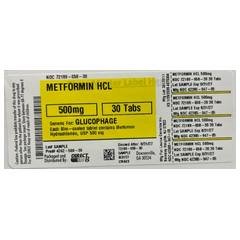
Metformin Hcl
DESCRIPTION Metformin Hydrochloride Tablets USP are oral antihyperglycemic drugs used in the management of type 2 diabetes. Metformin hydrochloride (N,N-dimethylimidodicarbonimidic diamide hydrochloride) is not chemically or pharmacologically related to any other classes of oral antihyperglycemic agents. The structural formula is as shown: Metformin hydrochloride is a white to off-white crystalline compound with a molecular formula of C 4 H 11 N 5 • HCl and a molecular weight of 165.63. Metformin hydrochloride is freely soluble in water and is practically insoluble in acetone, ether, and chloroform. The pKa of metformin is 12.4. The pH of a 1% aqueous solution of metformin hydrochloride is 6.68. Metformin Hydrochloride Tablets USP contain 500 mg, 850 mg, or 1000 mg of metformin hydrochloride. Each tablet contains the inactive ingredients povidone (K-30), povidone (K-90), pregelatinized starch,and magnesium stearate. In addition, the coating for the tablets contains artificial blackberry flavor, hypromellose and polyethylene glycol. Metformin Hydrochloride Structure
Information page. Not necessarily available for purchase.
What is Metformin Hcl?
DESCRIPTION Metformin Hydrochloride Tablets USP are oral antihyperglycemic drugs used in the management of type 2 diabetes. Metformin hydrochloride (N,N-dimethylimidodicarbonimidic diamide hydrochloride) is not chemically or pharmacologically related to any other classes of oral antihyperglycemic agents. The structural formula is as shown: Metformin hydrochloride is a white to off-white crystalline compound with a molecular formula of C 4 H 11 N 5 • HCl and a molecular weight of 165.63. Metformin hydrochloride is freely soluble in water and is practically insoluble in acetone, ether, and chloroform. The pKa of metformin is 12.4. The pH of a 1% aqueous solution of metformin hydrochloride is 6.68. Metformin Hydrochloride Tablets USP contain 500 mg, 850 mg, or 1000 mg of metformin hydrochloride. Each tablet contains the inactive ingredients povidone (K-30), povidone (K-90), pregelatinized starch,and magnesium stearate. In addition, the coating for the tablets contains artificial blackberry flavor, hypromellose and polyethylene glycol. Metformin Hydrochloride Structure
Uses of Metformin Hcl
Established uses
- INDICATIONS & USAGE Metformin Hydrochloride Tablets USP are indicated as an adjunct to diet and exercise to improve glycemic control in adults and children with type 2 diabetes mellitus.
How to take Metformin Hcl
DOSAGE & ADMINISTRATION There is no fixed dosage regimen for the management of hyperglycemia in patients with type 2 diabetes with metformin hydrochloride or any other pharmacologic agent. Dosage of metformin hydrochloride must be individualized on the basis of both effectiveness and tolerance, while not exceeding the maximum recommended daily doses. The maximum recommended daily dose of metformin hydrochloride is 2550 mg in adults and 2000 mg in pediatric patients (10 to 16 years of age). Metformin hydrochloride should be given in divided doses with meals. Metformin hydrochloride should be started at a low dose, with gradual dose escalation, both to reduce gastrointestinal side effects and to permit identification of the minimum dose required for adequate glycemic control of the patient. During treatment initiation and dose titration (see Recommended Dosing Schedule ), fasting plasma glucose should be used to determine the therapeutic response to metformin hydrochloride and identify the minimum effective dose for the patient. Thereafter, glycosylated hemoglobin should be measured at intervals of approximately three months. The therapeutic goal should be to decrease both fasting pl
Dosage
Follow the dose prescribed by your doctor or pharmacist. The ranges below are general information, not a personal prescription.
- Adults
- DOSAGE & ADMINISTRATION There is no fixed dosage regimen for the management of hyperglycemia in patients with type 2 diabetes with metformin hydrochloride or any other pharmacologic agent. Dosage of metformin hydrochloride must be individualized on the basis of both effectiveness and tolerance, while not exceeding the maximum recommended daily doses. The maximum recommended daily dose of metformin hydrochloride is 2550 mg in adults and 2000 mg in pediatric patients (10 to 16 years of age). Metformin hydrochloride should be given in divided doses with meals. Metformin hydrochloride should be started at a low dose, with gradual dose escalation, both to reduce gastrointestinal side effects and to permit identification of the minimum dose required for adequate glycemic control of the patient. During treatment initiation and dose titration (see Recommended Dosing Schedule ), fasting plasma glucose should be used to determine the therapeutic response to metformin hydrochloride and identify the minimum effective dose for the patient. Thereafter, glycosylated hemoglobin should be measured at intervals of approximately three months. The therapeutic goal should be to decrease both fasting pl
Side effects of Metformin Hcl
Common
- ADVERSE REACTIONS In a US double-blind clinical study of Metformin Hydrochloride Tablets USP in patients with type 2 diabetes, a total of 141 patients received Metformin Hydrochloride Tablets USP therapy (up to 2550 mg per day) and 145 patients received placebo.
- Adverse reactions reported in greater than 5% of the Metformin Hydrochloride Tablets USP patients, and that were more common in Metformin Hydrochloride Tablets USP- than placebo-treated patients, are listed in Table 9 .
- Table 9: Most Common Adverse Reactions (>5.0 Percent) in a Placebo-Controlled Clinical Study of Metformin Hydrochloride Tablets Monotherapy * Adverse Reaction Metformin Hydrochloride Tablets Monotherapy (n=141) Placebo (n=145) % of Patients Diarrhea 53.2 11.7 Nausea/Vomiting 25.5 8.3 Flatulence 12.1 5.5 Asthenia 9.2 5.5 Indigestion 7.1 4.1 Abdominal Discomfort 6.4 4.8 Headache 5.7 4.8 * Reactions that were more common in metformin hydrochloride tablets than placebo-treated patients.
- Diarrhea led to discontinuation of study medication in 6% of patients treated with Metformin Hydrochloride Tablets USP.
- Additionally, the following adverse reactions were reported in ≥1.0 to ≤5.0% of Metformin Hydrochloride Table
Warnings and who should not take it
Who should NOT take Metformin Hcl?
- CONTRAINDICATIONS Metformin Hydrochloride Tablets USP are contraindicated in patients with: 1.
- Renal disease or renal dysfunction (e.g., as suggested by serum creatinine levels ≥1.5 mg/dL [males], ≥1.4 mg/dL [females] or abnormal creatinine clearance) which may also result from conditions such as cardiovascular collapse (shock), acute myocardial infarction, and septicemia (see WARNINGS and PRECAUTIONS ).
- 2.
- Known hypersensitivity to metformin hydrochloride 3.
- Acute or chronic metabolic acidosis, including diabetic ketoacidosis, with or without coma.
- Diabetic ketoacidosis should be treated with insulin.
Warnings and precautions
- WARNINGS Lactic Acidosis: Lactic acidosis is a rare, but serious, metabolic complication that can occur due to metformin accumulation during treatment with Metformin Hydrochloride Tablets USP;
- when it occurs, it is fatal in approximately 50% of cases.
- Lactic acidosis may also occur in association with a number of pathophysiologic conditions, including diabetes mellitus, and whenever there is significant tissue hypoperfusion and hypoxemia.
- Lactic acidosis is characterized by elevated blood lactate levels (>5 mmol/L), decreased blood pH, electrolyte disturbances with an increased anion gap, and an increased lactate/pyruvate ratio.
- When metformin is implicated as the cause of lactic acidosis, metformin plasma levels >5 mcg/mL are generally found.
- The reported incidence of lactic acidosis in patients receiving metformin hydrochloride is very low (approximately 0.03 cases/1000 patient-years, with approximately 0.015 fatal cases/1000 patient-years).
Overdose
OVERDOSAGE Overdose of metformin hydrochloride has occurred, including ingestion of amounts greater than 50 grams. Hypoglycemia was reported in approximately 10% of cases, but no causal association with metformin hydrochloride has been established. Lactic acidosis has been reported in approximately 32% of metformin overdose cases (see WARNINGS ). Metformin is dialyzable with a clearance of up to 170 mL/min under good hemodynamic conditions. Therefore, hemodialysis may be useful for removal of accumulated drug from patients in whom metformin overdosage is suspected.
Safety at a glance
PREGNANCY Teratogenic Effects: Pregnancy Category B Recent information strongly suggests that abnormal blood glucose levels during pregnancy are associated with a higher incidence of congenital abnormalities. Most experts recommend that insulin be used during pregnancy to maintain blood glucose levels as close to normal as possible. Because animal reproduction studies are not always predictive of human response, Metformin Hydrochloride Tablets USP should not be used during pregnancy unless clearly needed. There are no adequate and well-controlled studies in pregnant women with Metformin Hydrochloride Tablets USP. Metformin was not teratogenic in rats and rabbits at doses up to 600 mg/kg/day. This represents an exposure of about two and six times the maximum recommended human daily dose of 2000 mg based on body surface area comparisons for rats and rabbits, respectively. Determination of fetal concentrations demonstrated a partial placental barrier to metformin.
NURSING MOTHERS Studies in lactatingrats show that metformin is excreted into milk and reaches levels comparable tothose in plasma. Similar studies have not been conducted in nursing mothers.Because the potential for hypoglycemia in nursing infants may exist, a decisionshould be made whether to discontinue nursing or to discontinue the drug,taking into account the importance of the drug to the mother. If Metformin HydrochlorideTablets USP are discontinued, and if diet alone is inadequate for controllingblood glucose, insulin therapy should be considered.
Children and elderly
Children
PEDIATRIC USE The safety and effectiveness of Metformin Hydrochloride Tablets USP for the treatment of type 2 diabetes have been established in pediatric patients ages 10 to 16 years (studies have not been conducted in pediatric patients below the age of 10 years). Use of Metformin Hydrochloride Tablets USP in this age group is supported by evidence from adequate and well-controlled studies of Metformin Hydrochloride Tablets USP in adults with additional data from a controlled clinical study in pediatric patients ages 10 to 16 years with type 2 diabetes, which demonstrated a similar response in glycemic control to that seen in adults. (See CLINICAL PHARMACOLOGY: Pediatric Clinical Studies .) In this study, adverse effects were similar to those described in adults. (See ADVERSE REACTIONS: Pediatric Patients. ) A maximum daily dose of 2000 mg is recommended. (See DOSAGE AND ADMINISTRATION: Recommended Dosing Schedule: Pediatrics. )
Elderly
GERIATRIC USE Controlled clinical studies of Metformin Hydrochloride Tablets USP did not include sufficient numbers of elderly patients to determine whether they respond differently from younger patients, although other reported clinical experience has not identified differences in responses between the elderly and younger patients. Metformin is known to be substantially excreted by the kidney and because the risk of serious adverse reactions to the drug is greater in patients with impaired renal function, Metformin Hydrochloride Tablets USP should only be used in patients with normal renal function (see CONTRAINDICATIONS, WARNINGS , and CLINICAL PHARMACOLOGY: Pharmacokinetics ). Because aging is associated with reduced renal function, Metformin Hydrochloride Tablets USP should be used with caution as age increases. Care should be taken in dose selection and should be based on careful and regular monitoring of renal function. Generally, elderly patients should not be titrated to the maximum dose of Metformin Hydrochloride Tablets USP (see also WARNINGS and DOSAGE AND ADMINISTRATION ).
Interactions
Medicine and medicine
- DRUG INTERACTIONS (Clinical Evaluation of Drug Interactions Conducted with Metformin Hydrochloride Tablets USP) Glyburide —In a single-dose interaction study in type 2 diabetes patients, coadministration of metformin and glyburide did not result in any changes in either metformin pharmacokinetics or pharmacodynamics.
- Decreases in glyburide AUC and C max were observed, but were highly variable.
- The single-dose nature of this study and the lack of correlation between glyburide blood levels and pharmacodynamic effects, makes the clinical significance of this interaction uncertain (see DOSAGE AND ADMINISTRATION: Concomitant Metformin Hydrochloride Tablets USP and Oral Sulfonylurea Therapy in Adult Patients ).
- Furosemide —A single-dose, metformin-furosemide drug interaction study in healthy subjects demonstrated that pharmacokinetic parameters of both compounds were affected by coadministration.
- Furosemide increased the metformin plasma and blood C max by 22% and blood AUC by 15%, without any significant change in metformin renal clearance.
- When administered with metformin, the C max and AUC of furosemide were 31% and 12% smaller, respectively, than when administered alone, and the term
Frequently asked questions
What is Metformin Hcl used for?
INDICATIONS & USAGE Metformin Hydrochloride Tablets USP are indicated as an adjunct to diet and exercise to improve glycemic control in adults and children with type 2 diabetes mellitus..
How should I take Metformin Hcl?
DOSAGE & ADMINISTRATION There is no fixed dosage regimen for the management of hyperglycemia in patients with type 2 diabetes with metformin hydrochloride or any other pharmacologic agent. Dosage of metformin hydrochloride must be individualized on the basis of both effectiveness and tolerance, while not exceeding the maximum recommended daily doses. The maximum recommended daily dose of metformin hydrochloride is 2550 mg in adults and 2000 mg in pediatric patients (10 to 16 years of age). Metformin hydrochloride should be given in divided doses with meals. Metformin hydrochloride should be started at a low dose, with gradual dose escalation, both to reduce gastrointestinal side effects and to permit identification of the minimum dose required for adequate glycemic control of the patient. During treatment initiation and dose titration (see Recommended Dosing Schedule ), fasting plasma glucose should be used to determine the therapeutic response to metformin hydrochloride and identify the minimum effective dose for the patient. Thereafter, glycosylated hemoglobin should be measured at intervals of approximately three months. The therapeutic goal should be to decrease both fasting pl
What are the common side effects?
ADVERSE REACTIONS In a US double-blind clinical study of Metformin Hydrochloride Tablets USP in patients with type 2 diabetes, a total of 141 patients received Metformin Hydrochloride Tablets USP therapy (up to 2550 mg per day) and 145 patients received placebo., Adverse reactions reported in greater than 5% of the Metformin Hydrochloride Tablets USP patients, and that were more common in Metformin Hydrochloride Tablets USP- than placebo-treated patients, are listed in Table 9 ., Table 9: Most Common Adverse Reactions (>5.0 Percent) in a Placebo-Controlled Clinical Study of Metformin Hydrochloride Tablets Monotherapy * Adverse Reaction Metformin Hydrochloride Tablets Monotherapy (n=141) Placebo (n=145) % of Patients Diarrhea 53.2 11.7 Nausea/Vomiting 25.5 8.3 Flatulence 12.1 5.5 Asthenia 9.2 5.5 Indigestion 7.1 4.1 Abdominal Discomfort 6.4 4.8 Headache 5.7 4.8 * Reactions that were more common in metformin hydrochloride tablets than placebo-treated patients., Diarrhea led to discontinuation of study medication in 6% of patients treated with Metformin Hydrochloride Tablets USP., Additionally, the following adverse reactions were reported in ≥1.0 to ≤5.0% of Metformin Hydrochloride Table.
Who should not take Metformin Hcl?
CONTRAINDICATIONS Metformin Hydrochloride Tablets USP are contraindicated in patients with: 1.; Renal disease or renal dysfunction (e.g., as suggested by serum creatinine levels ≥1.5 mg/dL [males], ≥1.4 mg/dL [females] or abnormal creatinine clearance) which may also result from conditions such as cardiovascular collapse (shock), acute myocardial infarction, and septicemia (see WARNINGS and PRECAUTIONS ).; 2.; Known hypersensitivity to metformin hydrochloride 3.; Acute or chronic metabolic acidosis, including diabetic ketoacidosis, with or without coma.; Diabetic ketoacidosis should be treated with insulin..
Can I take Metformin Hcl during pregnancy?
PREGNANCY Teratogenic Effects: Pregnancy Category B Recent information strongly suggests that abnormal blood glucose levels during pregnancy are associated with a higher incidence of congenital abnormalities. Most experts recommend that insulin be used during pregnancy to maintain blood glucose levels as close to normal as possible. Because animal reproduction studies are not always predictive of human response, Metformin Hydrochloride Tablets USP should not be used during pregnancy unless clearly needed. There are no adequate and well-controlled studies in pregnant women with Metformin Hydrochloride Tablets USP. Metformin was not teratogenic in rats and rabbits at doses up to 600 mg/kg/day. This represents an exposure of about two and six times the maximum recommended human daily dose of 2000 mg based on body surface area comparisons for rats and rabbits, respectively. Determination of fetal concentrations demonstrated a partial placental barrier to metformin.
Can I take Metformin Hcl while breastfeeding?
NURSING MOTHERS Studies in lactatingrats show that metformin is excreted into milk and reaches levels comparable tothose in plasma. Similar studies have not been conducted in nursing mothers.Because the potential for hypoglycemia in nursing infants may exist, a decisionshould be made whether to discontinue nursing or to discontinue the drug,taking into account the importance of the drug to the mother. If Metformin HydrochlorideTablets USP are discontinued, and if diet alone is inadequate for controllingblood glucose, insulin therapy should be considered.
Can children take Metformin Hcl?
PEDIATRIC USE The safety and effectiveness of Metformin Hydrochloride Tablets USP for the treatment of type 2 diabetes have been established in pediatric patients ages 10 to 16 years (studies have not been conducted in pediatric patients below the age of 10 years). Use of Metformin Hydrochloride Tablets USP in this age group is supported by evidence from adequate and well-controlled studies of Metformin Hydrochloride Tablets USP in adults with additional data from a controlled clinical study in pediatric patients ages 10 to 16 years with type 2 diabetes, which demonstrated a similar response in glycemic control to that seen in adults. (See CLINICAL PHARMACOLOGY: Pediatric Clinical Studies .) In this study, adverse effects were similar to those described in adults. (See ADVERSE REACTIONS: Pediatric Patients. ) A maximum daily dose of 2000 mg is recommended. (See DOSAGE AND ADMINISTRATION: Recommended Dosing Schedule: Pediatrics. )
Does Metformin Hcl interact with other medicines?
DRUG INTERACTIONS (Clinical Evaluation of Drug Interactions Conducted with Metformin Hydrochloride Tablets USP) Glyburide —In a single-dose interaction study in type 2 diabetes patients, coadministration of metformin and glyburide did not result in any changes in either metformin pharmacokinetics or pharmacodynamics.; Decreases in glyburide AUC and C max were observed, but were highly variable.; The single-dose nature of this study and the lack of correlation between glyburide blood levels and pharmacodynamic effects, makes the clinical significance of this interaction uncertain (see DOSAGE AND ADMINISTRATION: Concomitant Metformin Hydrochloride Tablets USP and Oral Sulfonylurea Therapy in Adult Patients ).; Furosemide —A single-dose, metformin-furosemide drug interaction study in healthy subjects demonstrated that pharmacokinetic parameters of both compounds were affected by coadministration.; Furosemide increased the metformin plasma and blood C max by 22% and blood AUC by 15%, without any significant change in metformin renal clearance.; When administered with metformin, the C max and AUC of furosemide were 31% and 12% smaller, respectively, than when administered alone, and the term.
Medicine information on IMCURE is provided for educational purposes and is not a substitute for diagnosis, prescription or medical advice. Always follow your doctor’s or pharmacist’s instructions. Real product image from the U.S. National Library of Medicine's DailyMed listing for Metformin Hcl Tablet, Film Coated. Packaging varies by brand and manufacturer.