
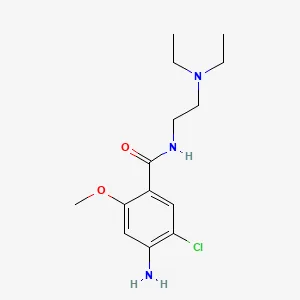
Dopamine-2 receptor antagonist (gut motility medicine)Prescription only (Schedule H)On NLEM 2022NPPA price ceilingJan Aushadhi listed
Metoclopramide
मेटोक्लोप्रामाइड
Metoclopramide is a dopamine-2 receptor antagonist tablet. The US label lists it for gastroesophageal reflux and diabetic gastroparesis in adults. It is Schedule H in India. A boxed warning covers tardive dyskinesia, a movement disorder that may not go away, so treatment should be short.
- Generic name
- Metoclopramide (metoclopramide hydrochloride)
- Used for
- Gastroesophageal reflux (up to 12 weeks) and diabetic gastroparesis in adults
- Prescription status (India)
- Prescription only (Schedule H)
- On NLEM 2022
- Yes
- NPPA price ceiling
- Yes (scheduled formulation)
- Jan Aushadhi
- Listed
More facts
- Banned combinations
- Appears in 1 entries of the banned combination list we checked
Compiled from official drug labels and Indian government sources. Always follow your doctor's or pharmacist's advice.
Safety at a glance
- AlcoholCaution in label textSee wording
- PregnancyCaution in label textSee wording
- BreastfeedingCaution in label textSee wording
- DrivingAvoid, per label textSee wording
- KidneyCaution in label textSee wording
- LiverCaution in label textSee wording
Taken only from the label text cited on this page. "Not mentioned" does not mean safe. Ask your doctor or pharmacist.
What is metoclopramide used for?
This page follows the US label for metoclopramide tablets (5 mg and 10 mg), taken by mouth.
The label lists treatment for 4 to 12 weeks of symptomatic gastroesophageal reflux in adults who do not respond to usual treatment.
It also lists relief of symptoms in adults with acute and recurrent diabetic gastroparesis.
The label does not recommend use in children.
- Gastroesophageal reflux in adults not helped by usual treatment (4 to 12 weeks)
- Diabetic gastroparesis in adults
It is for stubborn reflux and diabetic gastroparesis in adults, for a limited time.
Source1
How does metoclopramide work?
The label says metoclopramide stimulates movement of the upper gut without increasing stomach, bile or pancreatic secretions.
It raises stomach muscle contractions, relaxes the pylorus, increases the tone of the lower oesophageal sphincter and speeds stomach emptying.
The exact way it works in reflux and gastroparesis is not fully established.
It speeds up stomach emptying and tightens the lower oesophageal sphincter.
Source1
How is metoclopramide taken? Dosage information
The US label for adults gives different schedules by condition.
For reflux, the label lists 10 to 15 mg up to four times daily, 30 minutes before meals and at bedtime, with a maximum of 60 mg a day for 4 to 12 weeks. Single doses up to 20 mg are allowed before a provoking situation.
For diabetic gastroparesis, it lists 10 mg 30 minutes before each meal and at bedtime, with a maximum of 40 mg a day.
The label says to use the shortest duration, with 12 weeks the maximum for reflux, and to lower doses in older adults, in some liver or kidney impairment, and in CYP2D6 poor metabolisers.
Indian pack labels may differ from the US label. Your prescriber's instruction always comes first. Do not change the dose yourself.
Doses are taken before meals and at bedtime, for the shortest time. The label caps treatment at 12 weeks.
Source1
What are the side effects of metoclopramide?
Common
- The label says the most common effects, in about 10% of people on 10 mg four times daily, were restlessness, drowsiness, tiredness and lassitude.
- Side effects were linked to dose and treatment length.
- Common: restlessness, drowsiness, tiredness, lassitude
- Less often: insomnia, headache, confusion, dizziness
Serious: get help
- Serious effects include tardive dyskinesia, other movement disorders, neuroleptic malignant syndrome, depression with suicidal thoughts, high blood pressure and fits.
- Serious: tardive dyskinesia (involuntary face, tongue or limb movements)
- Serious: acute dystonia, parkinson-like symptoms, restlessness, neuroleptic malignant syndrome
- Serious: depression or suicidal thoughts, seizures, high blood pressure
Restlessness, drowsiness and tiredness are common. Involuntary movements, depression or fits need urgent care.
Source1
Who should be careful with metoclopramide? Warnings
Boxed warning: metoclopramide can cause tardive dyskinesia, a potentially irreversible movement disorder. Risk rises with longer treatment and higher total dose.
The label contraindicates it with a history of TD or dystonic reaction, gut bleeding, obstruction or perforation, pheochromocytoma, epilepsy, and hypersensitivity.
Older adults, especially older women, and people with diabetes have a higher TD risk. The label says to lower the dose in older adults.
The label advises avoiding it in Parkinson's disease and in people with depression.
Pregnancy: published studies do not show increased risk, but it crosses the placenta and may cause movement signs and methemoglobinemia in newborns.
Breastfeeding: it is present in breast milk in variable amounts. Infants have had gut effects, so weigh benefit and risk with your doctor.
Children: the label says it is not recommended because of TD and methemoglobinemia risks in neonates.
Driving: the label notes effects on the ability to drive and operate machinery.
Alcohol: the label lists alcohol among CNS depressants whose effects add up. Ask your doctor about alcohol.
- History of TD or dystonia, epilepsy, pheochromocytoma, gut obstruction or bleeding: contraindicated
- Parkinson's disease and depression: avoid
- Older adults: lower dose, higher TD risk
- Not recommended in children
- Avoid driving until you know how it affects you
Short courses only. Tardive dyskinesia risk is highest with long use, older age and diabetes.
Source1
What interacts with metoclopramide?
- Antipsychotics
- Alcohol, sedatives, opiates and anxiolytics
- Fluoxetine, paroxetine, bupropion, quinidine
- MAO inhibitors
- Medicines that impair gut movement
- Antipsychotics: effects add up and raise the risk of tardive dyskinesia and other movement symptoms.
- The label advises avoiding the combination.
- CNS depressants such as alcohol, sedatives, sleeping medicines, opiates and anxiolytics add to drowsiness.
- Strong CYP2D6 inhibitors such as quinidine, bupropion, fluoxetine and paroxetine raise metoclopramide levels, so the label advises a lower dose.
- MAO inhibitors raise the risk of high blood pressure, and the label advises avoiding them together.
- The label also says medicines that impair gut movement can reduce how much metoclopramide is absorbed.
No match in this label text. Ask your pharmacist about any medicine you take.
Antipsychotics, sedatives, alcohol, MAO inhibitors and some antidepressants are the main ones.
Source1
What happens in an overdose of metoclopramide?
The label says overdose can cause drowsiness, disorientation, movement disorders, methemoglobinemia and sometimes death.
Neuroleptic malignant syndrome has been reported with overdose and other related medicines.
There is no specific antidote. Dialysis does not remove significant amounts. Get emergency care at once.
Overdose can cause drowsiness, movement disorders and methemoglobinemia. Get emergency care.
Source1
How should metoclopramide be stored?
The label says to store tablets at controlled room temperature between 20 and 25 degrees C.
They should be kept in a tight, light-resistant container.
Store at room temperature in a tight, light-resistant container.
Source1
Is metoclopramide prescription-only? Legal status in India
In the Drugs Rules 1945 schedules we checked, Metoclopramide appears as Schedule H, serial 317 (rules 65 and 97).
The National List of Essential Medicines 2022 lists these forms: Tablet 10 mg; Injection 5 mg/mL; Tablet 4 mg.
The National Pharmaceutical Pricing Authority (NPPA) lists ceiling prices for the formulations in the table below. A seller cannot charge more than the ceiling per unit.
The banned-combination list we checked mentions Metoclopramide in 1 entries. Fixed-dose combinations differ, so check your exact product.
| Formulation | Strength | Unit | Ceiling price per unit | List date |
|---|---|---|---|---|
| Tablet | 10mg | 1 Tablet | Rs 1.38 | As on March, 2026 |
| Injection | 5mg/mL (Less than 10ML Pack) | 1 ML | Rs 2.74 | As on March, 2026 |
| Oral liquid | 5mg/5mL(p) | 1 ML | Rs 0.51 | As on March, 2026 |
| Injection | 5mg/mL (10 ML & More Pack) | 1 ML | Rs 1.67 | As on March, 2026 |
| Injection | 5 mg/ml (10 ml Pack) | 1 ml | Rs 1.42 | As on 30.09.2020 |
| Injection | 5 mg/ml (2 ml Pack) | 1 ml | Rs 2.33 | As on 30.09.2020 |
| Oral Liquid | 5 mg/5ml | 1 ml | Rs 0.44 | As on 30.09.2020 |
| Tablet | 10 mg | 1 Tablet | Rs 1.16 | As on 30.09.2020 |
It needs a prescription in India. Check the pack and ask your pharmacist. Listed ceiling prices are shown where found.
Metoclopramide price ceilings and Jan Aushadhi options
The ceiling price is the most a seller may charge per unit for a scheduled formulation. Actual brand prices are usually at or below it. Check the pack and seller for the real price.
Jan Aushadhi (PMBJP) product rows we found for Metoclopramide are listed next.
Metoclopramide Tablets IP 10 mg, pack 10's.
Metoclopramide Injection IP 5mg per ml, pack 2ml Ampoule.
Metoclopramide Hydrochloride Syrup IP 5mg per 5ml, pack 60ml.
We do not show a brand price here. Prices change, so confirm with the seller.
Ceiling prices and Jan Aushadhi rows are listed where found. Always check the pack and seller.
Frequently asked questions
What is metoclopramide used for?
The US label for tablets lists symptomatic gastroesophageal reflux and diabetic gastroparesis in adults.
Source1
What are the side effects of metoclopramide?
The label lists restlessness, drowsiness, tiredness and lassitude as the most common, with tardive dyskinesia as the major warning.
Source1
Can I take metoclopramide with alcohol?
The label lists alcohol among CNS depressants whose effects add up with metoclopramide. Ask your doctor or pharmacist.
Source1
How long can metoclopramide be taken?
The label says to use the shortest time, with a maximum of 12 weeks for reflux, and to avoid more than 12 weeks in gastroparesis.
Source1
Can children take metoclopramide?
The label does not recommend it in children, because of movement-disorder risks and methemoglobinemia in neonates.
Source1
What is tardive dyskinesia?
The label describes it as a potentially irreversible movement disorder. The risk rises with longer treatment and higher total dose.
Source1
Sources
- 1U.S. FDA-approved label (DailyMed) (797aad80-0597-42f8-99d5-39de180c3b5a) Open source · 2026-10-15
- 2Drugs Rules 1945, Schedules (2022 consolidation) (Schedule H, serial 317 (rules 65 and 97)) Open source · 2026-10-15
- 3National List of Essential Medicines 2022 (page 94) Open source · 2026-10-15
- 4NPPA price ceiling list (Anti-cancer, page 9) Open source · 2026-10-15
- 5NPPA price ceiling list (Anti-cancer, page 10) Open source · 2026-10-15
- 6NPPA price ceiling list (All scheduled (NLEM 2015), page 13) Open source · 2026-10-15
- 7PMBJP (Jan Aushadhi) product list (p7:sno160) Open source · 2026-10-15
- 8PMBJP (Jan Aushadhi) product list (p7:sno161) Open source · 2026-10-15
- 9PMBJP (Jan Aushadhi) product list (p75:sno1652) Open source · 2026-10-15
Compiled by software from the sources above and checked by automated rules. Last checked: 2026-10-15 · How we use sources · Report a correction
This information is educational and is not a substitute for advice from your doctor or pharmacist. It does not tell you what dose you personally should take. In an emergency call 112.