
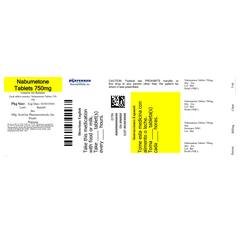
Nabumetone
DESCRIPTION Nabumetone, USP is a naphthylalkanone designated chemically as 4-(6-methoxy-2-naphthalenyl)-2-butanone. It has the following structure: Nabumetone, USP is a white to off-white crystalline substance. It is nonacidic and practically insoluble in water, but soluble in alcohol and most organic solvents. It has an n-octanol: phosphate buffer partition coefficient of 2,400 at pH 7.4. Each tablet, for oral administration, contains either 500 mg or 750 mg of nabumetone, USP. In addition, each tablet contains the following inactive ingredients: colloidal silicon dioxide, corn starch, hypromellose, magnesium stearate, povidone, sodium lauryl sulfate, sodium starch glycolate, titanium dioxide and triacetin. The 500 mg tablets also contain talc and the 750 mg tablets also contain iron oxide red.
Information page. Not necessarily available for purchase.
What is Nabumetone?
DESCRIPTION Nabumetone, USP is a naphthylalkanone designated chemically as 4-(6-methoxy-2-naphthalenyl)-2-butanone. It has the following structure: Nabumetone, USP is a white to off-white crystalline substance. It is nonacidic and practically insoluble in water, but soluble in alcohol and most organic solvents. It has an n-octanol: phosphate buffer partition coefficient of 2,400 at pH 7.4. Each tablet, for oral administration, contains either 500 mg or 750 mg of nabumetone, USP. In addition, each tablet contains the following inactive ingredients: colloidal silicon dioxide, corn starch, hypromellose, magnesium stearate, povidone, sodium lauryl sulfate, sodium starch glycolate, titanium dioxide and triacetin. The 500 mg tablets also contain talc and the 750 mg tablets also contain iron oxide red.
Uses of Nabumetone
Established uses
- INDICATIONS AND USAGE Carefully consider the potential benefits and risks of nabumetone tablets and other treatment options before deciding to use nabumetone tablets.
- Use the lowest effective dose for the shortest duration consistent with individual patient treatment goals (see WARNINGS ).
- Nabumetone tablets are indicated for relief of signs and symptoms of osteoarthritis and rheumatoid arthritis.
How to take Nabumetone
DOSAGE AND ADMINISTRATION Carefully consider the potential benefits and risks of nabumetone tablets and other treatment options before deciding to use nabumetone tablets. Use the lowest effective dose for the shortest duration consistent with individual patient treatment goals (see WARNINGS ). After observing the response to initial therapy with nabumetone tablets, the dose and frequency should be adjusted to suit an individual patient's needs. Osteoarthritis and Rheumatoid Arthritis The recommended starting dose is 1,000 mg taken as a single dose with or without food. Some patients may obtain more symptomatic relief from 1,500 mg to 2,000 mg per day. Nabumetone tablets can be given in either a single or twice-daily dose. Dosages greater than 2,000 mg per day have not been studied. The lowest effective dose should be used for chronic treatment (see WARNINGS , Renal Effects ). Patients weighing under 50 kg may be less likely to require dosages beyond 1,000 mg; therefore, after observing the response to initial therapy, the dose should be adjusted to meet individual patients' requirements.
Dosage
Follow the dose prescribed by your doctor or pharmacist. The ranges below are general information, not a personal prescription.
- Adults
- DOSAGE AND ADMINISTRATION Carefully consider the potential benefits and risks of nabumetone tablets and other treatment options before deciding to use nabumetone tablets. Use the lowest effective dose for the shortest duration consistent with individual patient treatment goals (see WARNINGS ). After observing the response to initial therapy with nabumetone tablets, the dose and frequency should be adjusted to suit an individual patient's needs. Osteoarthritis and Rheumatoid Arthritis The recommended starting dose is 1,000 mg taken as a single dose with or without food. Some patients may obtain more symptomatic relief from 1,500 mg to 2,000 mg per day. Nabumetone tablets can be given in either a single or twice-daily dose. Dosages greater than 2,000 mg per day have not been studied. The lowest effective dose should be used for chronic treatment (see WARNINGS , Renal Effects ). Patients weighing under 50 kg may be less likely to require dosages beyond 1,000 mg; therefore, after observing the response to initial therapy, the dose should be adjusted to meet individual patients' requirements.
Side effects of Nabumetone
Common
- ADVERSE REACTIONS Adverse reaction information was derived from blinded-controlled and open-labeled clinical trials and from worldwide marketing experience.
- In the description below, rates of the more common events (greater than 1%) and many of the less common events (less than 1%) represent results of U.S.
- clinical studies.
- Of the 1,677 patients who received nabumetone during U.S.
- clinical trials, 1,524 were treated for at least 1 month, 1,327 for at least 3 months, 929 for at least a year, and 750 for at least 2 years.
- More than 300 patients have been treated for 5 years or longer.
Warnings and who should not take it
Who should NOT take Nabumetone?
- CONTRAINDICATIONS Nabumetone tablets are contraindicated in patients with known hypersensitivity to nabumetone or product excipients.
- Nabumetone tablets should not be given to patients who have experienced asthma, urticaria, or allergic-type reactions after taking aspirin or other NSAIDs.
- Severe, rarely fatal, anaphylactic-like reactions to NSAIDs have been reported in such patients (see WARNINGS , Anaphylactoid Reactions and PRECAUTIONS , General , Preexisting Asthma ).
- In the setting of coronary artery bypass graft (CABG) surgery [see Warnings ].
Warnings and precautions
- WARNINGS Cardiovascular Effects Cardiovascular Thrombotic Events Clinical trials of several COX-2 selective and nonselective NSAIDs of up to three years duration have shown an increased risk of serious cardiovascular (CV) thrombotic events, including myocardial infarction (MI) and stroke, which can be fatal.
- Based on available data, it is unclear that the risk for CV thrombotic events is similar for all NSAIDs.
- The relative increase in serious CV thrombotic events over baseline conferred by NSAID use appears to be similar in those with and without known CV disease or risk factors for CV disease.
- However, patients with known CV disease or risk factors had a higher absolute incidence of excess serious CV thrombotic events, due to their increased baseline rate.
- Some observational studies found that this increased risk of serious CV thrombotic events began as early as the first weeks of treatment.
- The increase in CV thrombotic risk has been observed most consistently at higher doses.
Overdose
OVERDOSAGE Symptoms following acute NSAIDs overdoses are usually limited to lethargy, drowsiness, nausea, vomiting, and epigastric pain, which are generally reversible with supportive care. Gastrointestinal bleeding can occur. Hypertension, acute renal failure, respiratory depression, and coma may occur, but are rare. Anaphylactoid reactions have been reported with therapeutic ingestion of NSAIDs, and may occur following an overdose. Patients should be managed by symptomatic and supportive care following a NSAIDs overdose. There are no specific antidotes. Emesis and/or activated charcoal (60 to 100 grams in adults, 1 to 2 g/kg in children), and/or osmotic cathartic may be indicated in patients seen within 4 hours of ingestion with symptoms or following a large overdose (5 to 10 times the usual dose). Forced diuresis, alkalinization of urine, hemodialysis, or hemoperfusion may not be useful due to high protein binding. There have been overdoses of up to 25 grams of nabumetone reported with no long-term sequelae following standard emergency treatment (i.e., activated charcoal, gastric lavage, IV H 2 -blockers, etc.).
Safety at a glance
Fetal Toxicity Premature Closure of Fetal Ductus Arteriosus : Avoid use of NSAIDs, including nabumetone tablets, in pregnant women at about 30 weeks gestation and later. NSAIDs including nabumetone tablets, increase the risk of premature closure of the fetal ductus arteriosus at approximately this gestational age. Oligohydramnios/Neonatal Renal Impairment : Use of NSAIDs, including nabumetone tablets, at about 20 weeks gestation or later in pregnancy may cause fetal renal dysfunction leading to oligohydramnios and, in some cases, neonatal renal impairment. These adverse outcomes are seen, on average, after days to weeks of treatment, although oligohydramnios has been infrequently reported as soon as 48 hours after NSAID initiation. Oligohydramnios is often, but not always, reversible with treatment discontinuation. Complications of prolonged oligohydramnios may, for example, include limb contractures and delayed lung maturation. In some postmarketing cases of impaired neonatal renal function, invasive procedures such as exchange transfusion or dialysis were required. If NSAID treatment is necessary between about 20 weeks and 30 weeks gestation, limit nabumetone tablets use to the l
Nursing Mothers It is not known whether this drug is excreted in human milk, however 6MNA is excreted in the milk of lactating rats. Because many drugs are excreted in human milk and because of the potential for serious adverse reactions in nursing infants from nabumetone, a decision should be made whether to discontinue nursing or to discontinue the drug, taking into account the importance of the drug to the mother.
Children and elderly
Children
Pediatric Use Safety and effectiveness in pediatric patients have not been established.
Elderly
Geriatric Use As with any NSAIDs, caution should be exercised in treating the elderly (65 years and older). Of the 1,677 patients in U.S. clinical studies who were treated with nabumetone, 411 patients (24%) were 65 years or older; 22 patients (1%) were 75 years or older. No overall differences in efficacy or safety were observed between these older patients and younger ones. Similar results were observed in a 1 year, non-U.S. postmarketing surveillance study of 10,800 patients treated with nabumetone, of whom 4,577 patients (42%) were 65 years or older.
Interactions
Medicine and medicine
- Drug Interactions ACE-Inhibitors Reports suggest that NSAIDs may diminish the antihypertensive effect of ACE-inhibitors.
- This interaction should be given consideration in patients taking NSAIDs concomitantly with ACE-inhibitors.
- Aspirin When nabumetone tablets are administered with aspirin, its protein binding is reduced, although the clearance of free nabumetone is not altered.
- The clinical significance of this interaction is not known;
- however, as with other NSAIDs, concomitant administration of nabumetone tablets and aspirin is not generally recommended because of the potential of increased adverse effects.
- Diuretics Clinical studies, as well as postmarketing observations, have shown that nabumetone tablets can reduce the natriuretic effect of furosemide and thiazides in some patients.
Frequently asked questions
What is Nabumetone used for?
INDICATIONS AND USAGE Carefully consider the potential benefits and risks of nabumetone tablets and other treatment options before deciding to use nabumetone tablets., Use the lowest effective dose for the shortest duration consistent with individual patient treatment goals (see WARNINGS )., Nabumetone tablets are indicated for relief of signs and symptoms of osteoarthritis and rheumatoid arthritis..
How should I take Nabumetone?
DOSAGE AND ADMINISTRATION Carefully consider the potential benefits and risks of nabumetone tablets and other treatment options before deciding to use nabumetone tablets. Use the lowest effective dose for the shortest duration consistent with individual patient treatment goals (see WARNINGS ). After observing the response to initial therapy with nabumetone tablets, the dose and frequency should be adjusted to suit an individual patient's needs. Osteoarthritis and Rheumatoid Arthritis The recommended starting dose is 1,000 mg taken as a single dose with or without food. Some patients may obtain more symptomatic relief from 1,500 mg to 2,000 mg per day. Nabumetone tablets can be given in either a single or twice-daily dose. Dosages greater than 2,000 mg per day have not been studied. The lowest effective dose should be used for chronic treatment (see WARNINGS , Renal Effects ). Patients weighing under 50 kg may be less likely to require dosages beyond 1,000 mg; therefore, after observing the response to initial therapy, the dose should be adjusted to meet individual patients' requirements.
What are the common side effects?
ADVERSE REACTIONS Adverse reaction information was derived from blinded-controlled and open-labeled clinical trials and from worldwide marketing experience., In the description below, rates of the more common events (greater than 1%) and many of the less common events (less than 1%) represent results of U.S., clinical studies., Of the 1,677 patients who received nabumetone during U.S., clinical trials, 1,524 were treated for at least 1 month, 1,327 for at least 3 months, 929 for at least a year, and 750 for at least 2 years., More than 300 patients have been treated for 5 years or longer..
Who should not take Nabumetone?
CONTRAINDICATIONS Nabumetone tablets are contraindicated in patients with known hypersensitivity to nabumetone or product excipients.; Nabumetone tablets should not be given to patients who have experienced asthma, urticaria, or allergic-type reactions after taking aspirin or other NSAIDs.; Severe, rarely fatal, anaphylactic-like reactions to NSAIDs have been reported in such patients (see WARNINGS , Anaphylactoid Reactions and PRECAUTIONS , General , Preexisting Asthma ).; In the setting of coronary artery bypass graft (CABG) surgery [see Warnings ]..
Can I take Nabumetone during pregnancy?
Fetal Toxicity Premature Closure of Fetal Ductus Arteriosus : Avoid use of NSAIDs, including nabumetone tablets, in pregnant women at about 30 weeks gestation and later. NSAIDs including nabumetone tablets, increase the risk of premature closure of the fetal ductus arteriosus at approximately this gestational age. Oligohydramnios/Neonatal Renal Impairment : Use of NSAIDs, including nabumetone tablets, at about 20 weeks gestation or later in pregnancy may cause fetal renal dysfunction leading to oligohydramnios and, in some cases, neonatal renal impairment. These adverse outcomes are seen, on average, after days to weeks of treatment, although oligohydramnios has been infrequently reported as soon as 48 hours after NSAID initiation. Oligohydramnios is often, but not always, reversible with treatment discontinuation. Complications of prolonged oligohydramnios may, for example, include limb contractures and delayed lung maturation. In some postmarketing cases of impaired neonatal renal function, invasive procedures such as exchange transfusion or dialysis were required. If NSAID treatment is necessary between about 20 weeks and 30 weeks gestation, limit nabumetone tablets use to the l
Can I take Nabumetone while breastfeeding?
Nursing Mothers It is not known whether this drug is excreted in human milk, however 6MNA is excreted in the milk of lactating rats. Because many drugs are excreted in human milk and because of the potential for serious adverse reactions in nursing infants from nabumetone, a decision should be made whether to discontinue nursing or to discontinue the drug, taking into account the importance of the drug to the mother.
Can children take Nabumetone?
Pediatric Use Safety and effectiveness in pediatric patients have not been established.
Does Nabumetone interact with other medicines?
Drug Interactions ACE-Inhibitors Reports suggest that NSAIDs may diminish the antihypertensive effect of ACE-inhibitors.; This interaction should be given consideration in patients taking NSAIDs concomitantly with ACE-inhibitors.; Aspirin When nabumetone tablets are administered with aspirin, its protein binding is reduced, although the clearance of free nabumetone is not altered.; The clinical significance of this interaction is not known;; however, as with other NSAIDs, concomitant administration of nabumetone tablets and aspirin is not generally recommended because of the potential of increased adverse effects.; Diuretics Clinical studies, as well as postmarketing observations, have shown that nabumetone tablets can reduce the natriuretic effect of furosemide and thiazides in some patients..
Medicine information on IMCURE is provided for educational purposes and is not a substitute for diagnosis, prescription or medical advice. Always follow your doctor’s or pharmacist’s instructions. Real product image from the U.S. National Library of Medicine's DailyMed listing for Nabumetone Tablet. Packaging varies by brand and manufacturer.