
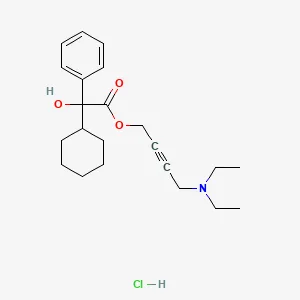
antimuscarinicPrescription only (Schedule H)Jan Aushadhi listed
Oxybutynin Chloride
ओक्सिबुटिनिन क्लोराइड
Oxybutynin chloride is a tablet for relief of bladder instability symptoms, such as urgency, frequency and urge incontinence, in neurogenic bladder. It can cause drowsiness, confusion and rarely dangerous swelling of the face or throat. Ask your doctor or pharmacist before use.
- Generic name
- Oxybutynin Chloride
- Used for
- Relieving bladder symptoms such as urgency, frequency and leakage in neurogenic bladder.
- Label used
- Tablets label, oral, DailyMed set 1a08a16a, effective 2026-07
- Prescription status (India)
- Prescription only (Schedule H) in the lists we checked
- On NLEM 2022
- Not found in the list we checked
- NPPA price ceiling
- Not listed in the lists we checked
More facts
- Jan Aushadhi
- Listed (1 product row)
- Banned combinations
- None found in the list we checked
Compiled from official drug labels and Indian government sources. Always follow your doctor's or pharmacist's advice.
Safety at a glance
- AlcoholNot mentioned in label text
- PregnancyCaution in label textSee wording
- BreastfeedingCaution in label textSee wording
- DrivingCaution in label textSee wording
- KidneyCaution in label textSee wording
- LiverCaution in label textSee wording
Taken only from the label text cited on this page. "Not mentioned" does not mean safe. Ask your doctor or pharmacist.
What is oxybutynin chloride used for?
The label describes oxybutynin chloride for relief of symptoms of bladder instability associated with voiding, in people with uninhibited or reflex neurogenic bladder.
The symptoms named include urgency, frequency, urinary leakage, urge incontinence and painful urination.
- Urgency and frequency
- Urinary leakage and urge incontinence
- Painful urination
- In neurogenic bladder
Oxybutynin is used for bladder urgency and leakage caused by nerve-related bladder problems.
Source1
How does oxybutynin chloride work?
The label says oxybutynin relaxes bladder smooth muscle. It has a direct antispasmodic effect and blocks the muscarinic action of acetylcholine on smooth muscle.
It relaxes the bladder muscle so the bladder spasms less.
How is oxybutynin chloride usually taken?
This page covers the US label for oxybutynin chloride tablets taken by mouth, with the dosing the label gives for adults and, where the label says so, children.
This is label-level information, not personal advice. Indian pack labels may differ, and your prescriber's instruction always comes first.
For adults, the label describes the usual dose as one 5 mg tablet two to three times a day, with a maximum of one 5 mg tablet four times a day.
For frail elderly people, a lower starting dose of 2.5 mg two or three times a day is described.
For children over 5 years, the usual dose is one 5 mg tablet twice a day, with a maximum of one 5 mg tablet three times a day.
- Adults: 5 mg two to three times daily
- Maximum 5 mg four times daily
- Frail elderly: 2.5 mg two or three times daily
- Children over 5: 5 mg twice daily
The label describes 5 mg tablets two to three times a day, with lower doses for frail elderly people.
Source1
What are the side effects of oxybutynin chloride?
Common
- The label says the most common effects are the expected anticholinergic ones, such as dry mouth, which is dose-related. Other reported effects include constipation, dry eyes, dry throat, nasal dryness, palpitations and headache.
- Dry mouth
- Constipation
- Drowsiness
- Confusion
- Dry eyes and nasal dryness
Serious: get help
- Central nervous system effects such as hallucinations, agitation, confusion and drowsiness have been reported. Angioedema of the face, lips, tongue or larynx can be life-threatening.
Dry mouth is the most common effect; confusion and swelling of the face or throat are serious.
Source1
Who should be careful with oxybutynin chloride?
The label says oxybutynin is contraindicated in urinary retention, gastric retention and other severe slow gut conditions, uncontrolled narrow-angle glaucoma, and known allergy to it.
The label advises caution in the frail elderly, in liver or kidney impairment, and in dementia treated with cholinesterase inhibitors, Parkinson's disease, myasthenia gravis, and bladder outflow obstruction.
The label says its safety in pregnant women has not been established. It is not known whether it passes into breast milk, so caution is advised.
- Urinary or gastric retention
- Uncontrolled narrow-angle glaucoma
- Angioedema can be life-threatening
- Caution in frail elderly, dementia, Parkinson's disease
- Caution in liver or kidney impairment
- Pregnancy and breastfeeding: caution
It must not be used with urinary retention or uncontrolled glaucoma, and can cause confusion in older adults.
Source1
What medicines interact with oxybutynin chloride?
- Other anticholinergic drugs
- Ketoconazole, itraconazole, miconazole
- Erythromycin and clarithromycin
- Metoclopramide
- The label says other anticholinergic drugs or drugs causing dry mouth, constipation or drowsiness may increase these effects.
- Ketoconazole raised oxybutynin levels about 3 to 4 times.
- Other CYP3A4 inhibitors such as itraconazole, miconazole, erythromycin and clarithromycin may also change levels, so caution is advised.
- It may also antagonize prokinetic agents such as metoclopramide.
No match in this label text. Ask your pharmacist about any medicine you take.
Other anticholinergic drugs and some antifungals and antibiotics can interact with oxybutynin.
Source1
How should oxybutynin chloride be stored?
The label gives a storage range of 20 to 25 degrees C.
The label also says to keep the container tightly closed.
Follow the storage line on your own pack, and keep medicines out of the reach of children.
Follow the storage instructions on your pack.
Source1
Is oxybutynin chloride a prescription medicine in India?
In the Drugs Rules schedules we checked, oxybutynin chloride is listed under Schedule H (serial and rule: Schedule H, serial 378 (rules 65 and 97)). Schedule H medicines are sold only on a registered doctor's prescription.
We did not find oxybutynin chloride on the National List of Essential Medicines 2022 in the list we checked.
The Jan Aushadhi (PMBJP) list we checked has 1 product row that mention oxybutynin chloride. We did not capture prices for them.
Prescription medicine (Schedule H), not found on NLEM 2022.
What is the price ceiling for oxybutynin chloride?
Jan Aushadhi lists oxybutynin chloride products including Oxybutynin Chloride 2.5mg Tablets 2.5mg. We have not shown a price for them. Check the pack and the seller for the actual price.
NPPA lists per-unit ceilings where a formulation is scheduled. Check the pack and seller.
Source3
Frequently asked questions
Can I drink alcohol while taking oxybutynin chloride?
The label we reviewed does not say. Ask your doctor or pharmacist.
Source1
Is oxybutynin chloride safe in pregnancy and breastfeeding?
The label says safety in pregnancy has not been established and it is not known if it passes into milk. Ask your doctor or pharmacist.
Source1
Should oxybutynin chloride be taken with food?
The label we reviewed does not say. Ask your doctor or pharmacist.
Source1
Can oxybutynin chloride affect driving or alertness?
The label lists drowsiness and confusion as possible effects. Ask your doctor or pharmacist about driving.
Source1
Can children or older adults take oxybutynin chloride?
The label describes use in children over 5 years and a lower starting dose for the frail elderly. Ask your doctor or pharmacist.
Source1
Sources
- 1U.S. FDA-approved label (DailyMed) (1a08a16a-f16d-4ef1-95bb-6943bcae0737) Open source · 2026-10-15
- 2U.S. FDA-approved label (DailyMed) (0c71bdfb-01db-49ac-a8e9-0037df0d24af) Open source · 2026-10-15
- 3PMBJP (Jan Aushadhi) product list (p71:sno1553) Open source · 2026-10-15
- 4Drugs Rules 1945, Schedules (2022 consolidation) (Schedule H, Schedule H, serial 378 (rules 65 and 97)) Open source · 2026-10-15
Compiled by software from the sources above and checked by automated rules. Last checked: 2026-10-15 · How we use sources · Report a correction
This information is educational and is not a substitute for advice from your doctor or pharmacist. It does not tell you what dose you personally should take. In an emergency call 112.