
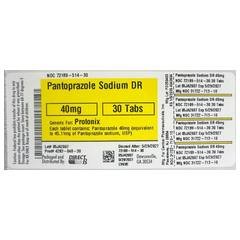
Pantoprazole Sodium Dr
The active ingredient in Pantoprazole Sodium Delayed-Release Tablets, USP, a PPI, is a substituted benzimidazole, 5-(Difluoromethoxy)-2-[[(3,4-dimethoxy-2-pyridyl)methyl] sulfinyl]benzimidazole, sodium salt, sesquihydrate, a compound that inhibits gastric acid secretion. Its empirical formula is C 16H 14F 2N 3NaO 4S . 1.5 H 2O, with a molecular weight of 432.4. The structural formula is: Pantoprazole sodium sesquihydrate, USP is a white to off-white powder. Pantoprazole sodium sesquihydrate, USP is freely soluble in water, in methanol, in dehydrated alcohol, practically insoluble in hexane and dichloromethane. The stability of the compound in aqueous solution is pH-dependent. The rate of degradation increases with decreasing pH. At ambient temperature, the degradation half-life is approximately 2.8 hours at pH 5 and approximately 220 hours at pH 7.8. Pantoprazole Sodium is supplied as a Delayed-Release Tablet, available in two strengths (20 mg and 40 mg). Each Pantoprazole Sodium Delayed-Release Tablet, USP contains 45.11 mg or 22.55 mg of pantoprazole sodium sesquihydrate, USP (equivalent to 40 mg or 20 mg pantoprazole, respectively) with the following inactive ingredients: calciu
Information page. Not necessarily available for purchase.
What is Pantoprazole Sodium Dr?
The active ingredient in Pantoprazole Sodium Delayed-Release Tablets, USP, a PPI, is a substituted benzimidazole, 5-(Difluoromethoxy)-2-[[(3,4-dimethoxy-2-pyridyl)methyl] sulfinyl]benzimidazole, sodium salt, sesquihydrate, a compound that inhibits gastric acid secretion. Its empirical formula is C 16H 14F 2N 3NaO 4S . 1.5 H 2O, with a molecular weight of 432.4. The structural formula is: Pantoprazole sodium sesquihydrate, USP is a white to off-white powder. Pantoprazole sodium sesquihydrate, USP is freely soluble in water, in methanol, in dehydrated alcohol, practically insoluble in hexane and dichloromethane. The stability of the compound in aqueous solution is pH-dependent. The rate of degradation increases with decreasing pH. At ambient temperature, the degradation half-life is approximately 2.8 hours at pH 5 and approximately 220 hours at pH 7.8. Pantoprazole Sodium is supplied as a Delayed-Release Tablet, available in two strengths (20 mg and 40 mg). Each Pantoprazole Sodium Delayed-Release Tablet, USP contains 45.11 mg or 22.55 mg of pantoprazole sodium sesquihydrate, USP (equivalent to 40 mg or 20 mg pantoprazole, respectively) with the following inactive ingredients: calciu
Uses of Pantoprazole Sodium Dr
Established uses
- Pantoprazole Sodium Delayed-Release Tablets are indicated for: 1.1 Short-Term Treatment of Erosive Esophagitis Associated With Gastroesophageal Reflux Disease (GERD) Pantoprazole Sodium Delayed-Release Tablet is indicated in adults and pediatric patients five years of age and older for the short-term treatment (up to 8 weeks) in the healing and symptomatic relief of erosive esophagitis (EE).
- For those adult patients who have not healed after 8 weeks of treatment, an additional 8-week course of pantoprazole sodium delayed-release tablets may be considered.
- Safety of treatment beyond 8 weeks in pediatric patients has not been established.
- 1.2 Maintenance of Healing of Erosive Esophagitis Pantoprazole Sodium Delayed-Release Tablets are indicated for maintenance of healing of EE and reduction in relapse rates of daytime and nighttime heartburn symptoms in adult patients with GERD.
- Controlled studies did not extend beyond 12 months.
- 1.3 Pathological Hypersecretory Conditions Including Zollinger-Ellison Syndrome Pantoprazole Sodium Delayed-Release Tablets are indicated for the long-term treatment of pathological hypersecretory conditions, including Zollinger-Ellison (ZE) Syndrome.
How to take Pantoprazole Sodium Dr
2.1 Recommended Dosing Schedule Pantoprazole sodium is supplied as delayed-release tablets. The recommended dosages are outlined in Table 1. Table 1: Recommended Dosing Schedule for Pantoprazole Sodium Delayed-Release Tablets Indication Dose Frequency Short-Term Treatment of Erosive Esophagitis Associated With GERD Adults 40 mg Once daily for up to 8 weeks* Children (5 years and older) ≥ 15 kg to < 40 kg ≥ 40 kg 20 mg Once daily for up to 8 weeks 40 mg Maintenance of Healing of Erosive Esophagitis Adults 40 mg Once daily*** Pathological Hypersecretory Conditions Including Zollinger-Ellison Syndrome Adults 40 mg Twice daily ** * For adult patients who have not healed after 8 weeks of treatment, an additional 8-week course of pantoprazole sodium delayed-release tablets may be considered. ** Dosage regimens should be adjusted to individual patient needs and should continue for as long as clinically indicated. Doses up to 240 mg daily have been administered. *** Controlled studies did not extend beyond 12 months. 2.2 Administration Instructions Directions for method of administration for each dosage form are presented in Table 2. Table 2: Administration Instructions Formulation Route I
Dosage
Follow the dose prescribed by your doctor or pharmacist. The ranges below are general information, not a personal prescription.
- Adults
- 2.1 Recommended Dosing Schedule Pantoprazole sodium is supplied as delayed-release tablets. The recommended dosages are outlined in Table 1. Table 1: Recommended Dosing Schedule for Pantoprazole Sodium Delayed-Release Tablets Indication Dose Frequency Short-Term Treatment of Erosive Esophagitis Associated With GERD Adults 40 mg Once daily for up to 8 weeks* Children (5 years and older) ≥ 15 kg to < 40 kg ≥ 40 kg 20 mg Once daily for up to 8 weeks 40 mg Maintenance of Healing of Erosive Esophagitis Adults 40 mg Once daily*** Pathological Hypersecretory Conditions Including Zollinger-Ellison Syndrome Adults 40 mg Twice daily ** * For adult patients who have not healed after 8 weeks of treatment, an additional 8-week course of pantoprazole sodium delayed-release tablets may be considered. ** Dosage regimens should be adjusted to individual patient needs and should continue for as long as clinically indicated. Doses up to 240 mg daily have been administered. *** Controlled studies did not extend beyond 12 months. 2.2 Administration Instructions Directions for method of administration for each dosage form are presented in Table 2. Table 2: Administration Instructions Formulation Route I
Side effects of Pantoprazole Sodium Dr
Common
- The following serious adverse reactions are described below and elsewhere in labeling: • Acute Tubulointerstitial Nephritis [see Warnings and Precautions (5.2)] • Clostridium difficile-Associated Diarrhea [see Warnings and Precautions (5.3)] • Bone Fracture [see Warnings and Precautions (5.4)] • Severe Cutaneous Adverse Reactions [see Warnings and Precautions ( 5.5)] • Cutaneous and Systemic Lupus Erythematosus [see Warnings and Precautions ( 5.6)] • Cyanocobalamin (Vitamin B-12) Deficiency [see Warnings and Precautions ( 5.7)] • Hypomagnesemia and Mineral Metabolism [see Warnings and Precautions ( 5.8)] • Fundic Gland Polyps [see Warnings and Precautions (5.10)] 6.1 Clinical Trials Experience The adverse reaction profiles for Pantoprazole Sodium For Delayed-Release Oral Suspension and Pantoprazole Sodium Delayed-Release Tablets are similar.
- Because clinical trials are conducted under widely varying conditions, adverse reaction rates observed in the clinical trials of a drug cannot be directly compared to rates in the clinical trials of another drug and may not reflect the rates observed in clinical practice.
- Adults Safety in nine randomized comparative US clinical trials in patien
Warnings and who should not take it
Who should NOT take Pantoprazole Sodium Dr?
- Pantoprazole sodium delayed-release tablets are contraindicated in patients with known hypersensitivity to any component of the formulation or any substituted benzimidazole.
- Hypersensitivity reactions may include anaphylaxis, anaphylactic shock, angioedema, bronchospasm, acute tubulointerstitial nephritis, and urticaria [see Warnings and Precautions ( 5.2), Adverse Reactions ( 6)].
- Proton pump inhibitors (PPIs), including pantoprazole sodium delayed-release tablets, are contraindicated in patients receiving rilpivirine-containing products [see Drug Interactions ( 7)].
Overdose
Experience in patients taking very high doses of pantoprazole sodium (greater than 240 mg) is limited. Spontaneous post-marketing reports of overdose are generally within the known safety profile of pantoprazole sodium. Pantoprazole is not removed by hemodialysis. In case of overdosage, treatment should be symptomatic and supportive. Single oral doses of pantoprazole at 709 mg/kg, 798 mg/kg, and 887 mg/kg were lethal to mice, rats, and dogs, respectively. The symptoms of acute toxicity were hypoactivity, ataxia, hunched sitting, limb-splay, lateral position, segregation, absence of ear reflex, and tremor. If overexposure to pantoprazole sodium occurs, call your Poison Control Center at 1-800-222-1222 for current information on the management of poisoning or overdosage.
Interactions
Medicine and medicine
- Table 4 includes drugs with clinically important drug interactions and interaction with diagnostics when administered concomitantly with pantoprazole sodium and instructions for preventing or managing them.
- Consult the labeling of concomitantly used drugs to obtain further information about interactions with PPIs.
- Table 4: Clinically Relevant Interactions Affecting Drugs Co-Administered with Pantoprazole Sodium and Interactions with Diagnostics Antiretrovirals Clinical Impact: The effect of PPIs on antiretroviral drugs is variable.
- The clinical importance and the mechanisms behind these interactions are not always known.
- Decreased exposure of some antiretroviral drugs (e.g., rilpivirine atazanavir, and nelfinavir) when used concomitantly with pantoprazole may reduce antiviral effect and promote the development of drug resistance.
- Increased exposure of other antiretroviral drugs (e.g., saquinavir) when used concomitantly with pantoprazole may increase toxicity of the antiretroviral drugs.
Frequently asked questions
What is Pantoprazole Sodium Dr used for?
Pantoprazole Sodium Delayed-Release Tablets are indicated for: 1.1 Short-Term Treatment of Erosive Esophagitis Associated With Gastroesophageal Reflux Disease (GERD) Pantoprazole Sodium Delayed-Release Tablet is indicated in adults and pediatric patients five years of age and older for the short-term treatment (up to 8 weeks) in the healing and symptomatic relief of erosive esophagitis (EE)., For those adult patients who have not healed after 8 weeks of treatment, an additional 8-week course of pantoprazole sodium delayed-release tablets may be considered., Safety of treatment beyond 8 weeks in pediatric patients has not been established., 1.2 Maintenance of Healing of Erosive Esophagitis Pantoprazole Sodium Delayed-Release Tablets are indicated for maintenance of healing of EE and reduction in relapse rates of daytime and nighttime heartburn symptoms in adult patients with GERD., Controlled studies did not extend beyond 12 months., 1.3 Pathological Hypersecretory Conditions Including Zollinger-Ellison Syndrome Pantoprazole Sodium Delayed-Release Tablets are indicated for the long-term treatment of pathological hypersecretory conditions, including Zollinger-Ellison (ZE) Syndrome..
How should I take Pantoprazole Sodium Dr?
2.1 Recommended Dosing Schedule Pantoprazole sodium is supplied as delayed-release tablets. The recommended dosages are outlined in Table 1. Table 1: Recommended Dosing Schedule for Pantoprazole Sodium Delayed-Release Tablets Indication Dose Frequency Short-Term Treatment of Erosive Esophagitis Associated With GERD Adults 40 mg Once daily for up to 8 weeks* Children (5 years and older) ≥ 15 kg to < 40 kg ≥ 40 kg 20 mg Once daily for up to 8 weeks 40 mg Maintenance of Healing of Erosive Esophagitis Adults 40 mg Once daily*** Pathological Hypersecretory Conditions Including Zollinger-Ellison Syndrome Adults 40 mg Twice daily ** * For adult patients who have not healed after 8 weeks of treatment, an additional 8-week course of pantoprazole sodium delayed-release tablets may be considered. ** Dosage regimens should be adjusted to individual patient needs and should continue for as long as clinically indicated. Doses up to 240 mg daily have been administered. *** Controlled studies did not extend beyond 12 months. 2.2 Administration Instructions Directions for method of administration for each dosage form are presented in Table 2. Table 2: Administration Instructions Formulation Route I
What are the common side effects?
The following serious adverse reactions are described below and elsewhere in labeling: • Acute Tubulointerstitial Nephritis [see Warnings and Precautions (5.2)] • Clostridium difficile-Associated Diarrhea [see Warnings and Precautions (5.3)] • Bone Fracture [see Warnings and Precautions (5.4)] • Severe Cutaneous Adverse Reactions [see Warnings and Precautions ( 5.5)] • Cutaneous and Systemic Lupus Erythematosus [see Warnings and Precautions ( 5.6)] • Cyanocobalamin (Vitamin B-12) Deficiency [see Warnings and Precautions ( 5.7)] • Hypomagnesemia and Mineral Metabolism [see Warnings and Precautions ( 5.8)] • Fundic Gland Polyps [see Warnings and Precautions (5.10)] 6.1 Clinical Trials Experience The adverse reaction profiles for Pantoprazole Sodium For Delayed-Release Oral Suspension and Pantoprazole Sodium Delayed-Release Tablets are similar., Because clinical trials are conducted under widely varying conditions, adverse reaction rates observed in the clinical trials of a drug cannot be directly compared to rates in the clinical trials of another drug and may not reflect the rates observed in clinical practice., Adults Safety in nine randomized comparative US clinical trials in patien.
Who should not take Pantoprazole Sodium Dr?
Pantoprazole sodium delayed-release tablets are contraindicated in patients with known hypersensitivity to any component of the formulation or any substituted benzimidazole.; Hypersensitivity reactions may include anaphylaxis, anaphylactic shock, angioedema, bronchospasm, acute tubulointerstitial nephritis, and urticaria [see Warnings and Precautions ( 5.2), Adverse Reactions ( 6)].; Proton pump inhibitors (PPIs), including pantoprazole sodium delayed-release tablets, are contraindicated in patients receiving rilpivirine-containing products [see Drug Interactions ( 7)]..
Does Pantoprazole Sodium Dr interact with other medicines?
Table 4 includes drugs with clinically important drug interactions and interaction with diagnostics when administered concomitantly with pantoprazole sodium and instructions for preventing or managing them.; Consult the labeling of concomitantly used drugs to obtain further information about interactions with PPIs.; Table 4: Clinically Relevant Interactions Affecting Drugs Co-Administered with Pantoprazole Sodium and Interactions with Diagnostics Antiretrovirals Clinical Impact: The effect of PPIs on antiretroviral drugs is variable.; The clinical importance and the mechanisms behind these interactions are not always known.; Decreased exposure of some antiretroviral drugs (e.g., rilpivirine atazanavir, and nelfinavir) when used concomitantly with pantoprazole may reduce antiviral effect and promote the development of drug resistance.; Increased exposure of other antiretroviral drugs (e.g., saquinavir) when used concomitantly with pantoprazole may increase toxicity of the antiretroviral drugs..
How should it be stored?
Storage Store pantoprazole sodium delayed-release tablets, USP at 20° to 25°C (68° to 77°F) [see USP Controlled Room Temperature].
Medicine information on IMCURE is provided for educational purposes and is not a substitute for diagnosis, prescription or medical advice. Always follow your doctor’s or pharmacist’s instructions. Real product image from the U.S. National Library of Medicine's DailyMed listing for Pantoprazole Sodium Dr Tablet, Delayed Release. Packaging varies by brand and manufacturer.