
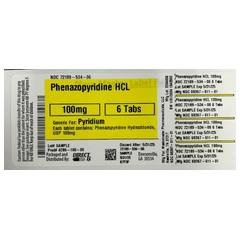
Phenazopyridine Hcl
Phenazopyridine Hydrochloride is a reddish-brown, odorless, slightly bitter, crystalline powder. It has a specific local analgesic effect in the urinary tract, promptly relieving burning and pain. Following is the structural formula: [Chemical Structure] C11H11N5 ∙ HCl M.W. 249.70 Phenazopyridine Hydrochloride oral tablets contain the following inactive ingredients: Croscarmellose Sodium, D&C Yellow #10 Aluminum Lake, FD&C Blue #1 Aluminum Lake, FD&C Red #40 Aluminum Lake, FD&C Yellow #6 Aluminum Lake, Magnesium Stearate, Microcrystalline Cellulose, Polyethylene Glycol, Polyvinyl Alcohol, Povidone, Pregelatinized Starch, Talc, and Titanium Dioxide.
Information page. Not necessarily available for purchase.
What is Phenazopyridine Hcl?
Phenazopyridine Hydrochloride is a reddish-brown, odorless, slightly bitter, crystalline powder. It has a specific local analgesic effect in the urinary tract, promptly relieving burning and pain. Following is the structural formula: [Chemical Structure] C11H11N5 ∙ HCl M.W. 249.70 Phenazopyridine Hydrochloride oral tablets contain the following inactive ingredients: Croscarmellose Sodium, D&C Yellow #10 Aluminum Lake, FD&C Blue #1 Aluminum Lake, FD&C Red #40 Aluminum Lake, FD&C Yellow #6 Aluminum Lake, Magnesium Stearate, Microcrystalline Cellulose, Polyethylene Glycol, Polyvinyl Alcohol, Povidone, Pregelatinized Starch, Talc, and Titanium Dioxide.
Uses of Phenazopyridine Hcl
Established uses
- Phenazopyridine Hydrochloride is indicated for the symptomatic relief of pain, burning, urgency frequency, and other discomforts arising from irritation of the mucosa of the lower urinary tract caused by infection, trauma, surgery, endoscopic procedures, or the passage of sounds or catheters.
- The use of Phenazopyridine Hydrochloride for relief of symptoms should not delay definitive diagnosis and treatment of causative conditions.
- The drug should be used for symptomatic relief of pain and not as a substitute for specific surgery or antimicrobial therapy.
- Phenazopyridine Hydrochloride is compatible with antimicrobial therapy and can help relieve pain and discomfort during the interval before antimicrobial therapy controls the infection.
- Treatment of a urinary tract infection with Phenazopyridine Hydrochloride should not exceed 2 days.
- There is no evidence that the combined administration of Phenazopyridine Hydrochloride and an antimicrobial provides greater benefit than administration of the antimicrobial alone after 2 days.
How to take Phenazopyridine Hcl
100 mg Tablets: Average adult dosage is two tablets 3 times a day after meals. 200 mg Tablets: Average adult dosage is one tablet 3 times a day after meals. When used concomitantly with an antibacterial agent for the treatment of a urinary tract infection, the administration of Phenazopyridine Hydrochloride should not exceed 2 days.
Dosage
Follow the dose prescribed by your doctor or pharmacist. The ranges below are general information, not a personal prescription.
- Adults
- 100 mg Tablets: Average adult dosage is two tablets 3 times a day after meals. 200 mg Tablets: Average adult dosage is one tablet 3 times a day after meals. When used concomitantly with an antibacterial agent for the treatment of a urinary tract infection, the administration of Phenazopyridine Hydrochloride should not exceed 2 days.
Side effects of Phenazopyridine Hcl
Common
- The following adverse events have been reported: CNS: headache.
- Gastrointestinal: nausea, vomiting and diarrhea.
- Dermatologic and Hypersensitivity: rash, pruritus, discoloration, anaphylactoid-like reaction and hypersensitivity hepatitis.
- Hematologic: methemoglobinemia, hemolytic anemia, potential hemolytic agent in G-6-PD deficiency, sulfhemoglobinemia.
- Other: visual disturbances, renal and hepatic toxicity usually associated with overdose, renal calculi, jaundice, discoloration of body fluids and aseptic meningitis.
Warnings and who should not take it
Who should NOT take Phenazopyridine Hcl?
- Phenazopyridine Hydrochloride should not be used in patients who are hypersensitive to the drug or its ingredients.
- Phenazopyridine Hydrochloride is contraindicated in patients with renal insufficiency, severe liver disease, severe hepatitis or pyelonephritis of pregnancy.
- It should be used cautiously in the presence of GI disturbances.
Warnings and precautions
- Phenazopyridine Hydrochloride is reasonably anticipated to be a human carcinogen based on sufficient evidence of carcinogenicity in experimental animals (IARC 1980, 1982, 1987, NCI 1978).
- When administered in the diet, Phenazopyridine hydrochloride increased the incidences of hepatocellular adenomas and carcinomas in female mice and adenomas and adenocarcinomas of the colon and rectum in rats of both sexes.
- There is inadequate evidence for the carcinogenicity of Phenazopyridine hydrochloride in humans (TARC 1987).
- In one limited epidemiological study, no significant excess of any cancer was observed among 2,214 patients who received Phenazopyridine hydrochloride and were followed for a minimum of 3 years.
Frequently asked questions
What is Phenazopyridine Hcl used for?
Phenazopyridine Hydrochloride is indicated for the symptomatic relief of pain, burning, urgency frequency, and other discomforts arising from irritation of the mucosa of the lower urinary tract caused by infection, trauma, surgery, endoscopic procedures, or the passage of sounds or catheters., The use of Phenazopyridine Hydrochloride for relief of symptoms should not delay definitive diagnosis and treatment of causative conditions., The drug should be used for symptomatic relief of pain and not as a substitute for specific surgery or antimicrobial therapy., Phenazopyridine Hydrochloride is compatible with antimicrobial therapy and can help relieve pain and discomfort during the interval before antimicrobial therapy controls the infection., Treatment of a urinary tract infection with Phenazopyridine Hydrochloride should not exceed 2 days., There is no evidence that the combined administration of Phenazopyridine Hydrochloride and an antimicrobial provides greater benefit than administration of the antimicrobial alone after 2 days..
How should I take Phenazopyridine Hcl?
100 mg Tablets: Average adult dosage is two tablets 3 times a day after meals. 200 mg Tablets: Average adult dosage is one tablet 3 times a day after meals. When used concomitantly with an antibacterial agent for the treatment of a urinary tract infection, the administration of Phenazopyridine Hydrochloride should not exceed 2 days.
What are the common side effects?
The following adverse events have been reported: CNS: headache., Gastrointestinal: nausea, vomiting and diarrhea., Dermatologic and Hypersensitivity: rash, pruritus, discoloration, anaphylactoid-like reaction and hypersensitivity hepatitis., Hematologic: methemoglobinemia, hemolytic anemia, potential hemolytic agent in G-6-PD deficiency, sulfhemoglobinemia., Other: visual disturbances, renal and hepatic toxicity usually associated with overdose, renal calculi, jaundice, discoloration of body fluids and aseptic meningitis..
Who should not take Phenazopyridine Hcl?
Phenazopyridine Hydrochloride should not be used in patients who are hypersensitive to the drug or its ingredients.; Phenazopyridine Hydrochloride is contraindicated in patients with renal insufficiency, severe liver disease, severe hepatitis or pyelonephritis of pregnancy.; It should be used cautiously in the presence of GI disturbances..
How should it be stored?
STORE at 20° to 25°C (68° to 77°F) with excursions permitted to 15° to 30°C (59° to 86°F) [See USP Controlled Room Temperature]. To report an adverse reaction, please contact Westminster Pharmaceuticals, LLC at 1-844-221-7294 KEEP THIS AND ALL MEDICATION OUT OF THE REACH OF CHILDREN.
Medicine information on IMCURE is provided for educational purposes and is not a substitute for diagnosis, prescription or medical advice. Always follow your doctor’s or pharmacist’s instructions. Real product image from the U.S. National Library of Medicine's DailyMed listing for Phenazopyridine Hcl Tablet. Packaging varies by brand and manufacturer.