
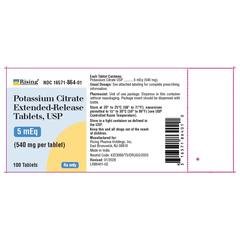
Potassium Citrate
11 DESCRIPTION Potassium citrate extended-release tablets are a citrate salt of potassium. Its empirical formula is K 3 C 6 H 5 O 7 • H 2 O, and it has the following chemical structure: Potassium citrate extended-release tablets are off white to tan yellowish, oral wax-matrix tablets, contain 5 mEq (540 mg) potassium citrate, 10 mEq (1080 mg) potassium citrate and 15 mEq (1620 mg) potassium citrate each. Inactive ingredients include carnauba wax, silicon dioxide and magnesium stearate. FDA approved dissolution test specifications differ from USP.
Information page. Not necessarily available for purchase.
What is Potassium Citrate?
11 DESCRIPTION Potassium citrate extended-release tablets are a citrate salt of potassium. Its empirical formula is K 3 C 6 H 5 O 7 • H 2 O, and it has the following chemical structure: Potassium citrate extended-release tablets are off white to tan yellowish, oral wax-matrix tablets, contain 5 mEq (540 mg) potassium citrate, 10 mEq (1080 mg) potassium citrate and 15 mEq (1620 mg) potassium citrate each. Inactive ingredients include carnauba wax, silicon dioxide and magnesium stearate. FDA approved dissolution test specifications differ from USP.
Uses of Potassium Citrate
Established uses
- 1 INDICATIONS AND USAGE Potassium citrate extended-release tablets are a citrate salt of potassium indicated for the management of: Renal tubular acidosis (RTA) with calcium stones (1.1) Hypocitraturic calcium oxalate nephrolithiasis of any etiology (1.2) Uric acid lithiasis with or without calcium stones (1.3) 1.1 Renal Tubular Acidosis (RTA) with Calcium Stones Potassium citrate is indicated for the management of renal tubular acidosis [see Clinical Studies (14.1)].
- 1.2 Hypocitraturic Calcium Oxalate Nephrolithiasis of any Etiology Potassium citrate is indicated for the management of Hypocitraturic calcium oxalate nephrolithiasis [see Clinical Studies (14.2)] .
- 1.3 Uric Acid Lithiasis with or without Calcium Stones Potassium citrate is indicated for the management of Uric acid lithiasis with or without calcium stones [see Clinical Studies (14.3)].
How to take Potassium Citrate
2 DOSAGE AND ADMINISTRATION Objective: To restore normal urinary citrate (greater than 320 mg/day and as close to the normal mean of 640 mg/day as possible), and to increase urinary pH to a level of 6.0 to 7.0. Severe hypocitraturia (urinary citrate < 150 mg/day): therapy should be initiated at 60 mEq per day; a dose of 30 mEq two times per day or 20 mEq three times per day with meals or within 30 minutes after meals or bedtime snack (2.2) Mild to moderate hypocitraturia (urinary citrate >150 mg/day): therapy should be initiated at 30 mEq per day; a dose of 15 mEq two times per day or 10 mEq three times per day with meals or within 30 minutes after meals or bedtime snack (2.3) 2.1 Dosing Instructions Treatment with extended release potassium citrate should be added to a regimen that limits salt intake (avoidance of foods with high salt content and of added salt at the table) and encourages high fluid intake (urine volume should be at least two liters per day). The objective of treatment with potassium citrate extended-release tablets is to provide potassium citrate in sufficient dosage to restore normal urinary citrate (greater than 320 mg/day and as close to the normal mean of 640
Dosage
Follow the dose prescribed by your doctor or pharmacist. The ranges below are general information, not a personal prescription.
- Adults
- 2 DOSAGE AND ADMINISTRATION Objective: To restore normal urinary citrate (greater than 320 mg/day and as close to the normal mean of 640 mg/day as possible), and to increase urinary pH to a level of 6.0 to 7.0. Severe hypocitraturia (urinary citrate < 150 mg/day): therapy should be initiated at 60 mEq per day; a dose of 30 mEq two times per day or 20 mEq three times per day with meals or within 30 minutes after meals or bedtime snack (2.2) Mild to moderate hypocitraturia (urinary citrate >150 mg/day): therapy should be initiated at 30 mEq per day; a dose of 15 mEq two times per day or 10 mEq three times per day with meals or within 30 minutes after meals or bedtime snack (2.3) 2.1 Dosing Instructions Treatment with extended release potassium citrate should be added to a regimen that limits salt intake (avoidance of foods with high salt content and of added salt at the table) and encourages high fluid intake (urine volume should be at least two liters per day). The objective of treatment with potassium citrate extended-release tablets is to provide potassium citrate in sufficient dosage to restore normal urinary citrate (greater than 320 mg/day and as close to the normal mean of 640
Side effects of Potassium Citrate
Common
- 6 ADVERSE REACTIONS Some patients may develop minor gastrointestinal complaints such as abdominal discomfort, vomiting, diarrhea, loose bowel movements or nausea.
- These may be alleviated by taking the dose with meals or snacks or by reducing the dosage (6.1) To report SUSPECTED ADVERSE REACTIONS, contact Camber Pharmaceuticals, Inc., at 1-866-495-8330 or FDA at 1-800-FDA-1088 or www.fda.gov/medwatch.
- 6.1 Postmarketing Experience Some patients may develop minor gastrointestinal complaints during potassium citrate therapy, such as abdominal discomfort, vomiting, diarrhea, loose bowel movements or nausea.
- These symptoms are due to the irritation of the gastrointestinal tract, and may be alleviated by taking the dose with meals or snacks, or by reducing the dosage.
- Patients may find intact matrices in their feces.
Warnings and who should not take it
Who should NOT take Potassium Citrate?
- 4 CONTRAINDICATIONS Potassium citrate extended-release tablets are contraindicated: In patients with hyperkalemia (or who have conditions predisposing them to hyperkalemia), as a further rise in serum potassium concentration may produce cardiac arrest.
- Such conditions include: chronic renal failure, uncontrolled diabetes mellitus, acute dehydration, strenuous physical exercise in unconditioned individuals, adrenal insufficiency, extensive tissue breakdown or the administration of a potassium-sparing agent (such as triamterene, spironolactone or amiloride).
- In patients in whom there is cause for arrest or delay in tablet passage through the gastrointestinal tract, such as those suffering from delayed gastric emptying, esophageal compression, intestinal obstruction or stricture, or those taking anticholinergic medication.
- In patients with peptic ulcer disease because of its ulcerogenic potential.
- In patients with active urinary tract infection (with either urea-splitting or other organisms, in association with either calcium or struvite stones).
- The ability of potassium citrate extended-release tablets to increase urinary citrate may be attenuated by bacterial enzymatic degradation o
Overdose
10 OVERDOSAGE Treatment of Overdosage: The administration of potassium salts to persons without predisposing conditions for hyperkalemia rarely causes serious hyperkalemia at recommended dosages. It is important to recognize that hyperkalemia is usually asymptomatic and may be manifested only by an increased serum potassium concentration and characteristic electrocardiographic changes (peaking of T-wave, loss of P-wave, depression of S-T segment and prolongation of the QT interval). Late manifestations include muscle paralysis and cardiovascular collapse from cardiac arrest. Treatment measures for hyperkalemia include the following: 1. Patients should be closely monitored for arrhythmias and electrolyte changes. 2. Elimination of medications containing potassium and of agents with potassium-sparing properties such as potassium-sparing diuretics, ARBs, ACE inhibitors, NSAIDs, certain nutritional supplements and many others. 3. Elimination of foods containing high levels of potassium such as almonds, apricots, bananas, beans (lima, pinto, white), cantaloupe, carrot juice (canned), figs, grapefruit juice, halibut, milk, oat bran, potato (with skin), salmon, spinach, tuna and many othe
Interactions
Medicine and medicine
- 7 DRUG INTERACTIONS The following drug interactions may occur with potassium citrate: Potassium-sparing diuretics: concomitant administration should be avoided since the simultaneous administration of these agents can produce severe hyperkalemia (7.1) Drugs that slow gastrointestinal transit time: These agents (such as anticholinergics) can be expected to increase the gastrointestinal irritation produced by potassium salts (7.2) Renin-angiotensin-aldosterone inhibitors: Monitor for hyperkalemia (7.3) Nonsteroidal Anti-inflammatory drugs (NSAIDs) monitor for hyperkalemia (7.4) 7.1 Potential Effects of Potassium Citrate on Other Drugs Potassium-sparing Diuretics: Concomitant administration of potassium citrate and a potassium-sparing diuretic (such as triamterene, spironolactone or amiloride) should be avoided since the simultaneous administration of these agents can produce severe hyperkalemia.
- 7.2 Potential Effects of Other Drugs on Potassium Citrate Drugs that slow gastrointestinal transit time: These agents (such as anticholinergics) can be expected to increase the gastrointestinal irritation produced by potassium salts.
- 7.3 Renin-Angiotensin-Aldosterone System Inhibitors Drugs t
Frequently asked questions
What is Potassium Citrate used for?
1 INDICATIONS AND USAGE Potassium citrate extended-release tablets are a citrate salt of potassium indicated for the management of: Renal tubular acidosis (RTA) with calcium stones (1.1) Hypocitraturic calcium oxalate nephrolithiasis of any etiology (1.2) Uric acid lithiasis with or without calcium stones (1.3) 1.1 Renal Tubular Acidosis (RTA) with Calcium Stones Potassium citrate is indicated for the management of renal tubular acidosis [see Clinical Studies (14.1)]., 1.2 Hypocitraturic Calcium Oxalate Nephrolithiasis of any Etiology Potassium citrate is indicated for the management of Hypocitraturic calcium oxalate nephrolithiasis [see Clinical Studies (14.2)] ., 1.3 Uric Acid Lithiasis with or without Calcium Stones Potassium citrate is indicated for the management of Uric acid lithiasis with or without calcium stones [see Clinical Studies (14.3)]..
How should I take Potassium Citrate?
2 DOSAGE AND ADMINISTRATION Objective: To restore normal urinary citrate (greater than 320 mg/day and as close to the normal mean of 640 mg/day as possible), and to increase urinary pH to a level of 6.0 to 7.0. Severe hypocitraturia (urinary citrate < 150 mg/day): therapy should be initiated at 60 mEq per day; a dose of 30 mEq two times per day or 20 mEq three times per day with meals or within 30 minutes after meals or bedtime snack (2.2) Mild to moderate hypocitraturia (urinary citrate >150 mg/day): therapy should be initiated at 30 mEq per day; a dose of 15 mEq two times per day or 10 mEq three times per day with meals or within 30 minutes after meals or bedtime snack (2.3) 2.1 Dosing Instructions Treatment with extended release potassium citrate should be added to a regimen that limits salt intake (avoidance of foods with high salt content and of added salt at the table) and encourages high fluid intake (urine volume should be at least two liters per day). The objective of treatment with potassium citrate extended-release tablets is to provide potassium citrate in sufficient dosage to restore normal urinary citrate (greater than 320 mg/day and as close to the normal mean of 640
What are the common side effects?
6 ADVERSE REACTIONS Some patients may develop minor gastrointestinal complaints such as abdominal discomfort, vomiting, diarrhea, loose bowel movements or nausea., These may be alleviated by taking the dose with meals or snacks or by reducing the dosage (6.1) To report SUSPECTED ADVERSE REACTIONS, contact Camber Pharmaceuticals, Inc., at 1-866-495-8330 or FDA at 1-800-FDA-1088 or www.fda.gov/medwatch., 6.1 Postmarketing Experience Some patients may develop minor gastrointestinal complaints during potassium citrate therapy, such as abdominal discomfort, vomiting, diarrhea, loose bowel movements or nausea., These symptoms are due to the irritation of the gastrointestinal tract, and may be alleviated by taking the dose with meals or snacks, or by reducing the dosage., Patients may find intact matrices in their feces..
Who should not take Potassium Citrate?
4 CONTRAINDICATIONS Potassium citrate extended-release tablets are contraindicated: In patients with hyperkalemia (or who have conditions predisposing them to hyperkalemia), as a further rise in serum potassium concentration may produce cardiac arrest.; Such conditions include: chronic renal failure, uncontrolled diabetes mellitus, acute dehydration, strenuous physical exercise in unconditioned individuals, adrenal insufficiency, extensive tissue breakdown or the administration of a potassium-sparing agent (such as triamterene, spironolactone or amiloride).; In patients in whom there is cause for arrest or delay in tablet passage through the gastrointestinal tract, such as those suffering from delayed gastric emptying, esophageal compression, intestinal obstruction or stricture, or those taking anticholinergic medication.; In patients with peptic ulcer disease because of its ulcerogenic potential.; In patients with active urinary tract infection (with either urea-splitting or other organisms, in association with either calcium or struvite stones).; The ability of potassium citrate extended-release tablets to increase urinary citrate may be attenuated by bacterial enzymatic degradation o.
Does Potassium Citrate interact with other medicines?
7 DRUG INTERACTIONS The following drug interactions may occur with potassium citrate: Potassium-sparing diuretics: concomitant administration should be avoided since the simultaneous administration of these agents can produce severe hyperkalemia (7.1) Drugs that slow gastrointestinal transit time: These agents (such as anticholinergics) can be expected to increase the gastrointestinal irritation produced by potassium salts (7.2) Renin-angiotensin-aldosterone inhibitors: Monitor for hyperkalemia (7.3) Nonsteroidal Anti-inflammatory drugs (NSAIDs) monitor for hyperkalemia (7.4) 7.1 Potential Effects of Potassium Citrate on Other Drugs Potassium-sparing Diuretics: Concomitant administration of potassium citrate and a potassium-sparing diuretic (such as triamterene, spironolactone or amiloride) should be avoided since the simultaneous administration of these agents can produce severe hyperkalemia.; 7.2 Potential Effects of Other Drugs on Potassium Citrate Drugs that slow gastrointestinal transit time: These agents (such as anticholinergics) can be expected to increase the gastrointestinal irritation produced by potassium salts.; 7.3 Renin-Angiotensin-Aldosterone System Inhibitors Drugs t.
Medicine information on IMCURE is provided for educational purposes and is not a substitute for diagnosis, prescription or medical advice. Always follow your doctor’s or pharmacist’s instructions. Real product image from the U.S. National Library of Medicine's DailyMed listing for Potassium Citrate Tablet, Extended Release. Packaging varies by brand and manufacturer.