
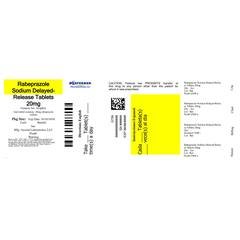
Rabeprazole Sodium
11 DESCRIPTION The active ingredient in rabeprazole sodium delayed-release tablets is rabeprazole sodium hydrate, USP, which is a proton pump inhibitor. It is a substituted benzimidazole known chemically as 2-[[[4-(3-methoxypropoxy)-3-methyl-2-pyridinyl]-methyl]sulfinyl]-1 H– benzimidazole sodium salt. It has an empirical formula of C 18 H 20 N 3 NaO 3 S and a molecular weight of 381.42. Rabeprazole sodium hydrate, USP is a white to slightly yellowish-white solid. It is very soluble in water and methanol, freely soluble in ethanol, chloroform, and ethyl acetate and insoluble in ether and n -hexane. The stability of rabeprazole sodium hydrate, USP is a function of pH; it is rapidly degraded in acid media, and is more stable under alkaline conditions. The structural figure is: Rabeprazole sodium hydrate, USP is available for oral administration as delayed-release, enteric-coated tablets containing 20 mg of rabeprazole sodium hydrate, USP. Inactive ingredients of the 20 mg tablet are diethyl phthalate, ethylcellulose, hypromellose phthalate, magnesium oxide, magnesium stearate, mannitol, povidone, sodium starch glycolate, talc, and titanium dioxide. Ferric oxide yellow is the coloring
Information page. Not necessarily available for purchase.
What is Rabeprazole Sodium?
11 DESCRIPTION The active ingredient in rabeprazole sodium delayed-release tablets is rabeprazole sodium hydrate, USP, which is a proton pump inhibitor. It is a substituted benzimidazole known chemically as 2-[[[4-(3-methoxypropoxy)-3-methyl-2-pyridinyl]-methyl]sulfinyl]-1 H– benzimidazole sodium salt. It has an empirical formula of C 18 H 20 N 3 NaO 3 S and a molecular weight of 381.42. Rabeprazole sodium hydrate, USP is a white to slightly yellowish-white solid. It is very soluble in water and methanol, freely soluble in ethanol, chloroform, and ethyl acetate and insoluble in ether and n -hexane. The stability of rabeprazole sodium hydrate, USP is a function of pH; it is rapidly degraded in acid media, and is more stable under alkaline conditions. The structural figure is: Rabeprazole sodium hydrate, USP is available for oral administration as delayed-release, enteric-coated tablets containing 20 mg of rabeprazole sodium hydrate, USP. Inactive ingredients of the 20 mg tablet are diethyl phthalate, ethylcellulose, hypromellose phthalate, magnesium oxide, magnesium stearate, mannitol, povidone, sodium starch glycolate, talc, and titanium dioxide. Ferric oxide yellow is the coloring
Uses of Rabeprazole Sodium
Established uses
- 1 INDICATIONS AND USAGE Rabeprazole sodium delayed-release tablets is a proton pump inhibitor (PPI) indicated in adults for: Healing of Erosive or Ulcerative Gastroesophageal Reflux Disease (GERD) ( 1.1 ).
- Maintenance of Healing of Erosive or Ulcerative GERD ( 1.2 ).
- Treatment of Symptomatic GERD ( 1.3 ).
- Healing of Duodenal Ulcers ( 1.4 ).
- Helicobacter pylori Eradication to Reduce Risk of Duodenal Ulcer Recurrence ( 1.5 ).
- Treatment of Pathological Hypersecretory Conditions, Including Zollinger-Ellison Syndrome ( 1.6 ).
How Rabeprazole Sodium works
In more detail: 12.1 Mechanism of Action Rabeprazole belongs to a class of antisecretory compounds (substituted benzimidazole proton-pump inhibitors) that do not exhibit anticholinergic or histamine H 2 -receptor antagonist properties, but suppress gastric acid secretion by inhibiting the gastric H + , K + ATPase at the secretory surface of the gastric parietal cell. Because this enzyme is regarded as the acid (proton) pump within the parietal cell, rabeprazole has been characterized as a gastric proton-pump inhibitor. Rabeprazole blocks the final step of gastric acid secretion. In gastric parietal cells, rabeprazole is protonated, accumulates, and is transformed to an active sulfenamide. When studied in vitro , rabeprazole is chemically activated at pH 1.2 with a half-life of 78 seconds. It inhibits acid transport in porcine gastric vesicles with a half-life of 90 seconds.
How to take Rabeprazole Sodium
2 DOSAGE AND ADMINISTRATION Indication Recommended Dosage ( 2 ) Healing of Erosive or Ulcerative Gastroesophageal Reflux Disease (GERD) 20 mg once daily for 4 to 8 weeks Maintenance of Healing of Erosive or Ulcerative GERD* studied for 12 months 20 mg once daily* Symptomatic GERD in Adults 20 mg once daily for 4 weeks Healing of Duodenal Ulcers 20 mg once daily after morning meal for up to 4 weeks Helicobacter pylori Eradication to Reduce the Risk of Duodenal Ulcer Recurrence Three Drug Regimen: Rabeprazole sodium delayed-release tablets 20 mg Amoxicillin 1,000 mg Clarithromycin 500 mg All three medications should be taken twice daily with morning and evening meals for 7 days. Pathological Hypersecretory Conditions, Including Zollinger-Ellison Syndrome Starting dose 60 mg once daily then adjust to patient needs Symptomatic GERD in Adolescents 12 Years of Age and Older 20 mg once daily for up to 8 weeks Administration Instructions ( 2 ) : Swallow rabeprazole sodium delayed-release tablets whole. Do not chew, crush or split the tablets. For the treatment of duodenal ulcers take rabeprazole sodium delayed-release tablets after a meal. For Helicobacter pylori eradication take rabeprazo
Dosage
Follow the dose prescribed by your doctor or pharmacist. The ranges below are general information, not a personal prescription.
- Adults
- 2 DOSAGE AND ADMINISTRATION Indication Recommended Dosage ( 2 ) Healing of Erosive or Ulcerative Gastroesophageal Reflux Disease (GERD) 20 mg once daily for 4 to 8 weeks Maintenance of Healing of Erosive or Ulcerative GERD* studied for 12 months 20 mg once daily* Symptomatic GERD in Adults 20 mg once daily for 4 weeks Healing of Duodenal Ulcers 20 mg once daily after morning meal for up to 4 weeks Helicobacter pylori Eradication to Reduce the Risk of Duodenal Ulcer Recurrence Three Drug Regimen: Rabeprazole sodium delayed-release tablets 20 mg Amoxicillin 1,000 mg Clarithromycin 500 mg All three medications should be taken twice daily with morning and evening meals for 7 days. Pathological Hypersecretory Conditions, Including Zollinger-Ellison Syndrome Starting dose 60 mg once daily then adjust to patient needs Symptomatic GERD in Adolescents 12 Years of Age and Older 20 mg once daily for up to 8 weeks Administration Instructions ( 2 ) : Swallow rabeprazole sodium delayed-release tablets whole. Do not chew, crush or split the tablets. For the treatment of duodenal ulcers take rabeprazole sodium delayed-release tablets after a meal. For Helicobacter pylori eradication take rabeprazo
Side effects of Rabeprazole Sodium
Common
- 6 ADVERSE REACTIONS Most common adverse reactions in adults (>2%) are pain, pharyngitis, flatulence, infection, and constipation ( 6.1 ).
- Most common adverse reactions in adolescents (≥2%) are headache, diarrhea, nausea, vomiting, and abdominal pain ( 6.1 ).
- To report SUSPECTED ADVERSE REACTIONS, contact Torrent Pharma Inc.
- at 1-800-912-9561 or FDA at 1-800-FDA-1088 or www.fda.gov/medwatch The following serious adverse reactions are described below and elsewhere in labeling: Acute Tubulointerstitial Nephritis [see Warnings and Precautions ( 5.3 )] Clostridium difficile- Associated Diarrhea [see Warnings and Precautions ( 5.4 )] Bone Fracture [see Warnings and Precautions ( 5.5 )] Cutaneous and Systemic Lupus Erythematosus [ see Warnings and Precautions ( 5.7 ) ] Cyanocobalamin (Vitamin B-12) Deficiency [see Warnings and Precautions ( 5.8 )] Hypomagnesemia and Mineral Metabolism [see Warnings and Precautions ( 5.9 )] Fundic Gland Polyps [see Warnings and Precautions ( 5.11 )] 6.1 Clinical Studies Experience Because clinical trials are conducted under varying conditions, adverse reaction rates observed in the clinical trials of a drug cannot be directly compared to rates in the clini
Warnings and who should not take it
Who should NOT take Rabeprazole Sodium?
- 4 CONTRAINDICATIONS Patients with a history of hypersensitivity to rabeprazole ( 4 ).
- PPIs, including rabeprazole sodium delayed-release tablets, are contraindicated in patients receiving rilpivirine-containing products ( 4 , 7 ).
- Refer to the Contraindications section of the prescribing information for clarithromycin and amoxicillin, when administered in combination with rabeprazole sodium delayed-release tablets ( 4 ).
- Rabeprazole sodium delayed-release tablets are contraindicated in patients with known hypersensitivity to rabeprazole, substituted benzimidazoles, or to any component of the formulation.
- Hypersensitivity reactions may include anaphylaxis, anaphylactic shock, angioedema, bronchospasm, acute tubulointerstitial nephritis, and urticaria [see Warnings and Precautions ( 5.3 ), Adverse Reactions ( 6 )] .
- PPIs, including rabeprazole sodium delayed-release tablets, are contraindicated with rilpivirine-containing products [see Drug Interactions ( 7 )].
Overdose
10 OVERDOSAGE Seven reports of accidental overdosage with rabeprazole have been received. The maximum reported overdose was 80 mg. There were no clinical signs or symptoms associated with any reported overdose. Patients with Zollinger-Ellison syndrome have been treated with up to 120 mg rabeprazole once daily. No specific antidote for rabeprazole is known. Rabeprazole is extensively protein bound and is not readily dialyzable. In the event of overdosage, treatment should be symptomatic and supportive. If over-exposure occurs, call your Poison Control Center at 1-800-222-1222 for current information on the management of poisoning or overdosage.
Safety at a glance
8.1 Pregnancy Risk Summary There are no available human data on rabeprazole sodium delayed-release tablets use in pregnant women to inform the drug associated risk. The background risk of major birth defects and miscarriage for the indicated populations are unknown. However, the background risk in the U.S. general population of major birth defects is 2 to 4% and of miscarriage is 15 to 20% of clinically recognized pregnancies. No evidence of adverse developmental effects were seen in animal reproduction studies with rabeprazole administered during organogenesis at 13 and 8 times the human area under the plasma concentration-time curve (AUC) at the recommended dose for GERD, in rats and rabbits, respectively [see Data] . Changes in bone morphology were observed in offspring of rats treated with oral doses of a different PPI through most of pregnancy and lactation. When maternal administration was confined to gestation only, there were no effects on bone physeal morphology in the offspring at any age [ see Data] . Data Animal Data Embryo-fetal developmental studies have been performed in rats during organogenesis at intravenous doses of rabeprazole up to 50 mg/kg/day (plasma AUC of 1
8.2 Lactation Risk Summary Lactation studies have not been conducted to assess the presence of rabeprazole in human milk, the effects of rabeprazole on the breastfed infant, or the effects of rabeprazole on milk production. Rabeprazole is present in rat milk. The development and health benefits of breastfeeding should be considered along with the mother's clinical need for rabeprazole sodium delayed-release tablets and any potential adverse effects on the breastfed infant from rabeprazole sodium delayed-release tablets or from the underlying maternal condition.
Children and elderly
Children
8.4 Pediatric Use The safety and effectiveness of rabeprazole sodium delayed-release tablets have been established in pediatric patients for adolescent patients 12 years of age and older for the treatment of symptomatic GERD. Use of rabeprazole sodium delayed-release tablets in this age group is supported by adequate and well controlled studies in adults and a multicenter, randomized, open-label, parallel-group study in 111 adolescent patients 12 to 16 years of age. Patients had a clinical diagnosis of symptomatic GERD, or suspected or endoscopically proven GERD and were randomized to either 10 mg or 20 mg once daily for up to 8 weeks for the evaluation of safety and efficacy. The adverse reaction profile in adolescent patients was similar to that of adults. The related reported adverse reactions that occurred in ≥2% of patients were headache (5%) and nausea (2%). There were no adverse reactions reported in these studies that were not previously observed in adults. The safety and effectiveness of rabeprazole sodium delayed-release tablets have not been established in pediatric patients for: Healing of Erosive or Ulcerative GERD Maintenance of Healing of Erosive or Ulcerative GERD T
Elderly
8.5 Geriatric Use Of the total number of subjects (n=2,009) in clinical studies of rabeprazole sodium delayed-release tablets, 19% were 65 years and over, while 4% were 75 years and over. No overall differences in safety or effectiveness were observed between these subjects and younger subjects, and other reported clinical experience has not identified differences in responses between the elderly and younger patients, but greater sensitivity of some older individuals cannot be ruled out.
Interactions
Medicine and medicine
- 7 DRUG INTERACTIONS See full prescribing information for a list of clinically important drug interactions ( 7 ).
- Table 2 includes drugs with clinically important drug interactions and interaction with diagnostics when administered concomitantly with rabeprazole sodium delayed-release tablets and instructions for preventing or managing them.
- Consult the labeling of concomitantly used drugs to obtain further information about interactions with PPIs.
- Table 2: Clinically Relevant Interactions Affecting Drugs Co-Administered with Rabeprazole Sodium Delayed-Release Tablets and Interactions with Diagnostics Antiretrovirals Clinical Impact: The effect of PPI on antiretroviral drugs is variable.
- The clinical importance and the mechanisms behind these interactions are not always known.
- Decreased exposure of some antiretroviral drugs (e.g., rilpivirine, atazanavir, and nelfinavir) when used concomitantly with rabeprazole may reduce antiviral effect and promote the development of drug resistance.
Frequently asked questions
What is Rabeprazole Sodium used for?
1 INDICATIONS AND USAGE Rabeprazole sodium delayed-release tablets is a proton pump inhibitor (PPI) indicated in adults for: Healing of Erosive or Ulcerative Gastroesophageal Reflux Disease (GERD) ( 1.1 )., Maintenance of Healing of Erosive or Ulcerative GERD ( 1.2 )., Treatment of Symptomatic GERD ( 1.3 )., Healing of Duodenal Ulcers ( 1.4 )., Helicobacter pylori Eradication to Reduce Risk of Duodenal Ulcer Recurrence ( 1.5 )., Treatment of Pathological Hypersecretory Conditions, Including Zollinger-Ellison Syndrome ( 1.6 )..
How should I take Rabeprazole Sodium?
2 DOSAGE AND ADMINISTRATION Indication Recommended Dosage ( 2 ) Healing of Erosive or Ulcerative Gastroesophageal Reflux Disease (GERD) 20 mg once daily for 4 to 8 weeks Maintenance of Healing of Erosive or Ulcerative GERD* studied for 12 months 20 mg once daily* Symptomatic GERD in Adults 20 mg once daily for 4 weeks Healing of Duodenal Ulcers 20 mg once daily after morning meal for up to 4 weeks Helicobacter pylori Eradication to Reduce the Risk of Duodenal Ulcer Recurrence Three Drug Regimen: Rabeprazole sodium delayed-release tablets 20 mg Amoxicillin 1,000 mg Clarithromycin 500 mg All three medications should be taken twice daily with morning and evening meals for 7 days. Pathological Hypersecretory Conditions, Including Zollinger-Ellison Syndrome Starting dose 60 mg once daily then adjust to patient needs Symptomatic GERD in Adolescents 12 Years of Age and Older 20 mg once daily for up to 8 weeks Administration Instructions ( 2 ) : Swallow rabeprazole sodium delayed-release tablets whole. Do not chew, crush or split the tablets. For the treatment of duodenal ulcers take rabeprazole sodium delayed-release tablets after a meal. For Helicobacter pylori eradication take rabeprazo
What are the common side effects?
6 ADVERSE REACTIONS Most common adverse reactions in adults (>2%) are pain, pharyngitis, flatulence, infection, and constipation ( 6.1 )., Most common adverse reactions in adolescents (≥2%) are headache, diarrhea, nausea, vomiting, and abdominal pain ( 6.1 )., To report SUSPECTED ADVERSE REACTIONS, contact Torrent Pharma Inc., at 1-800-912-9561 or FDA at 1-800-FDA-1088 or www.fda.gov/medwatch The following serious adverse reactions are described below and elsewhere in labeling: Acute Tubulointerstitial Nephritis [see Warnings and Precautions ( 5.3 )] Clostridium difficile- Associated Diarrhea [see Warnings and Precautions ( 5.4 )] Bone Fracture [see Warnings and Precautions ( 5.5 )] Cutaneous and Systemic Lupus Erythematosus [ see Warnings and Precautions ( 5.7 ) ] Cyanocobalamin (Vitamin B-12) Deficiency [see Warnings and Precautions ( 5.8 )] Hypomagnesemia and Mineral Metabolism [see Warnings and Precautions ( 5.9 )] Fundic Gland Polyps [see Warnings and Precautions ( 5.11 )] 6.1 Clinical Studies Experience Because clinical trials are conducted under varying conditions, adverse reaction rates observed in the clinical trials of a drug cannot be directly compared to rates in the clini.
Who should not take Rabeprazole Sodium?
4 CONTRAINDICATIONS Patients with a history of hypersensitivity to rabeprazole ( 4 ).; PPIs, including rabeprazole sodium delayed-release tablets, are contraindicated in patients receiving rilpivirine-containing products ( 4 , 7 ).; Refer to the Contraindications section of the prescribing information for clarithromycin and amoxicillin, when administered in combination with rabeprazole sodium delayed-release tablets ( 4 ).; Rabeprazole sodium delayed-release tablets are contraindicated in patients with known hypersensitivity to rabeprazole, substituted benzimidazoles, or to any component of the formulation.; Hypersensitivity reactions may include anaphylaxis, anaphylactic shock, angioedema, bronchospasm, acute tubulointerstitial nephritis, and urticaria [see Warnings and Precautions ( 5.3 ), Adverse Reactions ( 6 )] .; PPIs, including rabeprazole sodium delayed-release tablets, are contraindicated with rilpivirine-containing products [see Drug Interactions ( 7 )]..
Can I take Rabeprazole Sodium during pregnancy?
8.1 Pregnancy Risk Summary There are no available human data on rabeprazole sodium delayed-release tablets use in pregnant women to inform the drug associated risk. The background risk of major birth defects and miscarriage for the indicated populations are unknown. However, the background risk in the U.S. general population of major birth defects is 2 to 4% and of miscarriage is 15 to 20% of clinically recognized pregnancies. No evidence of adverse developmental effects were seen in animal reproduction studies with rabeprazole administered during organogenesis at 13 and 8 times the human area under the plasma concentration-time curve (AUC) at the recommended dose for GERD, in rats and rabbits, respectively [see Data] . Changes in bone morphology were observed in offspring of rats treated with oral doses of a different PPI through most of pregnancy and lactation. When maternal administration was confined to gestation only, there were no effects on bone physeal morphology in the offspring at any age [ see Data] . Data Animal Data Embryo-fetal developmental studies have been performed in rats during organogenesis at intravenous doses of rabeprazole up to 50 mg/kg/day (plasma AUC of 1
Can I take Rabeprazole Sodium while breastfeeding?
8.2 Lactation Risk Summary Lactation studies have not been conducted to assess the presence of rabeprazole in human milk, the effects of rabeprazole on the breastfed infant, or the effects of rabeprazole on milk production. Rabeprazole is present in rat milk. The development and health benefits of breastfeeding should be considered along with the mother's clinical need for rabeprazole sodium delayed-release tablets and any potential adverse effects on the breastfed infant from rabeprazole sodium delayed-release tablets or from the underlying maternal condition.
Can children take Rabeprazole Sodium?
8.4 Pediatric Use The safety and effectiveness of rabeprazole sodium delayed-release tablets have been established in pediatric patients for adolescent patients 12 years of age and older for the treatment of symptomatic GERD. Use of rabeprazole sodium delayed-release tablets in this age group is supported by adequate and well controlled studies in adults and a multicenter, randomized, open-label, parallel-group study in 111 adolescent patients 12 to 16 years of age. Patients had a clinical diagnosis of symptomatic GERD, or suspected or endoscopically proven GERD and were randomized to either 10 mg or 20 mg once daily for up to 8 weeks for the evaluation of safety and efficacy. The adverse reaction profile in adolescent patients was similar to that of adults. The related reported adverse reactions that occurred in ≥2% of patients were headache (5%) and nausea (2%). There were no adverse reactions reported in these studies that were not previously observed in adults. The safety and effectiveness of rabeprazole sodium delayed-release tablets have not been established in pediatric patients for: Healing of Erosive or Ulcerative GERD Maintenance of Healing of Erosive or Ulcerative GERD T
Does Rabeprazole Sodium interact with other medicines?
7 DRUG INTERACTIONS See full prescribing information for a list of clinically important drug interactions ( 7 ).; Table 2 includes drugs with clinically important drug interactions and interaction with diagnostics when administered concomitantly with rabeprazole sodium delayed-release tablets and instructions for preventing or managing them.; Consult the labeling of concomitantly used drugs to obtain further information about interactions with PPIs.; Table 2: Clinically Relevant Interactions Affecting Drugs Co-Administered with Rabeprazole Sodium Delayed-Release Tablets and Interactions with Diagnostics Antiretrovirals Clinical Impact: The effect of PPI on antiretroviral drugs is variable.; The clinical importance and the mechanisms behind these interactions are not always known.; Decreased exposure of some antiretroviral drugs (e.g., rilpivirine, atazanavir, and nelfinavir) when used concomitantly with rabeprazole may reduce antiviral effect and promote the development of drug resistance..
Medicine information on IMCURE is provided for educational purposes and is not a substitute for diagnosis, prescription or medical advice. Always follow your doctor’s or pharmacist’s instructions. Real product image from the U.S. National Library of Medicine's DailyMed listing for Rabeprazole Sodium Tablet, Delayed Release. Packaging varies by brand and manufacturer.