
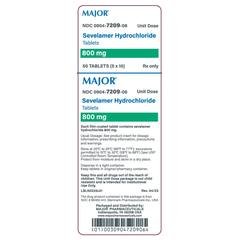
Sevelamer Hydrochloride
11. DESCRIPTION The active ingredient in Sevelamer Hydrochloride Tablets is sevelamer hydrochloride, a polymeric amine that binds phosphate and is meant for oral administration. Sevelamer hydrochloride is poly(allylamine hydrochloride) crosslinked with epichlorohydrin in which 40% of the amines are protonated. It is known chemically as poly(allylamine- co -N,N'-diallyl-1,3-diamino-2-hydroxypropane) hydrochloride. Sevelamer hydrochloride is hydrophilic, but insoluble in water. The structure is represented in Figure 1. Figure 1: Chemical Structure of Sevelamer Hydrochloride a, b = number of primary amine groups a + b = 9 c = number of crosslinking groups c = 1 n = fraction of protonated amines n = 0.4 m = large number to indicate extended polymer network The primary amine groups shown in the structure are derived directly from poly(allylamine hydrochloride). The crosslinking groups consist of two secondary amine groups derived from poly(allylamine hydrochloride) and one molecule of epichlorohydrin. Sevelamer Hydrochloride Tablets: Each film-coated tablet of sevelamer hydrochloride contains either 800 mg or 400 mg of sevelamer hydrochloride on an anhydrous basis. The inactive ingredie
Information page. Not necessarily available for purchase.
What is Sevelamer Hydrochloride?
11. DESCRIPTION The active ingredient in Sevelamer Hydrochloride Tablets is sevelamer hydrochloride, a polymeric amine that binds phosphate and is meant for oral administration. Sevelamer hydrochloride is poly(allylamine hydrochloride) crosslinked with epichlorohydrin in which 40% of the amines are protonated. It is known chemically as poly(allylamine- co -N,N'-diallyl-1,3-diamino-2-hydroxypropane) hydrochloride. Sevelamer hydrochloride is hydrophilic, but insoluble in water. The structure is represented in Figure 1. Figure 1: Chemical Structure of Sevelamer Hydrochloride a, b = number of primary amine groups a + b = 9 c = number of crosslinking groups c = 1 n = fraction of protonated amines n = 0.4 m = large number to indicate extended polymer network The primary amine groups shown in the structure are derived directly from poly(allylamine hydrochloride). The crosslinking groups consist of two secondary amine groups derived from poly(allylamine hydrochloride) and one molecule of epichlorohydrin. Sevelamer Hydrochloride Tablets: Each film-coated tablet of sevelamer hydrochloride contains either 800 mg or 400 mg of sevelamer hydrochloride on an anhydrous basis. The inactive ingredie
Uses of Sevelamer Hydrochloride
Established uses
- 1.
- INDICATIONS AND USAGE Sevelamer hydrochloride tablets are indicated for the control of serum phosphorus in patients with chronic kidney disease (CKD) on dialysis.
- The safety and efficacy of sevelamer hydrochloride tablets in CKD patients who are not on dialysis have not been studied.
- Sevelamer hydrochloride tablets are a phosphate binder indicated for the control of serum phosphorus in patients with chronic kidney disease on dialysis.
- ( 1 )
How Sevelamer Hydrochloride works
In more detail: 12.1 Mechanism of Action Sevelamer hydrochloride tablets contain sevelamer hydrochloride, a non-absorbed binding crosslinked polymer. It contains multiple amines separated by one carbon from the polymer backbone. These amines exist in a protonated form in the intestine and interact with phosphate molecules through ionic and hydrogen bonding. By binding phosphate in the dietary tract and decreasing absorption, sevelamer hydrochloride lowers the phosphate concentration in the serum.
How to take Sevelamer Hydrochloride
2. DOSAGE AND ADMINISTRATION Patients Not Taking a Phosphate Binder . The recommended starting dose of sevelamer hydrochloride tablets is 800 to 1600 mg, which can be administered as one or two 800 mg sevelamer hydrochloride tablets or two to four 400 mg sevelamer hydrochloride tablets, with meals based on serum phosphorus level. Table 1 provides recommended starting doses of sevelamer hydrochloride tablets for patients not taking a phosphate binder. Table 1: Starting Dose for Dialysis Patients Not Taking a Phosphate Binder Serum Phosphorus Sevelamer Hydrochloride Tablets 800 mg Sevelamer Hydrochloride Tablets 400 mg >5.5 and <7.5 mg/dL 1 tablet three times daily with meals 2 tablets three times daily with meals ≥7.5 and <9 mg/dL 2 tablets three times daily with meals 3 tablets three times daily with meals ≥9 mg/dL 2 tablets three times daily with meals 4 tablets three times daily with meals Patients Switching from Calcium Acetate . In a study in 84 CKD patients on hemodialysis, a similar reduction in serum phosphorus was seen with equivalent doses (approximately mg for mg) of sevelamer hydrochloride tablets and calcium acetate. Table 2 gives recommended starting doses of sevelamer
Dosage
Follow the dose prescribed by your doctor or pharmacist. The ranges below are general information, not a personal prescription.
- Adults
- 2. DOSAGE AND ADMINISTRATION Patients Not Taking a Phosphate Binder . The recommended starting dose of sevelamer hydrochloride tablets is 800 to 1600 mg, which can be administered as one or two 800 mg sevelamer hydrochloride tablets or two to four 400 mg sevelamer hydrochloride tablets, with meals based on serum phosphorus level. Table 1 provides recommended starting doses of sevelamer hydrochloride tablets for patients not taking a phosphate binder. Table 1: Starting Dose for Dialysis Patients Not Taking a Phosphate Binder Serum Phosphorus Sevelamer Hydrochloride Tablets 800 mg Sevelamer Hydrochloride Tablets 400 mg >5.5 and <7.5 mg/dL 1 tablet three times daily with meals 2 tablets three times daily with meals ≥7.5 and <9 mg/dL 2 tablets three times daily with meals 3 tablets three times daily with meals ≥9 mg/dL 2 tablets three times daily with meals 4 tablets three times daily with meals Patients Switching from Calcium Acetate . In a study in 84 CKD patients on hemodialysis, a similar reduction in serum phosphorus was seen with equivalent doses (approximately mg for mg) of sevelamer hydrochloride tablets and calcium acetate. Table 2 gives recommended starting doses of sevelamer
Side effects of Sevelamer Hydrochloride
Common
- 6.
- ADVERSE REACTIONS • The most common reasons for discontinuing treatment were gastrointestinal adverse reactions.
- ( 6.1 ) • In a parallel design study of 12 weeks duration, treatment-emergent adverse reactions to sevelamer hydrochloride tablets in peritoneal dialysis patients included dyspepsia (12%), peritonitis (8%), diarrhea (5%), nausea (5%), constipation (4%), pruritus (4%), abdominal distension (3%), vomiting (3%), fatigue (3%), anorexia (3%), and arthralgia (3%).
- ( 6.1 ) • Cases of fecal impaction and, less commonly, ileus, bowel obstruction, and bowel perforation have been reported.
- ( 6.2 ) To report SUSPECTED ADVERSE REACTIONS, contact Glenmark Pharmaceuticals Inc., USA at 1 (888) 721-7115 or FDA at 1-800-FDA-1088 or www.fda.gov/medwatch.
- 6.1 Clinical Trials Experience Because clinical trials are conducted under widely varying conditions, adverse reaction rates observed in the clinical trials of a drug cannot be directly compared to rates in the clinical trials of another drug and may not reflect the rates observed in practice.
Warnings and who should not take it
Who should NOT take Sevelamer Hydrochloride?
- 4.
- CONTRAINDICATIONS Sevelamer hydrochloride is contraindicated in patients with bowel obstruction.
- Sevelamer hydrochloride tablets are contraindicated in patients with known hypersensitivity to sevelamer hydrochloride or to any of the excipients.
- Bowel obstruction.
- ( 4 ) • Known hypersensitivity to sevelamer hydrochloride or to any of the excipients.
- ( 4 )
Overdose
10. OVERDOSAGE Sevelamer hydrochloride has been given to normal healthy volunteers in doses of up to 14 g per day for eight days with no adverse effects. Sevelamer hydrochloride has been given in average doses up to 13 g per day to hemodialysis patients. There are no reports of overdosage with sevelamer hydrochloride in patients. Since sevelamer hydrochloride is not absorbed, the risk of systemic toxicity is low.
Safety at a glance
8.1 Pregnancy Risk Summary Sevelamer hydrochloride is not absorbed systemically following oral administration and maternal use is not expected to result in fetal exposure to the drug. Clinical Considerations Sevelamer hydrochloride may decrease serum levels of fat soluble vitamins and folic acid in pregnant women [ see Clinical Pharmacology ( 12.2 )] . Consider supplementing with these vitamins. Data Animal data In pregnant rats given dietary doses of 0.5, 1.5, or 4.5 g/kg/day of sevelamer hydrochloride during organogenesis, reduced or irregular ossification of fetal bones, probably due to a reduced absorption of fat-soluble vitamin D, occurred at 7-21 times the maximum human equivalent dose of 13 g based on 60 kg body weight. In pregnant rabbits given oral doses of 100, 500, or 1000 mg/kg/day of sevelamer hydrochloride by gavage during organogenesis, an increase of early resorptions occurredin the high-dose group (human equivalent dose approximately 5 times the maximum clinical trial dose based on 60 kg body weight).
Children and elderly
Children
8.4 Pediatric Use The safety and efficacy of sevelamer hydrochloride has not been established in pediatric patients.
Elderly
8.5 Geriatric Use Clinical studies of sevelamer hydrochloride did not include sufficient numbers of subjects aged 65 and over to determine whether they respond differently from younger subjects. Other reported clinical experience has not identified differences in responses between the elderly and younger patients. In general, dose selection for an elderly patient should be cautious, usually starting at the low end of the dosing range.
Interactions
Medicine and medicine
- 7.
- DRUG INTERACTIONS There are no empirical data on avoiding drug interactions between sevelamer hydrochloride and most concomitant oral drugs.
- For oral medication where a reduction in the bioavailability of that medication would have a clinically significant effect on its safety or efficacy (e.g., cyclosporine, tacrolimus, levothyroxine), consider separation of the timing of the administration of the two drugs [see Clinical Pharmacology ( 12.3 )] .
- The duration of separation depends upon the absorption characteristics of the medication concomitantly administered, such as the time to reach peak systemic levels and whether the drug is an immediate-release or an extended-release product.
- Where possible monitor clinical responses or blood levels of concomitant drugs that have a narrow therapeutic range.
- Table 4: Sevelamer Drug Interactions Oral drugs for which sevelamer did not alter the pharmacokinetics when administered concomitantly Digoxin Enalapril Iron Metoprolol Warfarin Oral drugs that have demonstrated interaction with sevelamer and are to be dosed separately from sevelamer hydrochloride Dosing Recommendations Ciprofloxacin Take at least 2 hours before or 6 hours after sevela
Frequently asked questions
What is Sevelamer Hydrochloride used for?
1., INDICATIONS AND USAGE Sevelamer hydrochloride tablets are indicated for the control of serum phosphorus in patients with chronic kidney disease (CKD) on dialysis., The safety and efficacy of sevelamer hydrochloride tablets in CKD patients who are not on dialysis have not been studied., Sevelamer hydrochloride tablets are a phosphate binder indicated for the control of serum phosphorus in patients with chronic kidney disease on dialysis., ( 1 ).
How should I take Sevelamer Hydrochloride?
2. DOSAGE AND ADMINISTRATION Patients Not Taking a Phosphate Binder . The recommended starting dose of sevelamer hydrochloride tablets is 800 to 1600 mg, which can be administered as one or two 800 mg sevelamer hydrochloride tablets or two to four 400 mg sevelamer hydrochloride tablets, with meals based on serum phosphorus level. Table 1 provides recommended starting doses of sevelamer hydrochloride tablets for patients not taking a phosphate binder. Table 1: Starting Dose for Dialysis Patients Not Taking a Phosphate Binder Serum Phosphorus Sevelamer Hydrochloride Tablets 800 mg Sevelamer Hydrochloride Tablets 400 mg >5.5 and <7.5 mg/dL 1 tablet three times daily with meals 2 tablets three times daily with meals ≥7.5 and <9 mg/dL 2 tablets three times daily with meals 3 tablets three times daily with meals ≥9 mg/dL 2 tablets three times daily with meals 4 tablets three times daily with meals Patients Switching from Calcium Acetate . In a study in 84 CKD patients on hemodialysis, a similar reduction in serum phosphorus was seen with equivalent doses (approximately mg for mg) of sevelamer hydrochloride tablets and calcium acetate. Table 2 gives recommended starting doses of sevelamer
What are the common side effects?
6., ADVERSE REACTIONS • The most common reasons for discontinuing treatment were gastrointestinal adverse reactions., ( 6.1 ) • In a parallel design study of 12 weeks duration, treatment-emergent adverse reactions to sevelamer hydrochloride tablets in peritoneal dialysis patients included dyspepsia (12%), peritonitis (8%), diarrhea (5%), nausea (5%), constipation (4%), pruritus (4%), abdominal distension (3%), vomiting (3%), fatigue (3%), anorexia (3%), and arthralgia (3%)., ( 6.1 ) • Cases of fecal impaction and, less commonly, ileus, bowel obstruction, and bowel perforation have been reported., ( 6.2 ) To report SUSPECTED ADVERSE REACTIONS, contact Glenmark Pharmaceuticals Inc., USA at 1 (888) 721-7115 or FDA at 1-800-FDA-1088 or www.fda.gov/medwatch., 6.1 Clinical Trials Experience Because clinical trials are conducted under widely varying conditions, adverse reaction rates observed in the clinical trials of a drug cannot be directly compared to rates in the clinical trials of another drug and may not reflect the rates observed in practice..
Who should not take Sevelamer Hydrochloride?
4.; CONTRAINDICATIONS Sevelamer hydrochloride is contraindicated in patients with bowel obstruction.; Sevelamer hydrochloride tablets are contraindicated in patients with known hypersensitivity to sevelamer hydrochloride or to any of the excipients.; Bowel obstruction.; ( 4 ) • Known hypersensitivity to sevelamer hydrochloride or to any of the excipients.; ( 4 ).
Can I take Sevelamer Hydrochloride during pregnancy?
8.1 Pregnancy Risk Summary Sevelamer hydrochloride is not absorbed systemically following oral administration and maternal use is not expected to result in fetal exposure to the drug. Clinical Considerations Sevelamer hydrochloride may decrease serum levels of fat soluble vitamins and folic acid in pregnant women [ see Clinical Pharmacology ( 12.2 )] . Consider supplementing with these vitamins. Data Animal data In pregnant rats given dietary doses of 0.5, 1.5, or 4.5 g/kg/day of sevelamer hydrochloride during organogenesis, reduced or irregular ossification of fetal bones, probably due to a reduced absorption of fat-soluble vitamin D, occurred at 7-21 times the maximum human equivalent dose of 13 g based on 60 kg body weight. In pregnant rabbits given oral doses of 100, 500, or 1000 mg/kg/day of sevelamer hydrochloride by gavage during organogenesis, an increase of early resorptions occurredin the high-dose group (human equivalent dose approximately 5 times the maximum clinical trial dose based on 60 kg body weight).
Can children take Sevelamer Hydrochloride?
8.4 Pediatric Use The safety and efficacy of sevelamer hydrochloride has not been established in pediatric patients.
Does Sevelamer Hydrochloride interact with other medicines?
7.; DRUG INTERACTIONS There are no empirical data on avoiding drug interactions between sevelamer hydrochloride and most concomitant oral drugs.; For oral medication where a reduction in the bioavailability of that medication would have a clinically significant effect on its safety or efficacy (e.g., cyclosporine, tacrolimus, levothyroxine), consider separation of the timing of the administration of the two drugs [see Clinical Pharmacology ( 12.3 )] .; The duration of separation depends upon the absorption characteristics of the medication concomitantly administered, such as the time to reach peak systemic levels and whether the drug is an immediate-release or an extended-release product.; Where possible monitor clinical responses or blood levels of concomitant drugs that have a narrow therapeutic range.; Table 4: Sevelamer Drug Interactions Oral drugs for which sevelamer did not alter the pharmacokinetics when administered concomitantly Digoxin Enalapril Iron Metoprolol Warfarin Oral drugs that have demonstrated interaction with sevelamer and are to be dosed separately from sevelamer hydrochloride Dosing Recommendations Ciprofloxacin Take at least 2 hours before or 6 hours after sevela.
Medicine information on IMCURE is provided for educational purposes and is not a substitute for diagnosis, prescription or medical advice. Always follow your doctor’s or pharmacist’s instructions. Real product image from the U.S. National Library of Medicine's DailyMed listing for Sevelamer Hydrochloride Tablet, Film Coated. Packaging varies by brand and manufacturer.