
Solifenacin Succinate
11 DESCRIPTION Solifenacin succinate tablets are a muscarinic receptor antagonist. Chemically, solifenacin succinate is a butanedioic acid compound with 1(S)-phenyl-1,2,3,4-tetrahydroisoquinoline-2-carboxylic acid 3(R)-quinuclidinyl ester Monosuccinate having an empirical formula of C 23 H 26 N 2 O 2 •C 4 H 6 O 4 , and a molecular weight of 480.55 g/mol. The structural formula of solifenacin succinate is: Solifenacin succinate is a white to pale-yellowish-white crystal or crystalline powder. It is freely soluble or soluble in water, glacial acetic acid, dimethyl sulfoxide; soluble in methanol, very slightly soluble in acetone and ethanol. Each solifenacin succinate tablet contains 5 or 10 mg of solifenacin succinate and is formulated for oral administration. In addition to the active ingredient solifenacin succinate, the tablets also contain the following inactive ingredients: corn starch, hypromellose, lactose monohydrate, magnesium stearate, talc, titanium dioxide and triacetin. The 5 mg tablets contain the colorants iron oxide yellow and FD&C yellow# 6. The 10 mg tablets contain the colorants iron oxide yellow and FD&C Red# 40. chemical-structure
Information page. Not necessarily available for purchase.
What is Solifenacin Succinate?
11 DESCRIPTION Solifenacin succinate tablets are a muscarinic receptor antagonist. Chemically, solifenacin succinate is a butanedioic acid compound with 1(S)-phenyl-1,2,3,4-tetrahydroisoquinoline-2-carboxylic acid 3(R)-quinuclidinyl ester Monosuccinate having an empirical formula of C 23 H 26 N 2 O 2 •C 4 H 6 O 4 , and a molecular weight of 480.55 g/mol. The structural formula of solifenacin succinate is: Solifenacin succinate is a white to pale-yellowish-white crystal or crystalline powder. It is freely soluble or soluble in water, glacial acetic acid, dimethyl sulfoxide; soluble in methanol, very slightly soluble in acetone and ethanol. Each solifenacin succinate tablet contains 5 or 10 mg of solifenacin succinate and is formulated for oral administration. In addition to the active ingredient solifenacin succinate, the tablets also contain the following inactive ingredients: corn starch, hypromellose, lactose monohydrate, magnesium stearate, talc, titanium dioxide and triacetin. The 5 mg tablets contain the colorants iron oxide yellow and FD&C yellow# 6. The 10 mg tablets contain the colorants iron oxide yellow and FD&C Red# 40. chemical-structure
Uses of Solifenacin Succinate
Established uses
- 1 INDICATIONS AND USAGE Solifenacin succinate tablets are indicated for the treatment of adults with overactive bladder with symptoms of urge urinary incontinence, urgency, and urinary frequency.
- Solifenacin succinate tablets are a muscarinic antagonist indicated for the treatment of adults with overactive bladder with symptoms of urge urinary incontinence, urgency, and urinary frequency ( 1 ).
How Solifenacin Succinate works
In more detail: 12.1 Mechanism of Action Solifenacin is a competitive muscarinic receptor antagonist. Muscarinic receptors play an important role in several major cholinergically mediated functions, including contractions of urinary bladder smooth muscle.
How to take Solifenacin Succinate
2 DOSAGE AND ADMINISTRATION • 5 mg tablet taken orally once daily, and if well tolerated may be increased to 10 mg once daily ( 2.1 ). • Do not exceed the 5 mg dose of solifenacin succinate tablets in patients with: • Severe renal impairment creatinine clearance <30 mL/min/1.73 m 2 ( 2.2 , 8.6 ). • Moderate hepatic impairment (Child-Pugh B). Solifenacin succinate tablets are not recommended in patients with severe hepatic impairment (Child- Pugh C) ( 2.3 , 8.7 ). • Concomitant use of strong CYP3A4 inhibitors ( 2.4 , 7.1 ). 2.1 Dosing Information The recommended oral dose of solifenacin succinate tablets is 5 mg once daily. If the 5 mg dose is well tolerated, the dose may be increased to 10 mg once daily. Solifenacin succinate tablets should be taken with water and swallowed whole. Solifenacin succinate tablets can be administered with or without food. 2.2 Dosing Recommendations in Patients with Renal Impairment Do not exceed 5 mg once daily in patients with severe renal impairment (CL cr <30 mL/min/1.73 m 2 ) [ see Use in Specific Populations (8.6) ]. 2.3 Dosing Recommendations in Patients with Hepatic Impairment Do not exceed 5 mg once daily in patients with moderate hepatic impai
Dosage
Follow the dose prescribed by your doctor or pharmacist. The ranges below are general information, not a personal prescription.
- Adults
- 2 DOSAGE AND ADMINISTRATION • 5 mg tablet taken orally once daily, and if well tolerated may be increased to 10 mg once daily ( 2.1 ). • Do not exceed the 5 mg dose of solifenacin succinate tablets in patients with: • Severe renal impairment creatinine clearance <30 mL/min/1.73 m 2 ( 2.2 , 8.6 ). • Moderate hepatic impairment (Child-Pugh B). Solifenacin succinate tablets are not recommended in patients with severe hepatic impairment (Child- Pugh C) ( 2.3 , 8.7 ). • Concomitant use of strong CYP3A4 inhibitors ( 2.4 , 7.1 ). 2.1 Dosing Information The recommended oral dose of solifenacin succinate tablets is 5 mg once daily. If the 5 mg dose is well tolerated, the dose may be increased to 10 mg once daily. Solifenacin succinate tablets should be taken with water and swallowed whole. Solifenacin succinate tablets can be administered with or without food. 2.2 Dosing Recommendations in Patients with Renal Impairment Do not exceed 5 mg once daily in patients with severe renal impairment (CL cr <30 mL/min/1.73 m 2 ) [ see Use in Specific Populations (8.6) ]. 2.3 Dosing Recommendations in Patients with Hepatic Impairment Do not exceed 5 mg once daily in patients with moderate hepatic impai
Side effects of Solifenacin Succinate
Common
- 6 ADVERSE REACTIONS The most common adverse reactions (> 4% in solifenacin succinate-treated patients and > placebo-treated patients) were dry mouth and constipation at both 5 mg and 10 mg doses;
- and urinary tract infection and blurred vision at the 10 mg dose ( 6.1 ).
- To report SUSPECTED ADVERSE REACTIONS, contact Glenmark Pharmaceuticals Inc., USA at 1 (888) 721-7115 or FDA at 1-800-FDA-1088 or http://www.fda.gov/medwatch .
- 6.1 Clinical Trials Experience Because clinical trials are conducted under widely varying conditions, adverse reaction rates observed in the clinical trials of a drug cannot be directly compared to rates in the clinical trials of another drug and may not reflect the rates observed in practice.
- Solifenacin succinate has been evaluated for safety in 1811 adult patients in four randomized, placebo-controlled trials (Studies 1 to 4) [see Clinical Studies ( 14 )] .
- Expected adverse reactions of antimuscarinic agents are dry mouth, constipation, blurred vision (accommodation abnormalities), urinary retention, and dry eyes.
Warnings and who should not take it
Who should NOT take Solifenacin Succinate?
- 4 CONTRAINDICATIONS Solifenacin succinate tablets are contraindicated in patients: • With urinary retention [ see Warnings and Precautions ( 5.2 ) ], • With gastric retention [ see Warnings and Precautions ( 5.3 ) ], • With uncontrolled narrow-angle glaucoma [ see Warnings and Precautions ( 5.5 ) ], and • Who have demonstrated hypersensitivity to solifenacin succinate or the inactive ingredients in solifenacin succinate tablets.
- Reported adverse reactions have included anaphylaxis and angioedema [ see Adverse Reactions ( 6.2 ) ].
- Urinary retention ( 4 , 5.2 ).
- Gastric retention ( 4 , 5.3 ).
- Uncontrolled narrow-angle glaucoma ( 4 , 5.5 ).
- Hypersensitivity to this product or any of its components ( 4 , 5.1 , 6.2 ).
Overdose
10 OVERDOSAGE Overdosage with solifenacin succinate can potentially result in severe antimuscarinic effects and should be treated accordingly. The highest dose ingested in an accidental overdose of solifenacin succinate was 280 mg (28 times the maximum dosage) in a 5-hour period. This case was associated with mental status changes. Some cases reported a decrease in the level of consciousness. Intolerable antimuscarinic adverse reactions (fixed and dilated pupils, blurred vision, failure of heel-to-toe exam, tremors, and dry skin) occurred on day 3 in normal volunteers taking 50 mg daily (5 times the maximum recommended therapeutic dose) and resolved within 7 days following discontinuation of drug. In the event of overdose with solifenacin succinate, treat with gastric lavage and appropriate supportive measures. ECG monitoring is also recommended.
Safety at a glance
8.1 Pregnancy Risk Summary There are no studies with the use of solifenacin succinate in pregnant women to inform a drug-associated risk of major birth defects, miscarriages, or adverse maternal or fetal outcomes. No adverse developmental outcomes were observed in animal reproduction studies with oral administration of solifenacin succinate to pregnant mice during the period of organogenesis at a dose resulting in 1.2 times the systemic exposure at the maximum recommended human dose (MRHD) of 10 mg/day. However, administration of doses 3.6 times and greater than the MRHD during organogenesis produced maternal toxicity in the pregnant mice and resulted in developmental toxicity and reduced fetal body weights in offspring [see Data] . In the U.S. general population, the estimated background risk of major birth defects or miscarriage in clinically recognized pregnancies is 2 to 4% and 15 to 20%, respectively. Data Animal Data Oral administration of 14 C-solifenacin succinate to pregnant mice resulted in the recovery of radiolabel in the fetus indicating that solifenacin-related product can cross the placental barrier. In pregnant mice, administration of solifenacin succinate at a dose
Interactions
Medicine and medicine
- 7 DRUG INTERACTIONS CYP3A4 Inhibitors : Do not exceed the 5 mg dose of solifenacin succinate with concomitant use of strong CYP3A4 inhibitors ( 7.1 ).
- 7.1 Strong CYP3A4 Inhibitors Solifenacin is a substrate of CYP3A4.
- Concomitant use of ketoconazole, a strong CYP3A4 inhibitor, significantly increased the exposure of solifenacin [ see Clinical Pharmacology ( 12.3 ) ].
- The dosage of solifenacin succinate greater than 5 mg once daily is not recommended when concomitantly used with strong CYP3A4 inhibitors [ see Dosage and Administration ( 2.4 ) ].
Frequently asked questions
What is Solifenacin Succinate used for?
1 INDICATIONS AND USAGE Solifenacin succinate tablets are indicated for the treatment of adults with overactive bladder with symptoms of urge urinary incontinence, urgency, and urinary frequency., Solifenacin succinate tablets are a muscarinic antagonist indicated for the treatment of adults with overactive bladder with symptoms of urge urinary incontinence, urgency, and urinary frequency ( 1 )..
How should I take Solifenacin Succinate?
2 DOSAGE AND ADMINISTRATION • 5 mg tablet taken orally once daily, and if well tolerated may be increased to 10 mg once daily ( 2.1 ). • Do not exceed the 5 mg dose of solifenacin succinate tablets in patients with: • Severe renal impairment creatinine clearance <30 mL/min/1.73 m 2 ( 2.2 , 8.6 ). • Moderate hepatic impairment (Child-Pugh B). Solifenacin succinate tablets are not recommended in patients with severe hepatic impairment (Child- Pugh C) ( 2.3 , 8.7 ). • Concomitant use of strong CYP3A4 inhibitors ( 2.4 , 7.1 ). 2.1 Dosing Information The recommended oral dose of solifenacin succinate tablets is 5 mg once daily. If the 5 mg dose is well tolerated, the dose may be increased to 10 mg once daily. Solifenacin succinate tablets should be taken with water and swallowed whole. Solifenacin succinate tablets can be administered with or without food. 2.2 Dosing Recommendations in Patients with Renal Impairment Do not exceed 5 mg once daily in patients with severe renal impairment (CL cr <30 mL/min/1.73 m 2 ) [ see Use in Specific Populations (8.6) ]. 2.3 Dosing Recommendations in Patients with Hepatic Impairment Do not exceed 5 mg once daily in patients with moderate hepatic impai
What are the common side effects?
6 ADVERSE REACTIONS The most common adverse reactions (> 4% in solifenacin succinate-treated patients and > placebo-treated patients) were dry mouth and constipation at both 5 mg and 10 mg doses;, and urinary tract infection and blurred vision at the 10 mg dose ( 6.1 )., To report SUSPECTED ADVERSE REACTIONS, contact Glenmark Pharmaceuticals Inc., USA at 1 (888) 721-7115 or FDA at 1-800-FDA-1088 or http://www.fda.gov/medwatch ., 6.1 Clinical Trials Experience Because clinical trials are conducted under widely varying conditions, adverse reaction rates observed in the clinical trials of a drug cannot be directly compared to rates in the clinical trials of another drug and may not reflect the rates observed in practice., Solifenacin succinate has been evaluated for safety in 1811 adult patients in four randomized, placebo-controlled trials (Studies 1 to 4) [see Clinical Studies ( 14 )] ., Expected adverse reactions of antimuscarinic agents are dry mouth, constipation, blurred vision (accommodation abnormalities), urinary retention, and dry eyes..
Who should not take Solifenacin Succinate?
4 CONTRAINDICATIONS Solifenacin succinate tablets are contraindicated in patients: • With urinary retention [ see Warnings and Precautions ( 5.2 ) ], • With gastric retention [ see Warnings and Precautions ( 5.3 ) ], • With uncontrolled narrow-angle glaucoma [ see Warnings and Precautions ( 5.5 ) ], and • Who have demonstrated hypersensitivity to solifenacin succinate or the inactive ingredients in solifenacin succinate tablets.; Reported adverse reactions have included anaphylaxis and angioedema [ see Adverse Reactions ( 6.2 ) ].; Urinary retention ( 4 , 5.2 ).; Gastric retention ( 4 , 5.3 ).; Uncontrolled narrow-angle glaucoma ( 4 , 5.5 ).; Hypersensitivity to this product or any of its components ( 4 , 5.1 , 6.2 )..
Can I take Solifenacin Succinate during pregnancy?
8.1 Pregnancy Risk Summary There are no studies with the use of solifenacin succinate in pregnant women to inform a drug-associated risk of major birth defects, miscarriages, or adverse maternal or fetal outcomes. No adverse developmental outcomes were observed in animal reproduction studies with oral administration of solifenacin succinate to pregnant mice during the period of organogenesis at a dose resulting in 1.2 times the systemic exposure at the maximum recommended human dose (MRHD) of 10 mg/day. However, administration of doses 3.6 times and greater than the MRHD during organogenesis produced maternal toxicity in the pregnant mice and resulted in developmental toxicity and reduced fetal body weights in offspring [see Data] . In the U.S. general population, the estimated background risk of major birth defects or miscarriage in clinically recognized pregnancies is 2 to 4% and 15 to 20%, respectively. Data Animal Data Oral administration of 14 C-solifenacin succinate to pregnant mice resulted in the recovery of radiolabel in the fetus indicating that solifenacin-related product can cross the placental barrier. In pregnant mice, administration of solifenacin succinate at a dose
Does Solifenacin Succinate interact with other medicines?
7 DRUG INTERACTIONS CYP3A4 Inhibitors : Do not exceed the 5 mg dose of solifenacin succinate with concomitant use of strong CYP3A4 inhibitors ( 7.1 ).; 7.1 Strong CYP3A4 Inhibitors Solifenacin is a substrate of CYP3A4.; Concomitant use of ketoconazole, a strong CYP3A4 inhibitor, significantly increased the exposure of solifenacin [ see Clinical Pharmacology ( 12.3 ) ].; The dosage of solifenacin succinate greater than 5 mg once daily is not recommended when concomitantly used with strong CYP3A4 inhibitors [ see Dosage and Administration ( 2.4 ) ]..
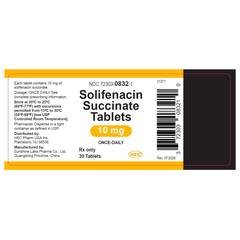
Medicine information on IMCURE is provided for educational purposes and is not a substitute for diagnosis, prescription or medical advice. Always follow your doctor’s or pharmacist’s instructions. Real product image from the U.S. National Library of Medicine's DailyMed listing for Solifenacin Succinate Tablet, Film Coated. Packaging varies by brand and manufacturer.