
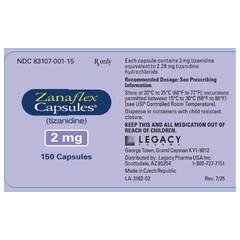
Zanaflex
11 DESCRIPTION Zanaflex ® (tizanidine hydrochloride) is a central alpha 2 -adrenergic agonist. Tizanidine HCl is a white to off-white, fine crystalline powder, which is odorless or with a faint characteristic odor. Tizanidine is slightly soluble in water and methanol; solubility in water decreases as the pH increases. Its chemical name is 5-chloro-4-(2-imidazolin-2-ylamino)-2,1,3-benzothiadiazole monohydrochloride. Tizanidine’s molecular formula is C 9 H 8 ClN 5 S-HCl, its molecular weight is 290.2 and its structural formula is: Zanaflex Capsules ® are supplied as 2, 4, and 6 mg capsules for oral administration. Zanaflex Capsules ® contain the active ingredient, tizanidine hydrochloride (2.29 mg equivalent to 2 mg tizanidine base, 4.58 mg equivalent to 4 mg tizanidine base, and 6.87 mg equivalent to 6 mg tizanidine base), and the inactive ingredients, hypromellose, silicon dioxide, sugar spheres, titanium dioxide, gelatin, and colorants. Zanaflex ® tablets are supplied as 4 mg tablets for oral administration. Zanaflex ® tablets contain the active ingredient, tizanidine hydrochloride (4.58 mg equivalent to 4 mg tizanidine base), and the inactive ingredients, colloidal silicon dioxid
Information page. Not necessarily available for purchase.
What is Zanaflex?
11 DESCRIPTION Zanaflex ® (tizanidine hydrochloride) is a central alpha 2 -adrenergic agonist. Tizanidine HCl is a white to off-white, fine crystalline powder, which is odorless or with a faint characteristic odor. Tizanidine is slightly soluble in water and methanol; solubility in water decreases as the pH increases. Its chemical name is 5-chloro-4-(2-imidazolin-2-ylamino)-2,1,3-benzothiadiazole monohydrochloride. Tizanidine’s molecular formula is C 9 H 8 ClN 5 S-HCl, its molecular weight is 290.2 and its structural formula is: Zanaflex Capsules ® are supplied as 2, 4, and 6 mg capsules for oral administration. Zanaflex Capsules ® contain the active ingredient, tizanidine hydrochloride (2.29 mg equivalent to 2 mg tizanidine base, 4.58 mg equivalent to 4 mg tizanidine base, and 6.87 mg equivalent to 6 mg tizanidine base), and the inactive ingredients, hypromellose, silicon dioxide, sugar spheres, titanium dioxide, gelatin, and colorants. Zanaflex ® tablets are supplied as 4 mg tablets for oral administration. Zanaflex ® tablets contain the active ingredient, tizanidine hydrochloride (4.58 mg equivalent to 4 mg tizanidine base), and the inactive ingredients, colloidal silicon dioxid
Uses of Zanaflex
Established uses
- 1 INDICATIONS AND USAGE Zanaflex is indicated for the management of spasticity.
- Because of the short duration of therapeutic effect, treatment with Zanaflex should be reserved for those daily activities and times when relief of spasticity is most important [see Dosage and Administration ( 2.1 )] .
- Zanaflex is a central alpha-2-adrenergic agonist indicated for the management of spasticity.
- Because of the short duration of therapeutic effect, treatment with Zanaflex should be reserved for those daily activities and times when relief of spasticity is most important.
- ( 1 )
How Zanaflex works
In more detail: 12.1 Mechanism of Action Tizanidine is a central alpha-2-adrenergic receptor agonist and presumably reduces spasticity by increasing presynaptic inhibition of motor neurons. The effects of tizanidine are greatest on polysynaptic pathways. The overall effect of these actions is thought to reduce facilitation of spinal motor neurons.
How to take Zanaflex
2 DOSAGE AND ADMINISTRATION Recommended starting dose: 2 mg; dose can be repeated at 6 to 8 hour intervals, up to a maximum of 3 doses in 24 hours ( 2.1 ) Dosage can be increased by 2 mg to 4 mg per dose, with 1 to 4 days between increases; total daily dose should not exceed 36 mg ( 2.1 ) Tizanidine pharmacokinetics differs between tablets and capsules, and when taken with or without food. These differences could result in a change in tolerability and control of symptoms ( 2.1 , 12.3 ) To discontinue Zanaflex, decrease dose slowly to minimize the risk of withdrawal and rebound hypertension, tachycardia, and hypertonia ( 2.2 ) 2.1 Dosing Information Zanaflex Capsules ® or Zanaflex ® tablets may be prescribed with or without food. Once the formulation has been selected and the decision to take with or without food has been made, this regimen should not be altered. Food has complex effects on tizanidine pharmacokinetics, which differ with the different formulations. Zanaflex Capsules and Zanaflex tablets are bioequivalent to each other under fasting conditions (more than 3 hours after a meal), but not under fed conditions (within 30 minutes of a meal). These pharmacokinetic difference
Dosage
Follow the dose prescribed by your doctor or pharmacist. The ranges below are general information, not a personal prescription.
- Adults
- 2 DOSAGE AND ADMINISTRATION Recommended starting dose: 2 mg; dose can be repeated at 6 to 8 hour intervals, up to a maximum of 3 doses in 24 hours ( 2.1 ) Dosage can be increased by 2 mg to 4 mg per dose, with 1 to 4 days between increases; total daily dose should not exceed 36 mg ( 2.1 ) Tizanidine pharmacokinetics differs between tablets and capsules, and when taken with or without food. These differences could result in a change in tolerability and control of symptoms ( 2.1 , 12.3 ) To discontinue Zanaflex, decrease dose slowly to minimize the risk of withdrawal and rebound hypertension, tachycardia, and hypertonia ( 2.2 ) 2.1 Dosing Information Zanaflex Capsules ® or Zanaflex ® tablets may be prescribed with or without food. Once the formulation has been selected and the decision to take with or without food has been made, this regimen should not be altered. Food has complex effects on tizanidine pharmacokinetics, which differ with the different formulations. Zanaflex Capsules and Zanaflex tablets are bioequivalent to each other under fasting conditions (more than 3 hours after a meal), but not under fed conditions (within 30 minutes of a meal). These pharmacokinetic difference
Side effects of Zanaflex
Common
- 6 ADVERSE REACTIONS The following adverse reactions are described elsewhere in other sections of the prescribing information: Hypotension [see Warnings and Precautions ( 5.1 )] Liver Injury [see Warnings and Precautions ( 5.2 )] Sedation [see Warnings and Precautions ( 5.3 )] Hallucinosis/Psychotic-Like Symptoms [see Warnings and Precautions ( 5.4 )] Hypersensitivity Reactions [see Warnings and Precautions ( 5.6 )] The most common adverse reactions (greater than 2% of 264 patients taking tizanidine and greater than in placebo-treated patients in three multiple dose, placebo-controlled studies) were dry mouth, somnolence, asthenia, dizziness, urinary tract infection, constipation, liver function tests abnormal, vomiting, speech disorder, amblyopia, urinary frequency, flu syndrome, SGPT/ALT increased, dyskinesia, nervousness, pharyngitis, and rhinitis ( 6.1 ) To report SUSPECTED ADVERSE REACTIONS, contact Covis Pharma at 1-866-488-4423 or FDA at 1-800-FDA-1088 or www.fda.gov/medwatch.
- 6.1 Clinical Trials Experience Because clinical studies are conducted under widely varying conditions, adverse reaction rates observed in the clinical studies of a drug cannot be directly compared to ra
Warnings and who should not take it
Who should NOT take Zanaflex?
- 4 CONTRAINDICATIONS Zanaflex is contraindicated in patients taking potent inhibitors of CYP1A2, such as fluvoxamine or ciprofloxacin [see Drug Interactions ( 7.1 , 7.2 )] .
- Concomitant use with potent inhibitors of CYP1A2, such as fluvoxamine or ciprofloxacin ( 4 , 5.5 , 7.1 , 7.2 )
Overdose
10 OVERDOSAGE A review of the safety surveillance database revealed cases of intentional and accidental Zanaflex overdose. Some of the cases resulted in fatality and many of the intentional overdoses were with multiple drugs including CNS depressants. The clinical manifestations of tizanidine overdose were consistent with its known pharmacology. In the majority of cases a decrease in sensorium was observed including lethargy, somnolence, confusion and coma. Depressed cardiac function is also observed including most often bradycardia and hypotension. Respiratory depression is another common feature of tizanidine overdose. Should overdose occur, basic steps to ensure the adequacy of an airway and the monitoring of cardiovascular and respiratory systems should be undertaken. Tizanidine is a lipid-soluble drug, which is only slightly soluble in water and methanol. Therefore, dialysis is not likely to be an efficient method of removing drug from the body. In general, symptoms resolve within one to three days following discontinuation of tizanidine and administration of appropriate therapy. Due to the similar mechanism of action, symptoms and management of tizanidine overdose are similar
Safety at a glance
8.1 Pregnancy Risk Summary There are no adequate data on the developmental risk associated with use of Zanaflex in pregnant women. In animal studies, administration of tizanidine during pregnancy resulted in developmental toxicity (embryofetal and postnatal offspring mortality and growth deficits) at doses less than those used clinically, which were not associated with maternal toxicity (see Animal Data ). In the U.S. general population, the estimated background risk of major birth defects and miscarriage in clinically recognized pregnancies is 2% - 4% and 15% - 20%, respectively. The background risk of major birth defects and miscarriage for the indicated population is unknown. Data Animal Data Oral administration of tizanidine (0.3 to 100 mg/kg/day) to pregnant rats during the period of organogenesis resulted in embryofetal and postnatal offspring mortality and reductions in body weight at doses of 30 mg/kg/day and above. Maternal toxicity was observed at the highest dose tested. The no-effect dose for embryofetal developmental toxicity in rats (3 mg/kg/day) is similar to the maximum recommended human dose (MRHD) of 36 mg/day on a body surface area (mg/m 2 ) basis. Oral administr
Children and elderly
Children
8.4 Pediatric Use Safety and effectiveness in pediatric patients have not been established.
Elderly
8.5 Geriatric Use Zanaflex is known to be substantially excreted by the kidney, and the risk of adverse reactions to this drug may be greater in patients with impaired renal function. Because elderly patients are more likely to have decreased renal function, care should be taken in dose selection, and it may be useful to monitor renal function. Clinical studies of Zanaflex did not include sufficient numbers of subjects aged 65 and over to determine whether they respond differently than younger subjects. Cross-study comparison of pharmacokinetic data following single dose administration of 6 mg Zanaflex showed that younger subjects cleared the drug four times faster than the elderly subjects. In elderly patients with renal insufficiency (creatinine clearance < 25 mL/min), tizanidine clearance is reduced by more than 50% compared to healthy elderly subjects; this would be expected to lead to a longer duration of clinical effect. During titration, the individual doses should be reduced. If higher doses are required, individual doses rather than dosing frequency should be increased. Monitor elderly patients because they may have an increased risk for adverse reactions associated with Z
Interactions
Medicine and medicine
- 7 DRUG INTERACTIONS 7.1 Fluvoxamine Concomitant use of fluvoxamine and Zanaflex is contraindicated.
- Changes in pharmacokinetics of tizanidine when administered with fluvoxamine resulted in significantly decreased blood pressure, increased drowsiness, and increased psychomotor impairment [see Contraindications ( 4 ) and Clinical Pharmacology ( 12.3 )] .
- 7.2 Ciprofloxacin Concomitant use of ciprofloxacin and Zanaflex is contraindicated.
- Changes in pharmacokinetics of tizanidine when administered with ciprofloxacin resulted in significantly decreased blood pressure, increased drowsiness, and increased psychomotor impairment [see Contraindications ( 4 ) and Clinical Pharmacology ( 12.3 )] .
- 7.3 CYP1A2 Inhibitors other than Fluvoxamine and Ciprofloxacin Because of potential drug interactions, concomitant use of Zanaflex with other CYP1A2 inhibitors, such as zileuton, fluoroquinolones other than strong CYP1A2 inhibitors (which are contraindicated), antiarrhythmics (amiodarone, mexiletine, propafenone, and verapamil), cimetidine, famotidine, oral contraceptives, acyclovir, and ticlopidine) should be avoided.
- If their use is clinically necessary, therapy should be initiated with 2 mg dose
Frequently asked questions
What is Zanaflex used for?
1 INDICATIONS AND USAGE Zanaflex is indicated for the management of spasticity., Because of the short duration of therapeutic effect, treatment with Zanaflex should be reserved for those daily activities and times when relief of spasticity is most important [see Dosage and Administration ( 2.1 )] ., Zanaflex is a central alpha-2-adrenergic agonist indicated for the management of spasticity., Because of the short duration of therapeutic effect, treatment with Zanaflex should be reserved for those daily activities and times when relief of spasticity is most important., ( 1 ).
How should I take Zanaflex?
2 DOSAGE AND ADMINISTRATION Recommended starting dose: 2 mg; dose can be repeated at 6 to 8 hour intervals, up to a maximum of 3 doses in 24 hours ( 2.1 ) Dosage can be increased by 2 mg to 4 mg per dose, with 1 to 4 days between increases; total daily dose should not exceed 36 mg ( 2.1 ) Tizanidine pharmacokinetics differs between tablets and capsules, and when taken with or without food. These differences could result in a change in tolerability and control of symptoms ( 2.1 , 12.3 ) To discontinue Zanaflex, decrease dose slowly to minimize the risk of withdrawal and rebound hypertension, tachycardia, and hypertonia ( 2.2 ) 2.1 Dosing Information Zanaflex Capsules ® or Zanaflex ® tablets may be prescribed with or without food. Once the formulation has been selected and the decision to take with or without food has been made, this regimen should not be altered. Food has complex effects on tizanidine pharmacokinetics, which differ with the different formulations. Zanaflex Capsules and Zanaflex tablets are bioequivalent to each other under fasting conditions (more than 3 hours after a meal), but not under fed conditions (within 30 minutes of a meal). These pharmacokinetic difference
What are the common side effects?
6 ADVERSE REACTIONS The following adverse reactions are described elsewhere in other sections of the prescribing information: Hypotension [see Warnings and Precautions ( 5.1 )] Liver Injury [see Warnings and Precautions ( 5.2 )] Sedation [see Warnings and Precautions ( 5.3 )] Hallucinosis/Psychotic-Like Symptoms [see Warnings and Precautions ( 5.4 )] Hypersensitivity Reactions [see Warnings and Precautions ( 5.6 )] The most common adverse reactions (greater than 2% of 264 patients taking tizanidine and greater than in placebo-treated patients in three multiple dose, placebo-controlled studies) were dry mouth, somnolence, asthenia, dizziness, urinary tract infection, constipation, liver function tests abnormal, vomiting, speech disorder, amblyopia, urinary frequency, flu syndrome, SGPT/ALT increased, dyskinesia, nervousness, pharyngitis, and rhinitis ( 6.1 ) To report SUSPECTED ADVERSE REACTIONS, contact Covis Pharma at 1-866-488-4423 or FDA at 1-800-FDA-1088 or www.fda.gov/medwatch., 6.1 Clinical Trials Experience Because clinical studies are conducted under widely varying conditions, adverse reaction rates observed in the clinical studies of a drug cannot be directly compared to ra.
Who should not take Zanaflex?
4 CONTRAINDICATIONS Zanaflex is contraindicated in patients taking potent inhibitors of CYP1A2, such as fluvoxamine or ciprofloxacin [see Drug Interactions ( 7.1 , 7.2 )] .; Concomitant use with potent inhibitors of CYP1A2, such as fluvoxamine or ciprofloxacin ( 4 , 5.5 , 7.1 , 7.2 ).
Can I take Zanaflex during pregnancy?
8.1 Pregnancy Risk Summary There are no adequate data on the developmental risk associated with use of Zanaflex in pregnant women. In animal studies, administration of tizanidine during pregnancy resulted in developmental toxicity (embryofetal and postnatal offspring mortality and growth deficits) at doses less than those used clinically, which were not associated with maternal toxicity (see Animal Data ). In the U.S. general population, the estimated background risk of major birth defects and miscarriage in clinically recognized pregnancies is 2% - 4% and 15% - 20%, respectively. The background risk of major birth defects and miscarriage for the indicated population is unknown. Data Animal Data Oral administration of tizanidine (0.3 to 100 mg/kg/day) to pregnant rats during the period of organogenesis resulted in embryofetal and postnatal offspring mortality and reductions in body weight at doses of 30 mg/kg/day and above. Maternal toxicity was observed at the highest dose tested. The no-effect dose for embryofetal developmental toxicity in rats (3 mg/kg/day) is similar to the maximum recommended human dose (MRHD) of 36 mg/day on a body surface area (mg/m 2 ) basis. Oral administr
Can children take Zanaflex?
8.4 Pediatric Use Safety and effectiveness in pediatric patients have not been established.
Does Zanaflex interact with other medicines?
7 DRUG INTERACTIONS 7.1 Fluvoxamine Concomitant use of fluvoxamine and Zanaflex is contraindicated.; Changes in pharmacokinetics of tizanidine when administered with fluvoxamine resulted in significantly decreased blood pressure, increased drowsiness, and increased psychomotor impairment [see Contraindications ( 4 ) and Clinical Pharmacology ( 12.3 )] .; 7.2 Ciprofloxacin Concomitant use of ciprofloxacin and Zanaflex is contraindicated.; Changes in pharmacokinetics of tizanidine when administered with ciprofloxacin resulted in significantly decreased blood pressure, increased drowsiness, and increased psychomotor impairment [see Contraindications ( 4 ) and Clinical Pharmacology ( 12.3 )] .; 7.3 CYP1A2 Inhibitors other than Fluvoxamine and Ciprofloxacin Because of potential drug interactions, concomitant use of Zanaflex with other CYP1A2 inhibitors, such as zileuton, fluoroquinolones other than strong CYP1A2 inhibitors (which are contraindicated), antiarrhythmics (amiodarone, mexiletine, propafenone, and verapamil), cimetidine, famotidine, oral contraceptives, acyclovir, and ticlopidine) should be avoided.; If their use is clinically necessary, therapy should be initiated with 2 mg dose.
Medicine information on IMCURE is provided for educational purposes and is not a substitute for diagnosis, prescription or medical advice. Always follow your doctor’s or pharmacist’s instructions. Real product image from the U.S. National Library of Medicine's DailyMed listing for Zanaflex (Tizanidine Hydrochloride) Capsule Zanaflex (Tizanidine Hydrochloride) Tablet. Packaging varies by brand and manufacturer.