
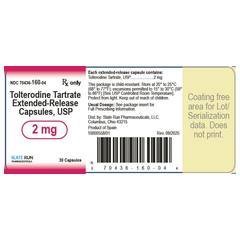
Tolterodine Tartrate
11. DESCRIPTION Tolterodine tartrate extended-release capsules, USP contain tolterodine tartrate USP. The active moiety, tolterodine, is a muscarinic receptor antagonist. The chemical name of tolterodine tartrate is (R)-N,N-diisopropyl-3-(2-hydroxy-5methylphenyl)-3-phenylpropanamine L-hydrogen tartrate. The empirical formula of tolterodine tartrate is C 26 H 37 NO 7 , Its structure is: Tolterodine tartrate is a white, crystalline powder with a molecular weight of 475.6. The pK a value is 9.87 and the solubility in water is 12 mg/mL. It is soluble in methanol, slightly soluble in ethanol, and practically insoluble in toluene. The partition coefficient (Log D) between n-octanol and water is 1.83 at pH 7.3. Tolterodine tartrate extended-release capsules 4 mg for oral administration contains 4 mg of tolterodine tartrate. Inactive ingredients are colloidal silicon dioxide, dibutyl sebacate, ethylcellulose, FD & C Blue no.2, gelatin, hypromellose, hypromellose phthalate, sucrose, talc and titanium dioxide. Tolterodine tartrate extended-release capsules 2 mg for oral administration contains 2 mg of tolterodine tartrate, and the following Inactive ingredients are colloidal silicon dioxide,
Information page. Not necessarily available for purchase.
What is Tolterodine Tartrate?
11. DESCRIPTION Tolterodine tartrate extended-release capsules, USP contain tolterodine tartrate USP. The active moiety, tolterodine, is a muscarinic receptor antagonist. The chemical name of tolterodine tartrate is (R)-N,N-diisopropyl-3-(2-hydroxy-5methylphenyl)-3-phenylpropanamine L-hydrogen tartrate. The empirical formula of tolterodine tartrate is C 26 H 37 NO 7 , Its structure is: Tolterodine tartrate is a white, crystalline powder with a molecular weight of 475.6. The pK a value is 9.87 and the solubility in water is 12 mg/mL. It is soluble in methanol, slightly soluble in ethanol, and practically insoluble in toluene. The partition coefficient (Log D) between n-octanol and water is 1.83 at pH 7.3. Tolterodine tartrate extended-release capsules 4 mg for oral administration contains 4 mg of tolterodine tartrate. Inactive ingredients are colloidal silicon dioxide, dibutyl sebacate, ethylcellulose, FD & C Blue no.2, gelatin, hypromellose, hypromellose phthalate, sucrose, talc and titanium dioxide. Tolterodine tartrate extended-release capsules 2 mg for oral administration contains 2 mg of tolterodine tartrate, and the following Inactive ingredients are colloidal silicon dioxide,
Uses of Tolterodine Tartrate
Established uses
- 1.
- INDICATIONS AND USAGE Tolterodine tartrate extended-release capsules, USP are indicated for the treatment of overactive bladder with symptoms of urge urinary incontinence, urgency, and frequency [see CLINICAL STUDIES (14) ] .
- Tolterodine tartrate extended-release capsules, USP are an antimuscarinic indicated for the treatment of overactive bladder with symptoms of urge urinary incontinence, urgency, and frequency.
- (1)
How Tolterodine Tartrate works
In more detail: 12.1 Mechanism of Action Tolterodine acts as a competitive antagonist of acetylcholine at postganglionic muscarinic receptors. Both urinary bladder contraction and salivation are mediated via cholinergic muscarinic receptors. After oral administration, tolterodine is metabolized in the liver, resulting in the formation of 5-hydroxymethyl tolterodine (5-HMT), the major pharmacologically active metabolite. 5-HMT, which exhibits an antimuscarinic activity similar to that of tolterodine, contributes significantly to the therapeutic effect. Both tolterodine and 5-HMT exhibit a high specificity for muscarinic receptors, since both show negligible activity or affinity for other neurotransmitter receptors and other potential cellular targets, such as calcium channels.
How to take Tolterodine Tartrate
2. DOSAGE AND ADMINISTRATION 4 mg capsules taken orally once daily with water and swallowed whole ( 2.1 ) 2 mg capsules taken orally once daily with water and swallowed whole in the presence of: mild to moderate hepatic impairment (Child-Pugh class A or B ( 2.2 ) severe renal impairment [Creatinine Clearance (CCr) 10-30 mL/min] ( 2.2 ) drugs that are potent CYP3A4 inhibitors. ( 2.2 ) Tolterodine tartrate extended-release capsules are not recommended for use in patients with CCr <10 mL/min. ( 2.2 ) Tolterodine tartrate extended-release capsules are not recommended for use in patients with severe hepatic impairment (Child-Pugh Class C). ( 2.2 ) 2.1 Dosing Information The recommended dose of tolterodine tartrate extended-release capsules is 4 mg once daily with water and swallowed whole. The dose may be lowered to 2 mg daily based on individual response and tolerability; however, limited efficacy data are available for tolterodine tartrate extended-release capsules 2 mg [see CLINICAL STUDIES (14) ] . 2.2 Dosage Adjustment in Specific Populations For patients with mild to moderate hepatic impairment (Child-Pugh Class A or B) or severe renal impairment (CCr 10 - 30 mL/min), the recommen
Dosage
Follow the dose prescribed by your doctor or pharmacist. The ranges below are general information, not a personal prescription.
- Adults
- 2. DOSAGE AND ADMINISTRATION 4 mg capsules taken orally once daily with water and swallowed whole ( 2.1 ) 2 mg capsules taken orally once daily with water and swallowed whole in the presence of: mild to moderate hepatic impairment (Child-Pugh class A or B ( 2.2 ) severe renal impairment [Creatinine Clearance (CCr) 10-30 mL/min] ( 2.2 ) drugs that are potent CYP3A4 inhibitors. ( 2.2 ) Tolterodine tartrate extended-release capsules are not recommended for use in patients with CCr <10 mL/min. ( 2.2 ) Tolterodine tartrate extended-release capsules are not recommended for use in patients with severe hepatic impairment (Child-Pugh Class C). ( 2.2 ) 2.1 Dosing Information The recommended dose of tolterodine tartrate extended-release capsules is 4 mg once daily with water and swallowed whole. The dose may be lowered to 2 mg daily based on individual response and tolerability; however, limited efficacy data are available for tolterodine tartrate extended-release capsules 2 mg [see CLINICAL STUDIES (14) ] . 2.2 Dosage Adjustment in Specific Populations For patients with mild to moderate hepatic impairment (Child-Pugh Class A or B) or severe renal impairment (CCr 10 - 30 mL/min), the recommen
Side effects of Tolterodine Tartrate
Common
- 6.
- ADVERSE REACTIONS Because clinical trials are conducted under widely varying conditions, adverse reaction rates observed in the clinical trials of a drug cannot be directly compared to rates in the clinical trials of another drug and may not reflect the rates observed in practice.
- The most common adverse reactions (incidence > 4% and >placebo) were dry mouth, headache, constipation, and abdominal pain.
- ( 6.1 ) To report SUSPECTED ADVERSE REACTIONS, contact Inventia Healthcare Limited, at 1-800-270-7585 or FDA at 1-800-FDA-1088 or www.fda.gov/medwatch.
- 6.1 Clinical Trials Experience The efficacy and safety of tolterodine tartrate extended-release capsules was evaluated in 1073 patients (537 assigned to tolterodine tartrate extended-release capsules;
- 536 assigned to placebo) who were treated with 2, 4, 6, or 8 mg/day for up to 15 months.
Warnings and who should not take it
Who should NOT take Tolterodine Tartrate?
- 4.
- CONTRAINDICATIONS Tolterodine tartrate extended-release capsules are contraindicated in patients with urinary retention, gastric retention, or uncontrolled narrow-angle glaucoma.
- Tolterodine tartrate extended-release capsules are also contraindicated in patients with known hypersensitivity to the drug or its ingredients, or to fesoterodine fumarate extended-release tablets which, like tolterodine tartrate extended-release capsules, are metabolized to 5-hydroxymethyl tolterodine [see WARNINGS AND PRECAUTIONS (5.2), (5.3), (5.4) ].
- Tolterodine tartrate extended-release capsules are contraindicated in patients with urinary retention, gastric retention, or uncontrolled narrow-angle glaucoma.
- Tolterodine tartrate extended-release capsules are also contraindicated in patients with known hypersensitivity to the drug or its ingredients, or to fesoterodine fumarate extended-release tablets which, like tolterodine tartrate extended-release capsules, are metabolized to 5-hydroxymethyl tolterodine.
- ( 4 )
Overdose
10. OVERDOSAGE Overdosage with tolterodine tartrate extended-release capsules can potentially result in severe central anticholinergic effects and should be treated accordingly. ECG monitoring is recommended in the event of overdosage. In dogs, changes in the QT interval (slight prolongation of 10% to 20%) were observed at a suprapharmacologic dose of 4.5 mg/kg, which is about 68 times higher than the recommended human dose. In clinical trials of normal volunteers and patients, QT interval prolongation was observed with tolterodine immediate release at doses up to 8 mg (4 mg bid) and higher doses were not evaluated [see WARNINGS AND PRECAUTIONS (5.9) and CLINICAL PHARMACOLOGY (12.2) ] . A 27-month-old child who ingested 5 to 7 tolterodine immediate release 2 mg tablets was treated with a suspension of activated charcoal and was hospitalized overnight with symptoms of dry mouth. The child fully recovered.
Safety at a glance
8.1 Pregnancy Risk Summary There are no available data with tolterodine tartrate extended-release capsules use in pregnant women to inform drug-associated risks. In animal reproduction studies, oral administration of tolterodine and its 5-HMT metabolite to pregnant mice during organogenesis did not produce adverse developmental outcomes at doses approximately 9 to 12 times the clinical exposure at a dose of 20 mg/kg/day; however, higher doses produced adverse developmental outcomes (see Data) . In the U.S. general population, the estimated background rate of major birth defects and miscarriage in clinically recognized pregnancies is 2-4% and 15-20%, respectively. Data Animal Data No anomalies or malformations were observed after oral administration of tolterodine to pregnant mice during organogenesis at approximately 9-12 times the clinical exposure to the pharmacologically active components of tolterodine tartrate extended-release capsules (based on the AUC of tolterodine and its 5-HMT metabolite at a dose of 20 mg/kg/day). At 1418 times the clinical exposure (doses of 30 to 40 mg/kg/day) in mice, tolterodine was embryo-lethal, caused reduced fetal weight, and increased the incide
Children and elderly
Children
8.4 Pediatric Use The effectiveness of tolterodine tartrate extended-release capsules has not been established in pediatric patients. Efficacy was not established in two randomized, placebo-controlled, double-blind, 12-week studies that enrolled 710 pediatric patients (486 on tolterodine tartrate extended-release capsules, 224 on placebo) aged 5–10 years with urinary frequency and urge incontinence. The percentage of patients with urinary tract infections was higher in patients treated with tolterodine tartrate extended-release capsules (6.6%) compared to patients who received placebo (4.5%). Aggressive, abnormal, and hyperactive behavior and attention disorders occurred in 2.9% of children treated with tolterodine tartrate extended-release capsules compared to 0.9% of children treated with placebo.
Elderly
8.5 Geriatric Use No overall differences in safety were observed between the older and younger patients treated with tolterodine. In multiple-dose studies in which tolterodine immediate release 4 mg (2 mg bid) was administered, serum concentrations of tolterodine and of 5-HMT were similar in healthy elderly volunteers (aged 64 through 80 years) and healthy young volunteers (aged less than 40 years). In another clinical study, elderly volunteers (aged 71 through 81 years) were given tolterodine immediate release 2 or 4 mg (1 or 2 mg bid). Mean serum concentrations of tolterodine and 5-HMT in these elderly volunteers were approximately 20% and 50% higher, respectively, than concentrations reported in young healthy volunteers. However, no overall differences were observed in safety between older and younger patients on tolterodine in the Phase 3, 12-week, controlled clinical studies; therefore, no tolterodine dosage adjustment for elderly patients is recommended.
Interactions
Medicine and medicine
- 7.
- DRUG INTERACTIONS Potent CYP3A4 inhibitors: Coadministration may increase systemic exposure to tolterodine tartrate extended-release capsules.
- Reduce tolterodine tartrate extended-release capsules dose to 2 mg once daily.
- ( 7.2 ) Other Anticholinergics (antimuscarinics): Concomitant use with other anticholinergic agents may increase the frequency and/or severity of dry mouth, constipation, blurred vision, and other anticholinergic pharmacological effects.
- ( 7.6 ) 7.1 Potent CYP2D6 Inhibitors Fluoxetine, a potent inhibitor of CYP2D6 activity, significantly inhibited the metabolism of tolterodine immediate release in CYP2D6 extensive metabolizers, resulting in a 4.8-fold increase in tolterodine AUC.
- There was a 52% decrease in C max and a 20% decrease in AUC of 5-hydroxymethyl tolterodine (5-HMT), the pharmacologically active metabolite of tolterodine [see CLINICAL PHARMACOLOGY (12.1) ] .
Frequently asked questions
What is Tolterodine Tartrate used for?
1., INDICATIONS AND USAGE Tolterodine tartrate extended-release capsules, USP are indicated for the treatment of overactive bladder with symptoms of urge urinary incontinence, urgency, and frequency [see CLINICAL STUDIES (14) ] ., Tolterodine tartrate extended-release capsules, USP are an antimuscarinic indicated for the treatment of overactive bladder with symptoms of urge urinary incontinence, urgency, and frequency., (1).
How should I take Tolterodine Tartrate?
2. DOSAGE AND ADMINISTRATION 4 mg capsules taken orally once daily with water and swallowed whole ( 2.1 ) 2 mg capsules taken orally once daily with water and swallowed whole in the presence of: mild to moderate hepatic impairment (Child-Pugh class A or B ( 2.2 ) severe renal impairment [Creatinine Clearance (CCr) 10-30 mL/min] ( 2.2 ) drugs that are potent CYP3A4 inhibitors. ( 2.2 ) Tolterodine tartrate extended-release capsules are not recommended for use in patients with CCr <10 mL/min. ( 2.2 ) Tolterodine tartrate extended-release capsules are not recommended for use in patients with severe hepatic impairment (Child-Pugh Class C). ( 2.2 ) 2.1 Dosing Information The recommended dose of tolterodine tartrate extended-release capsules is 4 mg once daily with water and swallowed whole. The dose may be lowered to 2 mg daily based on individual response and tolerability; however, limited efficacy data are available for tolterodine tartrate extended-release capsules 2 mg [see CLINICAL STUDIES (14) ] . 2.2 Dosage Adjustment in Specific Populations For patients with mild to moderate hepatic impairment (Child-Pugh Class A or B) or severe renal impairment (CCr 10 - 30 mL/min), the recommen
What are the common side effects?
6., ADVERSE REACTIONS Because clinical trials are conducted under widely varying conditions, adverse reaction rates observed in the clinical trials of a drug cannot be directly compared to rates in the clinical trials of another drug and may not reflect the rates observed in practice., The most common adverse reactions (incidence > 4% and >placebo) were dry mouth, headache, constipation, and abdominal pain., ( 6.1 ) To report SUSPECTED ADVERSE REACTIONS, contact Inventia Healthcare Limited, at 1-800-270-7585 or FDA at 1-800-FDA-1088 or www.fda.gov/medwatch., 6.1 Clinical Trials Experience The efficacy and safety of tolterodine tartrate extended-release capsules was evaluated in 1073 patients (537 assigned to tolterodine tartrate extended-release capsules;, 536 assigned to placebo) who were treated with 2, 4, 6, or 8 mg/day for up to 15 months..
Who should not take Tolterodine Tartrate?
4.; CONTRAINDICATIONS Tolterodine tartrate extended-release capsules are contraindicated in patients with urinary retention, gastric retention, or uncontrolled narrow-angle glaucoma.; Tolterodine tartrate extended-release capsules are also contraindicated in patients with known hypersensitivity to the drug or its ingredients, or to fesoterodine fumarate extended-release tablets which, like tolterodine tartrate extended-release capsules, are metabolized to 5-hydroxymethyl tolterodine [see WARNINGS AND PRECAUTIONS (5.2), (5.3), (5.4) ].; Tolterodine tartrate extended-release capsules are contraindicated in patients with urinary retention, gastric retention, or uncontrolled narrow-angle glaucoma.; Tolterodine tartrate extended-release capsules are also contraindicated in patients with known hypersensitivity to the drug or its ingredients, or to fesoterodine fumarate extended-release tablets which, like tolterodine tartrate extended-release capsules, are metabolized to 5-hydroxymethyl tolterodine.; ( 4 ).
Can I take Tolterodine Tartrate during pregnancy?
8.1 Pregnancy Risk Summary There are no available data with tolterodine tartrate extended-release capsules use in pregnant women to inform drug-associated risks. In animal reproduction studies, oral administration of tolterodine and its 5-HMT metabolite to pregnant mice during organogenesis did not produce adverse developmental outcomes at doses approximately 9 to 12 times the clinical exposure at a dose of 20 mg/kg/day; however, higher doses produced adverse developmental outcomes (see Data) . In the U.S. general population, the estimated background rate of major birth defects and miscarriage in clinically recognized pregnancies is 2-4% and 15-20%, respectively. Data Animal Data No anomalies or malformations were observed after oral administration of tolterodine to pregnant mice during organogenesis at approximately 9-12 times the clinical exposure to the pharmacologically active components of tolterodine tartrate extended-release capsules (based on the AUC of tolterodine and its 5-HMT metabolite at a dose of 20 mg/kg/day). At 1418 times the clinical exposure (doses of 30 to 40 mg/kg/day) in mice, tolterodine was embryo-lethal, caused reduced fetal weight, and increased the incide
Can children take Tolterodine Tartrate?
8.4 Pediatric Use The effectiveness of tolterodine tartrate extended-release capsules has not been established in pediatric patients. Efficacy was not established in two randomized, placebo-controlled, double-blind, 12-week studies that enrolled 710 pediatric patients (486 on tolterodine tartrate extended-release capsules, 224 on placebo) aged 5–10 years with urinary frequency and urge incontinence. The percentage of patients with urinary tract infections was higher in patients treated with tolterodine tartrate extended-release capsules (6.6%) compared to patients who received placebo (4.5%). Aggressive, abnormal, and hyperactive behavior and attention disorders occurred in 2.9% of children treated with tolterodine tartrate extended-release capsules compared to 0.9% of children treated with placebo.
Does Tolterodine Tartrate interact with other medicines?
7.; DRUG INTERACTIONS Potent CYP3A4 inhibitors: Coadministration may increase systemic exposure to tolterodine tartrate extended-release capsules.; Reduce tolterodine tartrate extended-release capsules dose to 2 mg once daily.; ( 7.2 ) Other Anticholinergics (antimuscarinics): Concomitant use with other anticholinergic agents may increase the frequency and/or severity of dry mouth, constipation, blurred vision, and other anticholinergic pharmacological effects.; ( 7.6 ) 7.1 Potent CYP2D6 Inhibitors Fluoxetine, a potent inhibitor of CYP2D6 activity, significantly inhibited the metabolism of tolterodine immediate release in CYP2D6 extensive metabolizers, resulting in a 4.8-fold increase in tolterodine AUC.; There was a 52% decrease in C max and a 20% decrease in AUC of 5-hydroxymethyl tolterodine (5-HMT), the pharmacologically active metabolite of tolterodine [see CLINICAL PHARMACOLOGY (12.1) ] ..
Medicine information on IMCURE is provided for educational purposes and is not a substitute for diagnosis, prescription or medical advice. Always follow your doctor’s or pharmacist’s instructions. Real product image from the U.S. National Library of Medicine's DailyMed listing for Tolterodine Tartrate Capsule, Extended Release. Packaging varies by brand and manufacturer.