
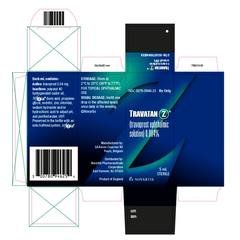
Travatan Z
11 DESCRIPTION Travoprost is a synthetic prostaglandin F analog. Its chemical name is [1 R -[1α( Z ),2β(1 E ,3 R *),3α,5α]]-7-[3,5-Dihydroxy-2-[3-hydroxy-4-[3-(trifluoromethyl) phenoxy]-1-butenyl]cyclopentyl]-5-heptenoic acid, 1-methylethylester. It has a molecular formula of C 26 H 35 F 3 O 6 and a molecular weight of 500.55 g/mol. The chemical structure of travoprost is: Travoprost is a clear, colorless to slightly yellow oil that is very soluble in acetonitrile, methanol, octanol, and chloroform. It is practically insoluble in water. TRAVATAN Z is supplied as sterile, buffered aqueous solution of travoprost with a pH of approximately 5.7 and an osmolality of approximately 290 mOsmol/kg. TRAVATAN Z contains Active: travoprost 0.04 mg/mL; Inactives: polyoxyl 40 hydrogenated castor oil, sof Zia ® (boric acid, propylene glycol, sorbitol, zinc chloride), sodium hydroxide and/or hydrochloric acid (to adjust pH), and purified water, USP. Preserved in the bottle with an ionic buffered system, sof Zia ® . chemical
Information page. Not necessarily available for purchase.
What is Travatan Z?
11 DESCRIPTION Travoprost is a synthetic prostaglandin F analog. Its chemical name is [1 R -[1α( Z ),2β(1 E ,3 R *),3α,5α]]-7-[3,5-Dihydroxy-2-[3-hydroxy-4-[3-(trifluoromethyl) phenoxy]-1-butenyl]cyclopentyl]-5-heptenoic acid, 1-methylethylester. It has a molecular formula of C 26 H 35 F 3 O 6 and a molecular weight of 500.55 g/mol. The chemical structure of travoprost is: Travoprost is a clear, colorless to slightly yellow oil that is very soluble in acetonitrile, methanol, octanol, and chloroform. It is practically insoluble in water. TRAVATAN Z is supplied as sterile, buffered aqueous solution of travoprost with a pH of approximately 5.7 and an osmolality of approximately 290 mOsmol/kg. TRAVATAN Z contains Active: travoprost 0.04 mg/mL; Inactives: polyoxyl 40 hydrogenated castor oil, sof Zia ® (boric acid, propylene glycol, sorbitol, zinc chloride), sodium hydroxide and/or hydrochloric acid (to adjust pH), and purified water, USP. Preserved in the bottle with an ionic buffered system, sof Zia ® . chemical
Uses of Travatan Z
Established uses
- 1 INDICATIONS AND USAGE TRAVATAN Z ® (travoprost ophthalmic solution) 0.004% is indicated for the reduction of elevated intraocular pressure (IOP) in patients with open-angle glaucoma or ocular hypertension.
- TRAVATAN Z is a prostaglandin analog indicated for the reduction of elevated intraocular pressure (IOP) in patients with open-angle glaucoma or ocular hypertension (1)
How Travatan Z works
In more detail: 12.1 Mechanism of Action Travoprost free acid, a prostaglandin analog is a selective FP prostanoid receptor agonist, which is believed to reduce IOP by increasing uveoscleral outflow. The exact mechanism of action is unknown at this time.
How to take Travatan Z
2 DOSAGE AND ADMINISTRATION The recommended dosage is one drop in the affected eye(s) once daily in the evening. TRAVATAN Z should not be administered more than once daily since it has been shown that more frequent administration of prostaglandin analogs may decrease the IOP-lowering effect. Reduction of the IOP starts approximately 2 hours after the first administration with maximum effect reached after 12 hours. TRAVATAN Z may be used concomitantly with other topical ophthalmic drug products to lower IOP. If more than one topical ophthalmic drug is being used, the drugs should be administered at least 5 minutes apart. One drop in the affected eye(s) once daily in the evening (2)
Dosage
Follow the dose prescribed by your doctor or pharmacist. The ranges below are general information, not a personal prescription.
- Adults
- 2 DOSAGE AND ADMINISTRATION The recommended dosage is one drop in the affected eye(s) once daily in the evening. TRAVATAN Z should not be administered more than once daily since it has been shown that more frequent administration of prostaglandin analogs may decrease the IOP-lowering effect. Reduction of the IOP starts approximately 2 hours after the first administration with maximum effect reached after 12 hours. TRAVATAN Z may be used concomitantly with other topical ophthalmic drug products to lower IOP. If more than one topical ophthalmic drug is being used, the drugs should be administered at least 5 minutes apart. One drop in the affected eye(s) once daily in the evening (2)
Side effects of Travatan Z
Common
- 6 ADVERSE REACTIONS Most common adverse reaction (30% to 50%) is conjunctival hyperemia (6.1) To report SUSPECTED ADVERSE REACTIONS, contact Novartis Pharmaceuticals Corporation at 1-888-669-6682 or FDA at 1-800-FDA-1088 or www.fda.gov/medwatch .
- 6.1 Clinical Trials Experience Because clinical trials are conducted under widely varying conditions, adverse reaction rates observed in the clinical trials of a drug cannot be directly compared to rates in the clinical trials of another drug and may not reflect the rates observed in practice.
- The most common adverse reaction observed in controlled clinical trials with TRAVATAN and TRAVATAN Z was ocular hyperemia, which was reported in 30% to 50% of patients.
- Up to 3% of patients discontinued therapy due to conjunctival hyperemia.
- Ocular adverse reactions, reported at an incidence of 5% to 10% in these clinical trials, included decreased visual acuity, eye discomfort, foreign body sensation, pain, and pruritus.
- Ocular adverse reactions, reported at an incidence of 1% to 4% in clinical trials with TRAVATAN or TRAVATAN Z, included abnormal vision, blepharitis, blurred vision, cataract, conjunctivitis, corneal staining, dry eye, iris discolor
Warnings and who should not take it
Who should NOT take Travatan Z?
- 4 CONTRAINDICATIONS None.
- None (4)
Safety at a glance
8.1 Pregnancy Risk Summary There are no adequate and well-controlled studies in pregnant women to inform a drug-associated risk. In animal reproduction studies, subcutaneous (SC) administration of travoprost to pregnant mice and rats throughout the period of organogenesis produced embryo-fetal lethality, spontaneous abortion, and premature delivery at potentially clinically relevant doses. Advise pregnant women of a potential risk to a fetus. Because animal reproductive studies are not always predictive of human response, TRAVATAN Z should be administered during pregnancy only if the potential benefit justifies the potential risk to the fetus. The background risk of major birth defects and miscarriage for the indicated population is unknown; however, in the U.S. general population, the estimated background risk of major birth defects is 2% to 4% and of miscarriage is 15% to 20% of clinically recognized pregnancies. Data Animal Data An embryo-fetal study was conducted in pregnant rats administered travoprost once daily by SC injection from gestation day (GD) 6 to 18, to target the period of organogenesis. At 10 mcg/kg (60 times the maximum recommended human ocular dose [MRHOD], base
Children and elderly
Children
8.4 Pediatric Use Use in pediatric patients below the age of 16 years is not recommended because of potential safety concerns related to increased pigmentation following long-term chronic use.
Elderly
8.5 Geriatric Use No overall clinical differences in safety or effectiveness have been observed between elderly and other adult patients.
Frequently asked questions
What is Travatan Z used for?
1 INDICATIONS AND USAGE TRAVATAN Z ® (travoprost ophthalmic solution) 0.004% is indicated for the reduction of elevated intraocular pressure (IOP) in patients with open-angle glaucoma or ocular hypertension., TRAVATAN Z is a prostaglandin analog indicated for the reduction of elevated intraocular pressure (IOP) in patients with open-angle glaucoma or ocular hypertension (1).
How should I take Travatan Z?
2 DOSAGE AND ADMINISTRATION The recommended dosage is one drop in the affected eye(s) once daily in the evening. TRAVATAN Z should not be administered more than once daily since it has been shown that more frequent administration of prostaglandin analogs may decrease the IOP-lowering effect. Reduction of the IOP starts approximately 2 hours after the first administration with maximum effect reached after 12 hours. TRAVATAN Z may be used concomitantly with other topical ophthalmic drug products to lower IOP. If more than one topical ophthalmic drug is being used, the drugs should be administered at least 5 minutes apart. One drop in the affected eye(s) once daily in the evening (2)
What are the common side effects?
6 ADVERSE REACTIONS Most common adverse reaction (30% to 50%) is conjunctival hyperemia (6.1) To report SUSPECTED ADVERSE REACTIONS, contact Novartis Pharmaceuticals Corporation at 1-888-669-6682 or FDA at 1-800-FDA-1088 or www.fda.gov/medwatch ., 6.1 Clinical Trials Experience Because clinical trials are conducted under widely varying conditions, adverse reaction rates observed in the clinical trials of a drug cannot be directly compared to rates in the clinical trials of another drug and may not reflect the rates observed in practice., The most common adverse reaction observed in controlled clinical trials with TRAVATAN and TRAVATAN Z was ocular hyperemia, which was reported in 30% to 50% of patients., Up to 3% of patients discontinued therapy due to conjunctival hyperemia., Ocular adverse reactions, reported at an incidence of 5% to 10% in these clinical trials, included decreased visual acuity, eye discomfort, foreign body sensation, pain, and pruritus., Ocular adverse reactions, reported at an incidence of 1% to 4% in clinical trials with TRAVATAN or TRAVATAN Z, included abnormal vision, blepharitis, blurred vision, cataract, conjunctivitis, corneal staining, dry eye, iris discolor.
Who should not take Travatan Z?
4 CONTRAINDICATIONS None.; None (4).
Can I take Travatan Z during pregnancy?
8.1 Pregnancy Risk Summary There are no adequate and well-controlled studies in pregnant women to inform a drug-associated risk. In animal reproduction studies, subcutaneous (SC) administration of travoprost to pregnant mice and rats throughout the period of organogenesis produced embryo-fetal lethality, spontaneous abortion, and premature delivery at potentially clinically relevant doses. Advise pregnant women of a potential risk to a fetus. Because animal reproductive studies are not always predictive of human response, TRAVATAN Z should be administered during pregnancy only if the potential benefit justifies the potential risk to the fetus. The background risk of major birth defects and miscarriage for the indicated population is unknown; however, in the U.S. general population, the estimated background risk of major birth defects is 2% to 4% and of miscarriage is 15% to 20% of clinically recognized pregnancies. Data Animal Data An embryo-fetal study was conducted in pregnant rats administered travoprost once daily by SC injection from gestation day (GD) 6 to 18, to target the period of organogenesis. At 10 mcg/kg (60 times the maximum recommended human ocular dose [MRHOD], base
Can children take Travatan Z?
8.4 Pediatric Use Use in pediatric patients below the age of 16 years is not recommended because of potential safety concerns related to increased pigmentation following long-term chronic use.
Medicine information on IMCURE is provided for educational purposes and is not a substitute for diagnosis, prescription or medical advice. Always follow your doctor’s or pharmacist’s instructions. Real product image from the U.S. National Library of Medicine's DailyMed listing for Travatan Z (Travoprost) Solution/ Drops. Packaging varies by brand and manufacturer.